Showing posts with label vintage sewing. Show all posts
Tuesday, November 1, 2016
Vintage 1950s Sewing: Pattern Measurement Chart for Women
If you want to learn how to sew vintage fashion, you will want to understand pattern measurements. Using vintage patterns will differ because 50s sizes aren't the same as current sizes. This 1950s measurement chart is from the same McCall's pattern magazine featured in my last post. I thought that this chart might help to give a better understanding of how dresses from the mid-1950s are a different fit from today's dresses.
Friday, July 29, 2016
Don Loper: Inside a 1950's Cocktail Dress
Don Loper's dresses are popular 1950's styles with vintage collectors. They come in a wide range of silhouettes and textiles, so there's quite a variety to choose from. Looking inside a 50s cocktail dress can show so many great vintage sewing details. This one is a gem, made from silk taffeta, hand draped and constructed with couture and hand techniques.
Wednesday, May 11, 2016
Spring 1967 Fashions: Butterick Patterns for Junior Styles
Monday, May 2, 2016
How to Knock Off or Copy a Vintage Dress
Monday, October 5, 2015
Bonnie Cashin: Mohair Coat Pattern & How to Make It
This bold and beautiful mohair coat by Bonnie Cashin for Sills looks as stylish today as it did when it was made in the late 60's. It's possible to copy and sew this rather simply constructed design to create a Cashin style coat to wear this winter. I first shared this colorful Cashin coat in an earlier post. This time I'll show how to draft a copy and show details used to construct it.
Wednesday, September 23, 2015
How to Copy: 1963 Party Dress & Draft an Over Skirt
This adorable vintage illustration from 1963 shows a navy or black brocade cocktail dress with a bustier type bodice and gathered skirt with a folded over-skirt or apron. It has a simple concept that appears more complicated than it is. By using current patterns, it's possible to copy this dress on your own.
Wednesday, September 16, 2015
How to sew a Vintage 1950's Capri Set: Quadriga Cloth Advertisement
This capri set from 1956 was used to advertise a fabric called "Quadriga" cloth, available for home sewing in prints and solids. This outfit is a fun 50's retro look that could be sewn today using contemporary patterns that are easy to find.
Thursday, July 30, 2015
Vintage 1950's Playset: Simplicity 1605 and How to Sew Your Own Playset
Sewing a 1950's vintage style summer play suit set is not has difficult as that may seem. When making vintage styles, sometimes you have to copy an idea, rather than use a pattern. This Simplicity Pattern 1605 dates from the 1950's. It has has a classic detachable skirt worn over a short playsuit.
The wrapped bodice seems strongly influenced by Claire McCardell and other American designers who were creating styles with an Indian sari influence. The jumpsuit image shows how the edge of a sari or border print could be used to create a dramatic diagonal on the one shoulder top.
For a sewing project, this outfit is worth taking a second look, especially for the wrapped neckline which can be made with or without the second shoulder panel. The easy to sew gathered skirt is accented by a detachable cummerbund. The skirt fastens in front and it acts as a cover-up for going indoors at the country club.
The back of the pattern shows how the pieces are cut. Even though this pattern is no longer available, it is possible to re-create the same look with a gathered skirt over a jumpsuit or shorts and halter top. Probably the easiest way to get a similar pattern is to create your own pattern hack. Using two Butterick patterns, this look could be created.
To sew your own wrap bodice and skirt, start with Butterick 6582. It has a great version of this wrapped bodice, but attached to a gathered skirt. Using this pattern, the surplice top could be used. When fitting it, be sure to determine your waistline, since that is where the shorts will be attached. If you want to make this a 'crop top' and not attach the shorts, that would be even easier to fit. Use this pattern for making the detachable skirt by sewing the fabric to a straight waistband that meets in the front. There should be a wide sash too that wraps around the waistline.
To make your shorts, use Butterick 5895. It is a well fit pant with a high 'natural' waistline. A fitting muslin would be the next step so that the best length for shorts can be drawn on the leg and transferred to the paper pattern. It would also be important to pin the bodice to the waistline so that the correct waistline is determined. You may want to lengthen or shorten the pant waistline at this time too.
This outfit would duplicate the one we see here, making it a great 50's style play suit for the summer!
This "Throw-back Thursday" post was adapted from the original posted July 13, 2011.
Tuesday, March 17, 2015
7 Best Sheath Dress Patterns with Vintage Style: Easy to Sew
Ever wanted to make your own Little Black Dress? This article will review fitted sheath dress patterns that are easy to sew. This is a second post on easy to sew dress patterns with vintage style, following "9 Best Dress Patterns for Beginners: Easy to Sew". After mastering the super easy shift style dress, it's time to sew a classic sheath dress. This article is edited from a very popular article from three years ago, so the patterns shown are current and available
What makes the sheath dresses shown here easy to sew?
1) no waistline seam, and they look great if belted
2) dress skims the body, but isn't super tight or super loose (like a shift dress)
3) no set in sleeve (but this pattern does have sleeves if you want them)
4) most are still 2 main pattern pieces: front and back
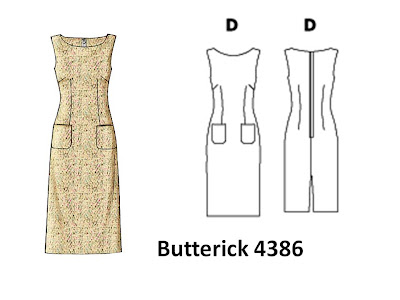
This is Butterick 4386, a dress with a classic darted torso. It can be sewn into so many great styles, from a "little black dress" to a tropical summer dress, the fit will be slender. There is a back zip and hem vent.
Now that you know what pattern style to look for when you want a smooth fit, here are more sheath style patterns that will create that silhouette. The patterns include New Look: 6261, Butterick, See and Sew: 5235, and two from McCalls: 2401, 7085. All of these patterns have vertical darts to shape the waistline and back views, and most have sleeves as well.
.
Curvey fit? A princess seam line pattern is the best for creating a good fit. Those long seam lines provide an opportunity to fit the bust line, torso and hips more carefully. There are six seam lines to work with, and each one can be let in or out only a little bit to affect the fit. Butterick "Fast and Easy" 5554 and Simplicity "Amazing Fit" 1586 both have armhole princess seams, so a good fit can be achieved with fuller bustlines. Both include sleeves, if that is something you want to include in your dress.
This style of shaping is a vintage feature, having both the angular French dart and the side bust dart. This will create a smooth 'fit and flare' silhouette. A French dart is sewn at an angle, and trims away the waistline without having the usual vertical dart showing in front. This is a good choice for bold patterns that shouldn't be cut up with vertical arts.
Once a good sheath pattern is selected, there will be a few things to consider.
Question: What fabrics are best for sheath dresses?
Answer: In addition to the simple cottons mentioned in the previous dress article for shift dresses (quilting cottons, cotton gingham, woven cotton plaids and stripes), we can add stretch wovens to our list. Keep your stretch manageable, don't select anything too 'wiggley' and out of control. When using a stretch, lay out the fabric so the stretch goes around the body (not 'up and down' or it will bag at the rear!).
If the fabric is soft or thin (like a brocade, lace or satin) I would suggest using a cotton or taffeta to 'back' that fashion fabric using a 'flat lining' or 'interlining' method shown in an earlier blog post HERE.
Obviously, the classic sheath dress is a vintage look that an experienced sewist can whip up in almost any fabric, from wool flannel to brocade.
Question: How can I make the sheath pattern fit me?
Answer: Make a fitting sample before cutting out the fashion fabric. This process is more essential with the semi-fitted sheath style. Plan to do a trial fit sample dress in a 'muslin' or similar cotton test fabric before cutting out your dress pattern.
If you feel you are an easy fit and don't need a fitting muslin, then when you cut your fashion fabric, I suggest using 1" wide seam allowances down the side and back seams lines. This will give room to alter for fit in case you need 'more room'. Math: get a 1" wide seam allowance by adding 3/8" to your cutting line if you are using standard US pattern's 5/8" wide seam allowances. Yes, you will have to draft that line onto your pattern tissue first, before you cut.
Slender fit: For a figure with small curves, look for slender darts. Don't take up extra width in the darts. Do your fitting from the side seams.
Curvey fit: For a figure with larger curves, the darts will be wider and may be shaped towards the dart point. This fit may also need side and back seam line adjustments. Traditionally, the back seam was cut 'on grain' or very straight, but now it is common to use that seam line to fit the back view more closely.
Princess seam lines make curvey fittings easier. Just distribute any alterations through the several seams, and you will notice that the fitting process is actually easy to achieve.
Question: How can I make the zipper easier to sew?
Answer: Add 1" wide seam allowances down the seamline where your zipper will be sewn. You will be soooo happy you have the extra fabric when you put in the zipper. It helps to have the extra width when trying to fold the fabric under. Before your start, be sure to clean finish the fabric edges. Doing that will make sure that the edge won't unravel and snag into the zipper. I use an overlock seam or I zig-zag over the fabric edge to bind that over and prevent it from unraveling.
Once you perfect sewing a sheath to fit, it could become your favorite: fast, great fit, and easy to sew.
Thank you for dropping by. If you liked this post, don't miss my articles on sewing and vintage fashion by subscribing to Pintuck Style blog on "Bloglovin", HERE . I'd love to hear from you too if you have any questions or want to see a blog post on a specific topic.
(This article was first published Feb. 21, 2012)
Wednesday, October 29, 2014
Sewing a Vintage Style Wardrobe: Pendleton Style Plaid Top Coat from Vintage Pattern, McCalls 7027
The Pendleton jacket that I showed in the previous post: Plaid Top Coat by Pendleton is a classic, but finding a sewing pattern in the same shape can be difficult. This vintage pattern: McCall's 7027 is exactly the style to make a look-alike coat. It dates from 1963, and even shows what is probably a plaid mohair coat on the cover.
This simple back view shows how clean and straight the silhouette was designed.
This view of the pattern pieces shows clearly how this pattern was drafted. The side seams fall straight from the underarms, with the front having a bust dart in that side seam. The center front edge is straight, so the lapel is not extended or pointed. The back is equally straight, with shoulder darts for fit. The sleeve is cut in one piece. The collar is nearly flat, with only a slight curve.
Overall, this pattern seems to be cut in similar style to a lab coat or a long shirt, and that is a possible pattern to use when drafting or creating your own pattern for this style. It might even be cut from a pajama top pattern, if the sleeve is not too baggy or low cut in the armhole.
Another thing great about this pattern is that the style can be made in so many fabrics. Imagine a denim version with contrast top stitching!
Saturday, January 25, 2014
Ceeb of Miami: Gold Lame Jumpsuit
This super glam gold jumpsuit was made by "Ceeb of Miami", and probably dates from the late 1950's.
It was recently sold by my friend Holly at her "French Laundry Co." shop on Etsy. But before it left her shop, I was able to get to see it up close, and thought I would share what I found with you.
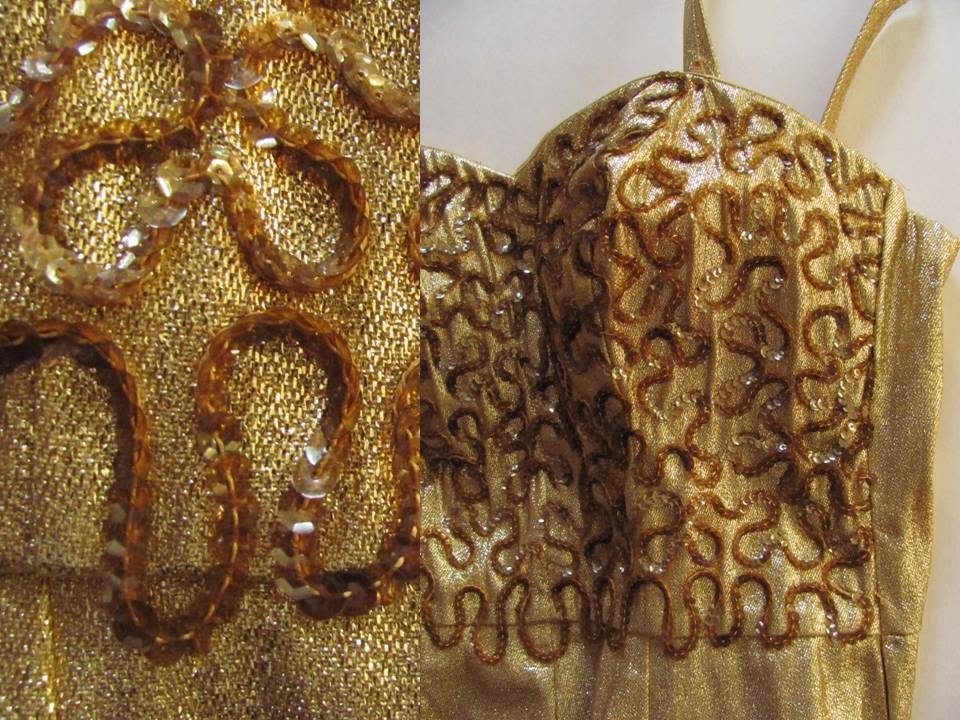
This bustier plus capri pant combo is made from a very stretch lame fabric. The lame fabric is stiff, yet flexible, with stretch in the cross-wise grain. The capri pants are simple, with traditional darting and slits at the ankles. It has a deep metal zipper with inside placket up the center back seamline.
The bustier is sewn with all-over sequin trim in a serpentine pattern. The bodice shaping is princess seamlines, with a back zipper.
The bustier is constructed with a full bra sewn into the top. There are small removeable stays at the sides of the built in bra to keep it 'up'.
There is a fold-over edge facing around the edges. This fold-over edge is backed with elastic to be sure it fits tightly. A wide nylon fabric fly backs the zipper opening to prevent any skin pinches. Buttons are sewn into the top edge of the bustier for removable straps.
The sequin design was applied after the bodice was sewn, using a chain stitch machine. It appears that the bodice front was sewn to the pant front across the waistline seam first. At this point the sequins were applied. After that the side seams were sewn.
The center back zipper is a strong metal type. This slide shows that zipper, both open to expose that fly fabric, and zipped up. A heavy snap secures the top edge.
Overall, this jumpsuit has a surprisingly simple pattern design and uses construction methods that are not difficult. The type of boning and lining that we often expect to see in a bustier is not present here. Perhaps this is because most women would be wearing their own strapless bra, often in a 'long line' design to the waist. This would then mean that the garment does not need to provide support or 'molded' bustline shaping.
The garment label lists this as a size 12 / 34.
Garment Measurements:
Bust: 34 inches
Waist 28 inches
Hips: 42 inches
Inseam crotch to hem: 25 inches
Underarm to waist: 8 inches
If you want to sew a glam jumpsuit like this for yourself, I think it would not be difficult. By working with a good pant pattern to start, a princess seamline bustier can be sewn to that around the waistline.
Pants: try Butterick B5895, a pant with 'high' waistline and back zipper (omit the pockets), or Vogue pant fitting pattern, V1003, a classic pant that has all the right darts.
Bustier: Butterick B5419, a long line bustier that can be altered to stop at the waistline. The bodice for McCalls M6646, is perfect.
On the Ceeb website they state that they have been in business since 1942 in southern Florida. Their main product is swimwear, I'm also interested in finding out more about jumpsuits of this type from the "Ceeb" label. Feel free to share what you know in the comment section.
Tuesday, February 12, 2013
A Closer View: Navy Silk Sheath, c. 1955
One of the best ways to learn fine dress making is to study examples of the craft. This silk sheath dress from the mid-1950's is a great example. It is clearly a custom made dress, with many hand sewn details. By looking at it in detail, we can learn more about the design and drape of this wrapped 'sarong style' dress, along with tips on how to sew a feather weight dress like this that holds its shape well when worn.
This gorgeous navy dress of silk twill has a blue floral pattern that is probably Italian silk. It is backed by lining that is sewn 'in one' with the outer fashion fabric. I use the term 'flat lining' for this process. The lining is also used as a base to hold the drapery in place. It is probable that the customer had a fitting wearing the lining, while the dress designer wrapped the silk fashion fabric around the body, pleating it into the side seams as shown below.
The right and left sides are patterned and sewn differently, creating the signature sarong effect. This sarong skirt is sewn into the sheath side seam on the right, but it wraps around the left without a side seam, hanging open at the center back.
Looking inside the dress we can see the construction techniques. These are classic points. The scarf weight fashion fabric was 'backed' by a lining. The two layers were stitched together, then cut with pinking shears. When pressed open, the stitching shows clearly that this was 'flat lined'.
The transfer marks used to place the darts shows as little white dots. These would have been part of the custom or couture process. Seam tape is sewn along the waistline seam to stablize it and keep it from ripping apart. This tape was also used to edge the hem. Using hem tape is an easy way to provide a clean edge that is easy to sew through.
The bodice of this dress was cut with princess seam lines in the back, while the front had conventional darts. The fashion fabric was draped on top of this and sewn in place. This same lining was used in the skirt, but only to the knee level. This would keep the hips smooth, but allow the hem area to drape nicely.
This wonderful dress is listed in my shop on Etsy where you will find more photos of it. If you like this style, look for designs by Dorothy O'Hara, Helen Rose, and Peggy Hunt among others from that era who specialized in draped dresses. (this dress does not have a label)
Monday, November 26, 2012
Clothes that Count: 1960's British Dress Making
This illustration from 1967 is from a set of Sunday magazine supplements to the "Radio Times" publications titled "Clothes that Count". They were written to promote a BBC series under the heading online of: "What We Wore". As a television show it first appeared in 1957 with six installments. These and others from 1967, 1969, 1976, and 1982 are available from the BBC video archives on line (but not in the US). Each installment is focused on one type of fashion garment and features British fashion designers.
These small brochures were published to be seen with the BBC shows in 1967, so the illustrations are of fashion styles from that year. The print is blurry, but there is a 'text' version that is easy to read. The content gives tips on sewing the fashion trends of the day, along with designer comments. If you love 60's fashion, these brochures will be fun to see and you may find them a worthwhile resource for both fashion and sewing during the late 1960's. If you are lucky enough to have seen the BBC series, let us know about those too!
Clothes that Count Part One, HERE, and the text of this pamphlet is HERE
Clothes that Count, Part Two, HERE, and the text of this pamphlet is HERE
BBC Archives Video Series: What We Wore, HERE
Subscribe to:
Posts (Atom)