Showing posts with label sewing vintage. Show all posts
Friday, October 28, 2016
1950s Vintage Fashion: Hourglass Corsage Silhouettes
1950s Vintage Fashion: Hourglass Corsage Silhouette
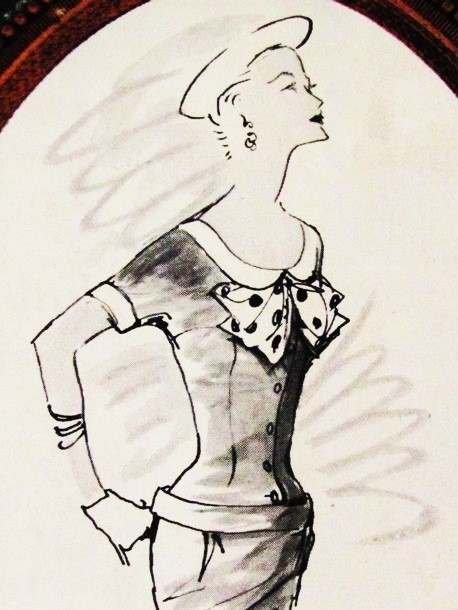
In the mid-1950’s, the Hourglass silhouette had a popular style termed “corsage”. This look was worn by fashionable women with slender waistlines. It had a fitted bodice or corsage that is not as tightly boned like a corset. I wanted to look closer at these dresses to learn more about how they are both similar and diverse.
When spotting this style, (such as the illustration above from 1956 advertisement for Burlington that showcases McCalls 3458), look first for a horizontal seamline, either just below the bust line, or around the upper hip level, somewhat in the same location as a corset edge. These seam lines are often accented with wide sashes, cuff-like belting, or a trim to emphasize the body fit.
This illustration shows the corsage fit in both a hip emphasis and under-bust shaping. Princess seam dresses are often part of the pattern design used to create this look without a defined waistline seam that has a strong hourglass silhouette.
The illustrations shown here again feature McCalls 3458, and come from a McCall’s spring 1956 pattern magazine, however many of the patterns in this issue seem to be dated 1955. This helps us to know that this look was a long term, strong and popular design feature.
A typical novelty print fabric with tiny houses is shown using patterns 3434, a true princess seam dress, and 3494, a drop waist corsage with an easy to sew darted bodice. The dramatic red sheath is pattern 3493, and shows an under bust seam that comes to a point at center front.
This shapely corsage style in the rose print is a separate skirt and top set, 3511 and 3512. The geometric print dress was not labeled with pattern, but it could be 3458 that has a similar cuff style hip band.
This magazine issue lists many similar patterns that create the corsage fit. I tracked down several to show original sewing pattern cover art. I find pattern covers are an excellent source for fabric color and print as well as accessories, hair and makeup.
3497: a modification of the princess seamed dress that shows a bustline seam
3434: a true princess shaped dress that has flared and shaped panels from neckline to hem
This set of patterns show the modifications of the princess pattern with addition of the hip level seam and applied gathered skirt. In this case I found both an all around skirt, 3479, and another with a smooth front and gathered sides, 3492. This style recalls the silhouette of Marie Antoinette and the 1700’s, creating a romantic air.
3492: the hip skirt has a wide sash sewn into the seam line with bows to emphasize the hips, the corsage is fit with curved bust seams into the armscye
3479: this simple version clearly shows the princess seams to shoulder in the corsage
This look was considered a youthful style, and can be found in many of the Givenchy designs for Audrey Hepburn (Sabrina, Funny Face, Love in the Afternoon). These were among the early styles produced by 'junior' style houses that catered to the growing teenage consumer population. Look for these additional corsage patterns by McCalls:
3499 (V front seam), 3478 (under bust seam), 3477 (fitted midriff), 3481 (knit top), 3467 (low waist, full skirt), 3355 (V waist jumper), 3432 (V waist dress), 3433 (shaped hip sash), 3523 (low waist, full skirt),
The patterns shown here are available at the following online vintage pattern shops, show your support and take a look:
3434: Pattern Shop
3479: The Perfect Pattern
3492: Midvale Cottage
3497: The Spectrum
Wednesday, May 11, 2016
Spring 1967 Fashions: Butterick Patterns for Junior Styles
Wednesday, September 23, 2015
How to Copy: 1963 Party Dress & Draft an Over Skirt
This adorable vintage illustration from 1963 shows a navy or black brocade cocktail dress with a bustier type bodice and gathered skirt with a folded over-skirt or apron. It has a simple concept that appears more complicated than it is. By using current patterns, it's possible to copy this dress on your own.
Thursday, July 30, 2015
Vintage 1950's Playset: Simplicity 1605 and How to Sew Your Own Playset
Sewing a 1950's vintage style summer play suit set is not has difficult as that may seem. When making vintage styles, sometimes you have to copy an idea, rather than use a pattern. This Simplicity Pattern 1605 dates from the 1950's. It has has a classic detachable skirt worn over a short playsuit.
The wrapped bodice seems strongly influenced by Claire McCardell and other American designers who were creating styles with an Indian sari influence. The jumpsuit image shows how the edge of a sari or border print could be used to create a dramatic diagonal on the one shoulder top.
For a sewing project, this outfit is worth taking a second look, especially for the wrapped neckline which can be made with or without the second shoulder panel. The easy to sew gathered skirt is accented by a detachable cummerbund. The skirt fastens in front and it acts as a cover-up for going indoors at the country club.
The back of the pattern shows how the pieces are cut. Even though this pattern is no longer available, it is possible to re-create the same look with a gathered skirt over a jumpsuit or shorts and halter top. Probably the easiest way to get a similar pattern is to create your own pattern hack. Using two Butterick patterns, this look could be created.
To sew your own wrap bodice and skirt, start with Butterick 6582. It has a great version of this wrapped bodice, but attached to a gathered skirt. Using this pattern, the surplice top could be used. When fitting it, be sure to determine your waistline, since that is where the shorts will be attached. If you want to make this a 'crop top' and not attach the shorts, that would be even easier to fit. Use this pattern for making the detachable skirt by sewing the fabric to a straight waistband that meets in the front. There should be a wide sash too that wraps around the waistline.
To make your shorts, use Butterick 5895. It is a well fit pant with a high 'natural' waistline. A fitting muslin would be the next step so that the best length for shorts can be drawn on the leg and transferred to the paper pattern. It would also be important to pin the bodice to the waistline so that the correct waistline is determined. You may want to lengthen or shorten the pant waistline at this time too.
This outfit would duplicate the one we see here, making it a great 50's style play suit for the summer!
This "Throw-back Thursday" post was adapted from the original posted July 13, 2011.
Monday, September 15, 2014
Sewing a Vintage Style Wardrobe: the 49er Plaid Jacket from Vintage Pendleton
I love those vintage 49er wool plaid jackets from the 1950's Pendleton ads. When summer winds down, a vintage style wardrobe can be inspired by the ads and articles in fashion magazines from past decades. Pendleton's 49er jacket were widely popular during the middle of the century, but its classic lines, color and fit are terrific as a new vintage inspired wardrobe addition.
This advertisement from the autumn of 1956 would be perfect to sew for this year's vintage inspired look. It is a very simple shirt jacket, with easy to sew details: four black shell buttons up the front with a convertible collar, long sleeves with cuffs, and a back yoke with small gathers. All of this can be topstitched to keep its shape.
Most of these jackets were shown belted. This ad from the winter of 1953 featured low set patch pockets cut on the bias, that sit below that belt. The convertible collar has longer points, and easily creates an open neckline above the larger scale four button front. The roomy sleeves have buttoned cuffs. From the back view, there is a back yoke with modestly gathered shirt body sewn to that.
Finding a current pattern with this style in women's patterns is not easy. While a convertible collared blouse has been considered a classic, right now the larger pattern companies are not featuring this style. Working from a Palmer/Pletsch sewing pattern may be the best option. Where I may have to alter that pattern is to create a higher sleeve cap, because I want the classic 49er shoulder. The sleeve should be shaped with a higher shoulder so that it hangs straight from the shoulder. Another feature in the original 49er is a front tuck in the jacket armhole that releases bustline fullness at about mid-armhole in front. A more modern fit solution is a side dart.
McCall's 6942 is the nearest in style to the 49er. It has the same convertible collar, back shoulder yoke, cuffed sleeves, and center front buttons without a placket. This means that the bias cut patch pockets will need to be drafted, and the back pleat at the yoke will need to be converted to gathers across that seamline.
This pattern may be too large in scale for smaller women's sizes. It also should be checked for the sleeve shape. I might alter the armhole and insert a more fitted sleeve with cuff from another sewing pattern (I must have a few patterns around with that sleeve). If the sleeve pattern is used, I would tape together the extra sleeve seam that creates that cuff placket and sew a more traditional cuff placket.
Two other patterns caught my eye: McCall's 5992, a PJ top with the right shape, and NewLook 6963, a shirt pattern with a more fitted body, high sleeve cap and back yoke. This pattern would need the sleeve lengthened and a cuff added (or substitute in a similar sleeve with those details). The back yoke probably rolls around towards the front more than the original does, but that might not be a problem.
With several different plaid variations, it's possible to sew up several to wear this fall. I also think this easy to sew shirt jacket would be a good pattern to use for making up holiday gifts that any vintage lover would want to own.
Read more about this famous shirt jacket by Pendleton, HERE.
Wednesday, July 2, 2014
Teach Yourself to Sew with Vintage Style Patterns
Learning to sew own your own can be fun when you work with patterns that fit your level of sewing skills. If you love vintage and retro styles, then carefully selecting vintage patterns can help to create new ‘vintage style’ looks. But authentic vintage pattern may be difficult to find in the right size, and often they need some alterations for a more modern fit.
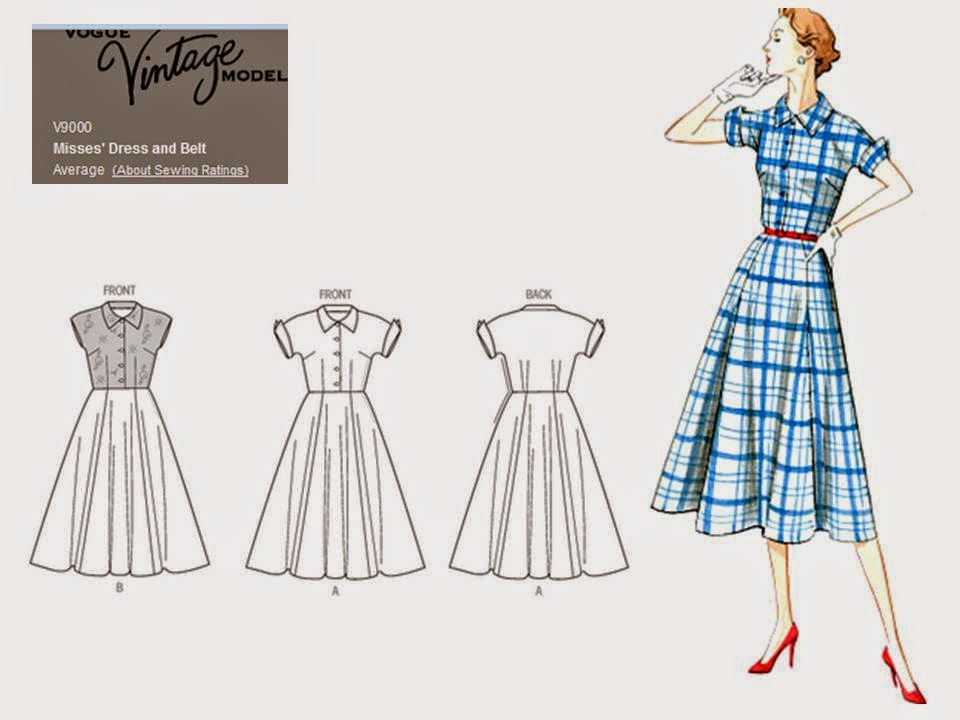
Probably the easiest true vintage pattern group to look for are Simplicity sewing patterns from the 1960's forward with a "How to Sew" banner. These patterns have instructions that show details on sewing specific techniques. Often they were designed to be used in traditional home ec. classrooms, so the styles have few pattern pieces and involve simple or entry level sewing techniques.
Starting with a new pattern that is a modern copy of a vintage pattern is a short cut to getting that retro look you want to sew. Learning to sew means that the styles you choose shouldn’t be difficult for someone with beginning sewing skills. The blouses shown above are excellent examples of styles that have easy to sew design elements and limited techniques required.
If you want to sew a blouse or dress with buttons and button holes, prepare by doing some research in sewing books or online so that you understand how buttonholes are located. You may need to consult your sewing machine manual to learn how your machine settings can make those buttonholes for you.
I feature here two styles that have short kimono sleeves, making the bodices easier to sew since set-in sleeves are not required. The patterns in this post are just a small selection of retro or vintage style sewing patterns currently available through the major pattern companies. These patterns were selected for their very basic level of design, limited pattern pieces, simple darts, facings and ease of fit. Using vintage prints or stripes, cute retro styles are possible using these sewing patterns. Some of the patterns do require an entry level skill in fitting, so be sure if you are very new to sewing that you select a style with a looser fit.
Even dresses are possible, just seek out styles that have few pieces and can be easily fit to your size if that is required. Usually dresses have zippers, so that technique may be your main challenge in sewing a dress.
When looking further at sewing patterns, read the list below so that you have a good idea what sewing projects may be at your skill level. You might want to avoid the more advanced level projects, since those techniques or design elements may be too difficult to sew right now.
Level ONE: You are a new sewist, and need patterns that aren’t difficult or complicated. Look for:
Few pattern pieces
Loose fit “A” line shapes on dress or skirt
2 dart front: side seam darts or French darts
Sleeveles and collarless blouses or bodices
Wrap skirts (no zipper)
No waistband on skirt
Back zipper (no side or underarm zippers), with one side overlap (not centered)
Patch pockets
Fabrics that are stable, smooth and easy to cut, sew and press, such as light weight quilting cottons, woven stripes and plaids in cotton.
Level TWO: You have started sewing fashions and are ready to try some patterns that are a bit more difficult. You are ready for some of the more easy challenges in fitting patterns too. Look for:
Sheath dress: a more fitted one piece dress with 2 or 4 darts in front, 2 darts in back
Princess seamline dress: more fitted one piece dress with shaped vertical seamlines from underarm to hem, both front and back
Fitted bodice with darts in front (not tight fitting)
Fitted bodice with princess seamlines in front (not tight fitting)
Plain sleeves (no cuffs)
Sleeves with gathered shoulder or puff sleeves
Waistband on skirt
Side seam pocket
Loose pajama pants or elastic waist pants
Collar sewn in a dress neckline
Men’s bowling or Hawaiian style shirt (small collar, no back yoke, short sleeves)
Invisible zipper: hard to understand, easy to sew
Fabrics: add soft cottons or rayons to your selection, also consider embroidered fabrics and border prints
Level THREE: If you have been sewing for awhile, then projects that require good sewing techniques, fabric control and fitting are nice to work on. Look for:
Close fitting one piece dress with darts or princess seamlines
Close fitting bodice with 4 darts in front or princess seamlines, has skirt sewn to bodice at waistline
Collar on blouse, convertible collar
Straight skirt, fitted with darts or princess seam lines
Dress with a waistline seam
Buttons and buttonholes
Pants with waistband or yoke, back or size zipper
Fabrics: wool flannel, velvet and velveteen and denim have the level difficulty that would be good to try sewing
Level FOUR: These projects are for the sewist who is ready to sew just about any style. Fitting and complicated techniques in sewing should be great for this skill level
Sleeves with cuffs
Men’s style shirt collars
Men’s style shirt with back yoke
Fly Front zippers on pant or skirt
Side zipper on dress with sleeves
Fitted bodices such as corsets and formal wear.
Difficult fabrics that might be slippery, thick or hard to work with.
In my next post, I'll go over a few sewing resources to help you problem solve and learn new techniques.
Friday, August 19, 2011
Vintage Simplicity Sewing Patterns: 1958
Mena Trott of Sew Weekly recently found a Simplicity 1958 pattern book. She has posted page after page on flickr for all of us to see. It's great fun to view these, and what's even better, the back views are there too. How often do we need to get those details and they aren't available? I think you'll enjoy this new resource, and if you're unfamiliar with Sew Weekly you may want to check that out too.
(the Simplicity pattern shown in this post is from my own collection)
Tuesday, August 16, 2011
Sewing Vintage Fashion: Vogue Patterns, April 1960
Vogue 9967. Blue eyelet, embroidered with dots, great full sleeves on fitted shirt waist dress
Vogue 9991. Floral border on cotton with matching stole wrap, sleeveless bodice with deep "V" back
Vogue 4101. Small kimono sleeve bodice with 3.5 yards wide gathered skirt in mauve ribbed cotton
These three vintage Vogue patterns are all sewn in cottons. They appear in "Ladies Home Journal", April 1960 (the Kim Novak cover is so sadly damaged I couldn't include a photo for you). It is interesting to note how easy the dresses would be to sew. The seam lines are classic, so that they might be duplicated today using patterns available.
The slides below show some current sewing patterns from Vogue, Butterick and McCall's that I found online. These could provide the basic garment to work from. Gathered skirts are not common in today's patterns, so that style would need to be improvised (easy stuff to do).
A kimono sleeve bodice is not common today, but there is one vintage styled pattern from Butterick that is similar. This pattern also has a "V" back (remove the bow). Small cap sleeves will also get the 'look'. When sewing a "V" back, that diagonal cut seam will need to be stabilized with twill tape, a strip of interfacing or elastic. That way it won't gap or fall off the shoulders.
The fitted top with deep "V" back on the blue floral dress is very simple. When cutting a "V" back neckline, be sure that the front neckline stays high enough to keep the shoulders in place. If the front is also low cut, the shoulders slip down easily. Dressmakers would add little snaps inside that neckline so the bra strap could be fastened to the shoulder, keeping it in place.
Basic fit patterns are great for classic bodices such as this one. For the vintage sewist, this type of pattern is essential to own. It can be used for many styles once a true fit has been made. All three pattern companies carry a version of this pattern.
An alternative to simple darts is the princess bodice. Those vertical seam lines make for a better fit on curvy bodices. I show a princess pattern for each style.
This full skirted shirt dress with puffed sleeves can be duplicated in two ways: as a dress or as a blouse with gathered skirt (an easier fit for most). Those great gathered sleeves are probably easier to locate in a 1980's pattern, since current sleeves have a slender upper arm. I found a few blouses that might make a fitted bodice, and two have fuller sleeves.
Wednesday, July 13, 2011
1950's Summer Pool and Play Set
When sewing vintage fashion styles, sometimes you have to copy an idea, rather than use a pattern. This Simplicity sewing pattern from the 1950's has a classic detachable skirt worn over a short playsuit. The wrapped bodice seems strongly influenced by Claire McCardell and other American designers who were creating styles with an Indian sari influence. The jumpsuit image shows how the edge of a sari could be used to create a dramatic diagonal on the one shoulder top.
For a sewing project, this outfit is worth taking a second look, especially for the wrapped neckline which can be made with or without the second shoulder panel. The easy to sew gathered skirt is accented by a detachable cummerbund. The skirt fastens in front and it acts as a cover-up for going indoors at the country club.
The back of the pattern shows how the pieces are cut. Even though this pattern is no longer available, it is possible to re-create the same look with a gathered skirt over a jumpsuit or shorts and halter top.
The original pattern seems to be Simplicity 7605, however with the torn edge I can't be sure. Currently Butterick 6582 has a similar wrapped bodice that could be used for the top and Vogue 1003 has a basic pant pattern that could be good place to start the shorts.
Saturday, May 14, 2011
Sewing Retro: Vintage Shirt and Blouses
Wearing true vintage fashion can be difficult. Sometimes they just seem too costumey, and not casual enough for real life. Fit and availability are other issues. These problems can be solved nicely by sewing your own vintage looks. But this project can present another problem: where to find vintage styled patterns and fabric?
A good place to start are casual shirts with a 1950's or early 60's design style sewn up in fabrics that seem very vintage in look. Shirts and blouses fit easily into our modern lives, while capturing the essence of vintage fashion. They are also some of the easiest fashion sewing projects, and can be a great way to start sewing for yourself.
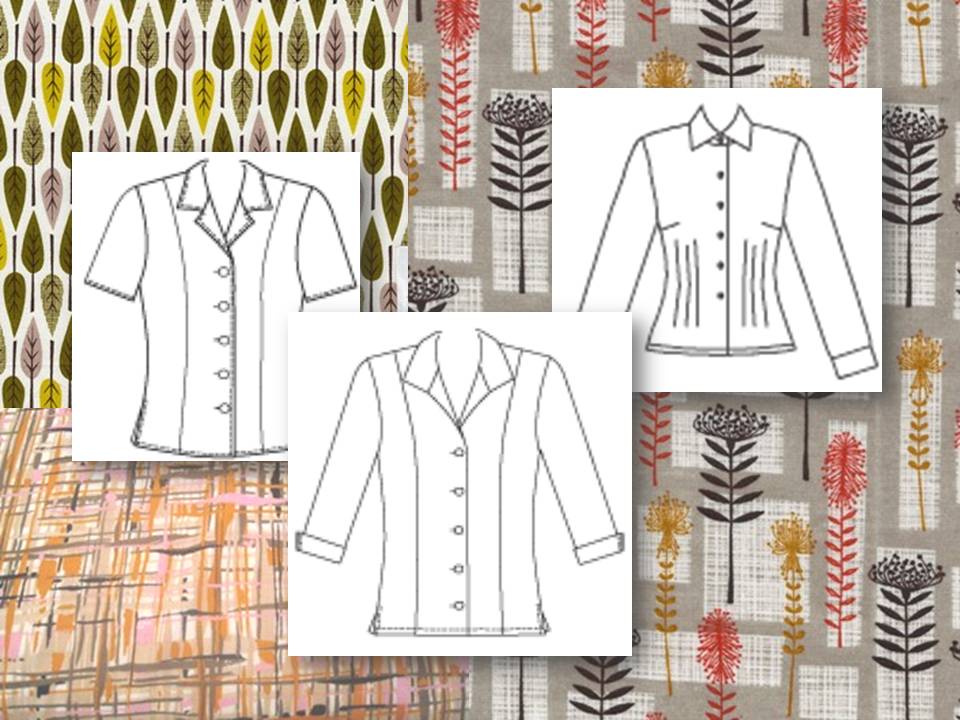
Button front blouses with a fitted silhouette are available from several of the big pattern companies. Keeping the fit close to the body provides the retro silhouette you want. Slim sleeves, worn short or long are classic. Note the details: collar shape and button fronts.
The best fit for a curvey body shape are the long princess seam lines that will make up a slender style. These are also easier to alter.
For more design details, the Vogue7003 blouse has several front darts, with is such a vintage look. This style also comes with French cuffs.
Selecting the right printed fabric comes next. Three of the most popular themes are nature (top), pictorial (middle) and graphic (bottom). The 'all over' prints are easiest to lay out, since you won't need to match anything. These prints are a good choice when sewing a princess seam line style. The horizontal motifs in the bottom set are best in patterns that have simple bodice darts and only the center front needs to be aligned.
So, consider making a blouse for summer (no sleeves, now that's easy!).
All of the retro style fabrics shown here are from BonBonAtelier on Etsy.
Fabrics:
CLOUD 9: POTS AND JUGS, PROTEAS, AVENUE, SHARDS
KOKKA: HOT AIR PARIS, RUSSIAN FAIR
LIZZIE HOUSE: PEEPS
ALEXANDER HENRY: DAGMAR PLAID
Blouse Patterns:
MCCALLS6285, MCCALLS6076, MCCALLS5138, MCCALLS2094,
UTTERICK5538, BUTTERICK5538, BUTTERICK5300
VOGUE 7903
Thursday, February 17, 2011
Vintage or Retro? Leaf Prints
An early 1950's pottery company, Stengl, produced a trend setting design in 1954 called "Amber Glo". Part of the charm was the leaf print, almost like a flame with a brush stroke style. When I saw this newly released "Naturewalk" leaf print in 100% cotton fabric pattern by Cloud 9, I saw that same leaf style. This time the leaf is in repeat in an all over motif. What better fabric to sew into a crisp vintage style blouse or throw pillows for the Nelson style sofa?
Simple fashion styles are perfect for busy cotton prints. These vintage sewing patterns are easy to make, and will work into any modern wardrobe. Busy prints need clean lines to show off the colors and details like these patterns do. Start now, and you'll be ready for the first spring day with a new blouse or dress!A: Vogue 1002, c. late 1970's
B: Butterick 2475, c. early 1960's
C: McCall's 7608, c. early 1960's
Read more about Stengl: Amber Glo design c. 1954
Shop for Naturewalk fabric by Cloud 9: Bon Bon Atlier (also, don't miss their daily blog posts, always fun new things to see!)
Saturday, January 1, 2011
The Party Dress Book by Mary Adams: a Book Review
The pattern itself may seem complicated for a beginner to work with, but similar patterns are available in purchased patterns, if that approach is easier. In fact, a purchased pattern might provide helpful supplementary sewing instructions not given in the book.
This bodice is shown without boning, which will make it soft, without structure. With this style, shoulder straps are essential. I am guessing the author left out boning to make the pattern easier. Having a purchased pattern may help to advise the sewer who wants a boned bodice instead.
I highly recommend this book as a source of inspiration, along with a great series of tutorials on how to create texture and visual interest when sewing fashion. This is something that has been left out of fashion sewing in recent years, so for many this may be a first peak into new territory for sewing.
Book: The Party Dress Book, How to Sew the Best Dress in the Room
Author: Mary Adams
Publisher: Watson-Guptill, 2010
Binding: spiral bound
Skill level: Intermediate
(With a purchased pattern, this book could be used by someone who has fit and sewn a dress or two successfully, and is ready to be more creative.)
Suggested:
This book will appeal to anyone who loves fanciful and creative fashion.
It is the perfect engagement gift for a creative bride to be.
This is equally fun as a 'look book' for someone who doesn't sew but loves new ideas.
It is also an interesting read to learn about the author's own career in the arts and fashion.
Supplimentary Patterns:
The following commercial patterns may be used when making the dress shown in this book.
Princess bodice, with sweet-heart neckline:
Simplicity 4070
New Look 6805
Princess bodice, with flat neckline:
Butterick 5322
Butterick 4443
Simplicity 2440
Tweet
Subscribe to:
Posts (Atom)