Showing posts with label 1960's fashions. Show all posts
Monday, November 11, 2013
Lilly Pulitzer: Close-up
Lilly Pulitzer fabrics and fashions made a transition during the later half of the 1960's to include white trimmings that were heavy and textured. She used the popular caftan shapes that were constructed with vertical seam lines and slash necklines to create 'outlines' and seam accents.
She had been using cotton fabric around edges, and expanded on that with shirred trims, ruffles and ruched panels cut from the dress fabric for texture.
These close-up view of her trims and textiles show how she used contrast and texture to create additional new looks and add a fresh face to her well known shift dresses in the late 1960s and early 1970s.
Her textile design color palette was based on citrus and tropical brights. She continued to make that her brand identification, rarely including other hues. During the 1970's she did work with deeper brights along the lines of then popular Pucci prints, as shown above.
The themes and images that she used in her designs tended to have a sea and surf motif. Usually there are identifiable images within each design, rarely using all abstract shapes. Floral are dominate, along with fish, frogs and other water creatures.
When trying to date her dresses, it is important to find examples that 'match up' to what you have found. With Lilly designs, due to her use of classic silhouettes and prints, this can be difficult to do, since some styles span a decade or more. In her early career, it is possible to find photos of her wearing her designs that date to the early and mid-1960s. Often she is shown wearing a triangle scarf to match the dress.
The 1960's dresses have a simple cut with popular details such as patch pockets and a deep side slit with contrast white banding and a bow. Contrast rick-rack or banding is also seen around the necklines and armholes. This might be due to the garment construction where under-lining or flat-lining is used to support the thin cottons she printed on. This technique requires that the seam allowances are pressed open and are not hidden behind a lining 'shell'. Rather than loose facings she seems to have chosen contrast binding, rick-rack or piping around the edges, most often in white as you can see in the photos.
Some primary sources are her advertisements (often in "Vogue"), catalogs, press photos, and magazine editorials. Because well known personalities such as Jackie Kennedy wore her dresses, photos are available with dates (note that Jackie favored simple gingham shifts, rather than bold prints).
I have found quite a few examples and have saved them in a Pinterest board "Lilly Pulitzer" for research reference. Feel free to let me know if you locate additional images.
Biography
the New York Times
Palm Beach Daily News
Huffington Post
This post is part of a three-part series. Part one: "Lilly Pulitzer and Her Dresses" can be seen HERE. Pinterest photo album can be found HERE
Saturday, November 9, 2013
Lilly Pulitzer & Her Dresses
The Lilly Pulitzer revival continued this year with a small but punched up exhibition of her dresses and other designs for both men and women. It was a good opportunity to view the diversity of her work over the span of her career, with many examples of silhouette and style all created from her textile designs.
Lilly dresses from the 1960s and 1970s are like those from other well know textile designers such as Pucci, Vera, and Marimekko designs: the fabric is first and foremost, while the garment structure is often the vehicle for the textile, rather than the other way around.
The photos here show some of the garments that were in the exhibition, and I offer them as an example of her diversity as a designer of fabric who found a way to marry those splashes of color with simple garment silhouettes. In a second post I'll share more detail photos and textiles close-up.
One important fact that is seldom emphasized about Lilly Pulitzer (1931 - 2013) is that she wasn't a homely Florida orange grove owner's wife selling juice, as the myth is often told. She was a socialite married to a Pulitzer publishing heir, living in Palm Beach, Florida. She was socially connected and knew the major characters who resided in Palm Beach as well as most of the east coast as well. That Jackie O was a former room mate at boarding school who owned and wore her dresses for a magazine cover photo attests to how easy it was for Lilly's company to gain popularity and success. The design business that she began in 1959 included a partner who had been a fashion editor, so she was given great advice along with expert assistance. Her brand is also a story of how a creative individual with drive can become a success especially if they are part of the established upper class system where their work is easily accepted and promoted.
Sadly, I can't give you the dates or descriptions for the garments in the exhibition because nothing was labeled. More to the point, this show appeared to be mounted for entertainment, rather than education, with odd and inappropriate accessories and pairing of garments. All of this aside, it was great to see her diversity when it came to textile design.
These photos were taken at the southern California exhibition "Loving Lilly: Lilly Pulitzer From the Keni Valenti Collection" on view late this summer. All garments shown are from the collection of Keni Valenti, a Miami-based vintage clothing collector.
Monday, July 8, 2013
Mother-Daughter: Dressing Alike in the 50's
Mothers and daughters dressing alike? During the 1950s and 1960s, matching outfits were almost a national style. Sometimes these matching sets were purchased, but more often they were home sewn.
At a time when mothers at home could sew their own fashions, it was very common to see tiny versions worn by their daughters. The same goes for fathers and sons, but in a lesser way. For them, matching sport shirts crafted by mom were worn.
When looking for vintage, it's very rare today to find a matching set from this era for a child and their parent. What we are left with are family photos and advertisements, capturing the charm of dressing alike. This nautical themed set is from an advertisement for "Everglaze" fabric. The dresses shown are by "Yolanda" in Springmaid cottons.
Monday, April 8, 2013
Cashin Coat for Spring: 1966

Bonnie Cashin's vision for Spring 1966 shows her love of texture and inventive silhouettes. This kimono inspired coat has unique angled sleeve lines, with a diagonal wrap closure that ends in an upswing hemline. All edges are bound in leather, which would have been colored to compliment her custom wool textiles. Doesn't it have an exciting look? I think it could be adapted and worn today, which is one of the amazing elements about a Cashin design.
Sunday, January 6, 2013
Audrey's Trench Coat
A bit of inspiration for winter styling, this adorable photo of Audrey Hepburn and Cary Grant comes from 1963, and shows her wearing a trench coat, as she made so popular in "Breakfast at Tiffany's" a few years earlier.
Photo source: "Look" magazine, December 1963 (nearly 50 years ago!)
Monday, November 26, 2012
Clothes that Count: 1960's British Dress Making
This illustration from 1967 is from a set of Sunday magazine supplements to the "Radio Times" publications titled "Clothes that Count". They were written to promote a BBC series under the heading online of: "What We Wore". As a television show it first appeared in 1957 with six installments. These and others from 1967, 1969, 1976, and 1982 are available from the BBC video archives on line (but not in the US). Each installment is focused on one type of fashion garment and features British fashion designers.
These small brochures were published to be seen with the BBC shows in 1967, so the illustrations are of fashion styles from that year. The print is blurry, but there is a 'text' version that is easy to read. The content gives tips on sewing the fashion trends of the day, along with designer comments. If you love 60's fashion, these brochures will be fun to see and you may find them a worthwhile resource for both fashion and sewing during the late 1960's. If you are lucky enough to have seen the BBC series, let us know about those too!
Clothes that Count Part One, HERE, and the text of this pamphlet is HERE
Clothes that Count, Part Two, HERE, and the text of this pamphlet is HERE
BBC Archives Video Series: What We Wore, HERE
Saturday, November 17, 2012
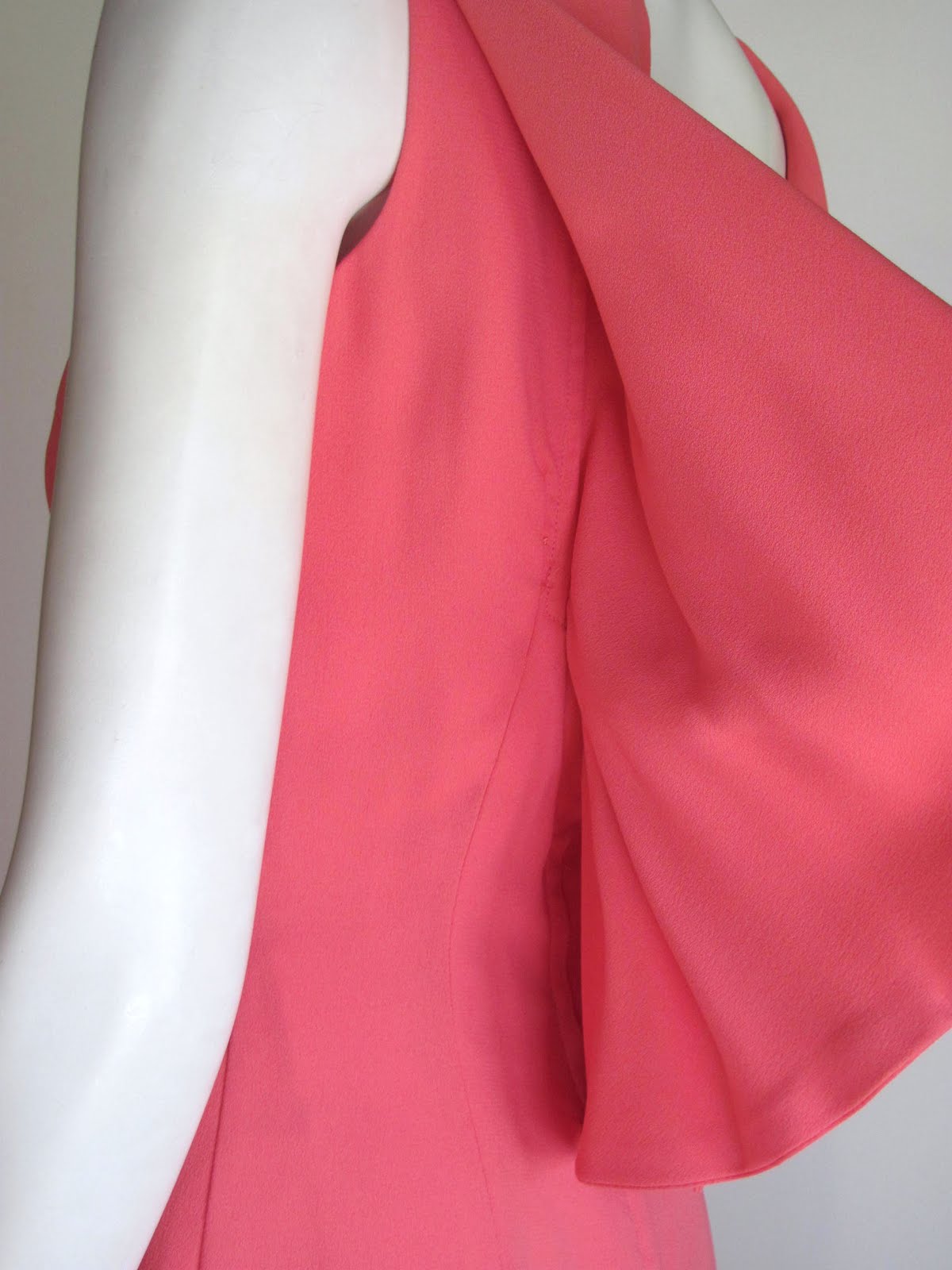
A Closer Look: 1960's Sheath Dress with Cape Drape
I thought it might be fun to take a closer look at this Mad Men era sheath dress with a great cape drape around the neckline. The back view really makes the dress, while the front view has a classic silhouette.
It looks like a circle cape is sewn around the neckline, that plunges to a deep "V" that is squared off at the point with a wide bow in back. This cape was then folded up at the neckline in front (see detail), and arranged over the shoulders in a fold, while the back floats open.
I include here a view that shows me lifting the back drape so you can see how it is sewn to the dress.
And finally a few close-up views to show more details.
This pink crepe cocktail dress was designed by Anita Modes (I'm guess it was sold at the popular Anita shops). It is fully lined with a center back zipper that has the cape floating open over that zip. A wide bow covers this opening. The sheath dress design has darts to fit and is very simple.
Isn't this inspiring? This style of cape could be added to an existing simple dress for a great holiday look. It flows nicely in crepe here, but a soft satin or even a soft lace could be gorgeous over a simple dress you already own. I would love to try draping this kind of cape collar sometime. If you try it, let me know how it goes!
Monday, November 5, 2012
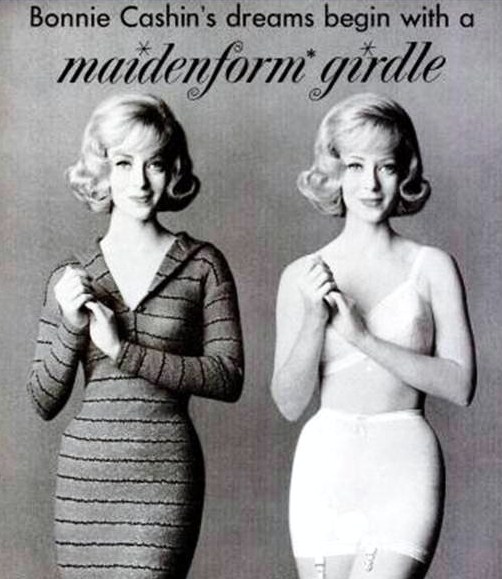
Cashin: Knits and Girdles in 1961
Bonnie Cashin's fashion style seems so natural, easy fit and easy to wear. But the illusion is often easier to achieve than the reality, as we can see in the foundation garment advertisement from the spring of 1961.
The dress is described as a green and gold striped knit on bright red which is such a modern, 1960's color concept. The knit has a 'natural' fit in the shoulder and body torso. This ad suggests wearing a Maidenform girdle to achieve that slender, effortless looking silhouette. It was promising a newer, more natural girdle of power mesh that would do the job. Where the previous decade had seen a stronger, boned waistline, the early 1960's would lead into a silhouette where natural was the newest look, and Bonnie Cashin was a leader in that field.
Thursday, July 19, 2012
1949 - 1980 Fashion Video
Women's Fashions, Year by Year: 1949 - 1980 by Wallygreeninker
When I was a kid, old fashioned movies were shown at school on rainy days and for special events, here's a fun 'movie' that's perfect for a hot afternoon. (enjoy!)
This video is a great overview of fashion history from 1949 to 1980, slowly progressing from one strong look to the next as the years roll by. Lasting more than 6 minutes, it shows 4 frames or slides for each year during this 30 year period. The images are of popular styles and give a good overview of the 1950's, 60's and 70's.
Thursday, April 19, 2012
Rudi Gernreich: On Exhibit
"The TOTAL LOOK" is a collection of 1960's fashions by L.A. designer Rudi Gernreich. Billed as the creative collaboration between Rudi Gernreich, his model Peggy Moffitt and her husband William Claxton, his photographer. This exhibit displays her personal collection of fashions, photos and movies. This is on display at the Los Angeles Museum of Contemporary Art's annex at the Pacific Design Center. The gallery site is a small two story building where the entry is into a dark gallery.
The opening gallery showcases tunics and full ensembles with matching leggings in animal prints. Ongoing is a large screen showing a short film with music from the 1960's featuring the clothes on Moffitt and other models.
Upstairs, a larger gallery packs a wide range of fashions into one space. His iconic topless swimsuit is there, of course, along with the famous photo of Moffitt wearing it. Grouped by style trends, his work during this decade is featured.
Many of his best know fashions are there to be seen up close and personal. The greatest impact might be color and pattern worn head to toe, a style that Gernreich made famous. Bright, bold colors are paired with graphic black and whites for emphasis and drama. Tunics and legs are usually color and texture coordinated, making for a 'Total Look' as the name implies.
These aren't fashions for the faint at heart, but they certainly capture a sense of fun and play that his fashions were known for. Beyond the bold and outrageous, there are many outfits that are wearable today (needless to say, often copied as well).
The Total Look is on now at the MOCA site at the Pacific Design Center through May 27, 2012.
Want to know more?
You can see close-up photos of the KABUKI dress shown here from my collection,
and pictures of some early Gernreich fashions, HERE.
Wednesday, March 21, 2012
Cybill Shepherd: 1960's College Style
In August, 1969, Cybill Shepherd at Hunter College, was one of several college women featured in the college issue of "Glamour" fashion magazine. Although she was on the cover, it is the editorial shots that really capture her iconic 1969 great look. These photos present the ideal look of the day, as she would wear it at that time. After this feature, she would be seen in many more magazines to come.
From a fashion perspective, everything that she is seen in here is wearable today without looking too retro or costumey. It's pretty amazing to think without making any changes, styles over 40 years old can be worn today as a current trend.
Labels:
1960's fashions,
Cybill Shepherd
Wednesday, October 26, 2011
Vintage Details: Rudi Gernreich: 2 Kabuki Dresses, Autumn 1963
It's not often that we get a chance to see two vintage dresses that are from the same collection: similar in design, but different in fabrication.
Rudi Gernreich produced a wide range of innovative designs during his career, but the Kabuki dress remains one of the most recognizable. Designed in 1963 for his Autumn collection, it is a wool double knit with body drape. What made it so unique was the eye popping textile colors and the innovative bodice 'obi' belting across the bustline.
As early as 1954, when in his early 30’s, Gernreich was noted for his colorful, geometric, and unique styling. His styles are highly influenced by the flapper silhouette of the 1920’s, which was a departure from the hourglass look being designed in Paris by Dior. In 1951 he began working for Walter Bass, a California manufacturer. There he became well known for contemporary clothing design.
He created boxy jackets and tight pants and other clothing styles that would become more commonplace in the early 1960’s but were considered bold, sophisticated, and shocking 10 years earlier.
Like Claire McCardell and Bonnie Cashin, he was influenced by Asian garment styles. As a designer he felt that he was a practicing artist, where aesthetics were important. He also believed that a good design need not be discarded after only one season.
Wool knit textiles were produced by Harmon knitwear. In the early 1960's his color sense and ability to manipulate textile graphics were becoming popular. The bold colors and patterns here predict the trend in fashion that would become mainstream by the late 1960's and early 1970's.
And finally, a quick look at the inside construction. The obi section is backed by cotton broadcloth to prevent it from stretching out of shape.
(click on the photos so see enlargements)
Please contact me if you wish to use these photos, thank you
Sunday, May 15, 2011
Helen Rose

Helen Rose has been in the news lately, with her stunning wedding gown for Princess Grace being so influential. Helen Rose was known for her softly feminine designs, and this is one that captivates her style. It is a weightless silk chiffon made with impeccable workmanship. The very modest bodice and sleeves are given drama with a swirling, soft pleated skirt. The design accent is a wrapped chiffon sash in scarlet, brown, and the self beige color. It's genius for the subtle red 'pop' toned down with the chocolate. Who would think of that color combination today? Yet it works perfectly.
Label:"Robinson's, California", a Southern California department store.
Labels:
1950's dress,
1960's fashions,
Helen Rose,
vintage gown
Saturday, October 23, 2010
1960's MOD Fashions to Wear or Sew
Would you use a 60's pattern to sew a dress like the ones here?
If you collect or wear vintage, this group of styles dates from Spring, 1967. Using patterns can be a great way to help with dating vintage garments too.
Tweet
Subscribe to:
Posts (Atom)