Showing posts with label 1950s fashion. Show all posts
Wednesday, February 28, 2018
Thursday, March 30, 2017
Fashion from 1949 to 1980: A video review of styles and trends
Take a little vacation into the past--below is a youtube peek into fashion history from 1949 to 1980:
It's a great way to sit back and take in 30 years of fashion styles, one year at a time.
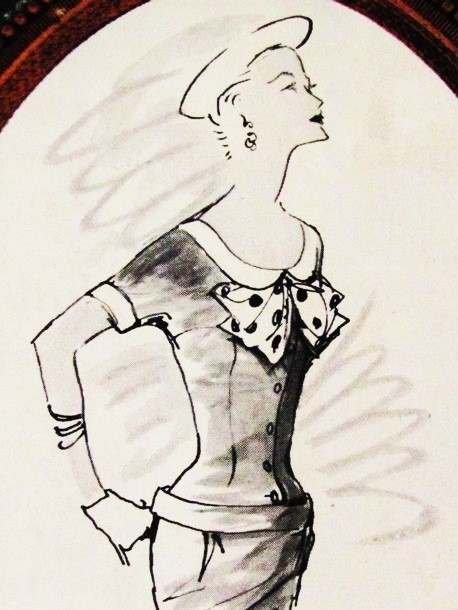
The illustrations at top are from a French fashion magazine during this era, can you guess the year by watching this video?
(1963)
Friday, November 4, 2016
Betty Barclay: Vintage 1950's Dress
This sweet 1950's dress with the "Betty Barclay" label is a follow-up to the "Hourglass Corsage Silhouettes" post on vintage dresses with fitted bodices that hint at a corset shaping. I have a few examples of this style, and thought it might be fun to take a look.
This "Betty Barclay" design was a junior division of the Jonathan Logan group. I wrote an earlier post that included this dress, and have wanted to give it a full review ever since.
This close up view of the front and collar shows the cute butterfly print clearly. It seems to be screen printed on a fabric with some sheen that is probably acetate. Tiny rhinestones are scattered on the collar. With these details, I'm guessing it was not an everyday school dress, but something special for dates and family events.
The bodice is closely fitted in both front and back, without a belt or seam around the waist. It closes up the back with a simple metal zipper, which was common at the time. The gathered skirt is emphasized by the lower dropped level seam line. This creates the corsage fit and hourglass silhouette.
The small Peter Pan collar provides a demure look that was very popular. The sleeves are cut in one with the bodice (small kimono style sleeves) and they have a narrow turned back cuff to compliment the collar detail.
The simple cut of this dress would have made it cheaper to manufacture for the junior budget. While the rhinestones are few, they provide a bit of embellishment on a conservative collar. Overall it's a very cute look, perfect for a high school girl to wear.
Measurements:
Bust: 35" / 89
Waist: 26" / 66Hips: full skirt
Length: 35.5" / 90 from shoulder/over bust/to hem
Friday, October 28, 2016
1950s Vintage Fashion: Hourglass Corsage Silhouettes
1950s Vintage Fashion: Hourglass Corsage Silhouette
In the mid-1950’s, the Hourglass silhouette had a popular style termed “corsage”. This look was worn by fashionable women with slender waistlines. It had a fitted bodice or corsage that is not as tightly boned like a corset. I wanted to look closer at these dresses to learn more about how they are both similar and diverse.
When spotting this style, (such as the illustration above from 1956 advertisement for Burlington that showcases McCalls 3458), look first for a horizontal seamline, either just below the bust line, or around the upper hip level, somewhat in the same location as a corset edge. These seam lines are often accented with wide sashes, cuff-like belting, or a trim to emphasize the body fit.
This illustration shows the corsage fit in both a hip emphasis and under-bust shaping. Princess seam dresses are often part of the pattern design used to create this look without a defined waistline seam that has a strong hourglass silhouette.
The illustrations shown here again feature McCalls 3458, and come from a McCall’s spring 1956 pattern magazine, however many of the patterns in this issue seem to be dated 1955. This helps us to know that this look was a long term, strong and popular design feature.
A typical novelty print fabric with tiny houses is shown using patterns 3434, a true princess seam dress, and 3494, a drop waist corsage with an easy to sew darted bodice. The dramatic red sheath is pattern 3493, and shows an under bust seam that comes to a point at center front.
This shapely corsage style in the rose print is a separate skirt and top set, 3511 and 3512. The geometric print dress was not labeled with pattern, but it could be 3458 that has a similar cuff style hip band.
This magazine issue lists many similar patterns that create the corsage fit. I tracked down several to show original sewing pattern cover art. I find pattern covers are an excellent source for fabric color and print as well as accessories, hair and makeup.
3497: a modification of the princess seamed dress that shows a bustline seam
3434: a true princess shaped dress that has flared and shaped panels from neckline to hem
This set of patterns show the modifications of the princess pattern with addition of the hip level seam and applied gathered skirt. In this case I found both an all around skirt, 3479, and another with a smooth front and gathered sides, 3492. This style recalls the silhouette of Marie Antoinette and the 1700’s, creating a romantic air.
3492: the hip skirt has a wide sash sewn into the seam line with bows to emphasize the hips, the corsage is fit with curved bust seams into the armscye
3479: this simple version clearly shows the princess seams to shoulder in the corsage
This look was considered a youthful style, and can be found in many of the Givenchy designs for Audrey Hepburn (Sabrina, Funny Face, Love in the Afternoon). These were among the early styles produced by 'junior' style houses that catered to the growing teenage consumer population. Look for these additional corsage patterns by McCalls:
3499 (V front seam), 3478 (under bust seam), 3477 (fitted midriff), 3481 (knit top), 3467 (low waist, full skirt), 3355 (V waist jumper), 3432 (V waist dress), 3433 (shaped hip sash), 3523 (low waist, full skirt),
The patterns shown here are available at the following online vintage pattern shops, show your support and take a look:
3434: Pattern Shop
3479: The Perfect Pattern
3492: Midvale Cottage
3497: The Spectrum
Friday, May 13, 2016
Cover Up Styles in Vintage Fashions
At one time a cover up was essential to wear over strapless and sleeveless dresses. This design from 1960 by the California designer Pat Primo is an example of how cocktail dresses might have been worn, with a little matching cover up to wear over a bare neckline.
Labels:
1950s fashion,
1970s fashion,
bolero,
cape,
cover up,
vintage cover up,
vintage sun dress
Friday, March 11, 2016
1958 Sack Back Dress
The Sack Back dress spent a brief moment in time on the 1950s fashion scene. While couture silhouettes flirted with this silhouette earlier that decade, it wasn't until 1958 that the general public gave this style a try. Clearly it was a departure from the ongoing hour glass silhouettes that had continued for a decade. It was time for something new, and maybe a draped back might be it.
Tuesday, November 3, 2015
1949 Fashions: Simplicity Sewing Patterns
This vintage 1949 August brochure for Simplicity sewing patterns shows diverse new silhouettes available to home sewers that year, for 25 cents each. The company provided a wide range of styles suitable for it's readers who would be making their own clothes for summer and fall.
Wednesday, May 13, 2015
1950 Fashion: Sewing Patterns for Dresses
Vintage fashion for January 1950: a new decade with new styles. Women were cutting and sewing a whole new silhouette that year. My sister has kept me well stocked with vintage sewing pattern brochures. This newsprint catalog she gave me has several punched up color pages that I'm sharing with you here.
In 1950 dresses sported the newer sloping shoulders, 3/4 sleeve length and wide hemlines. For many girls it was a good time to sew up new clothes, departing from the tired and well-worn ones that had gotten them through the post war era.
An hourglass silhouette with tiny peplum is accented by turn-back cuffs and standing collars.
Circle and flared skirts with small waisted wide belts. The rounded shoulders and tiny collars with high necklines keep the bodice demure, except for the bold white turned-back cuffs.
For more mature customers, the top two dresses carry over the diagonal draping and crepe textiles worn during the last decade. The perky red checked gingham number and the red dress are half size with a modern style spin.
Whether trying to date a vintage dress, sew up retro style copy, or just get inspired by fashion from 65 years ago, these pages with over a happy dozen dress patterns are great in both their differences and similarities.
Pattern Numbers shown here: Simplicity
3057
3058
3059
3060--Junior sizes
3061--Junior sizes
3064--Junior sizes
3065
3066
3067--Half sizes
3068--Half sizes
3069
3075--Junior sizes
3076--Junior sizes
Monday, December 1, 2014
Carl Naftal: a California label
I recently found a wonderful dress with a "Carl Naftal Originals, California" label. Because this brand was unfamiliar to me, I thought it would be fun to find out what I could about this label. Carl Naftal, owned an apparel firm in Los Angeles under his own name from the late 1940’s through the late 1960’s. I base that date on an advertisement. Records show that someone with his name was born about 1911 in New York and lived in Los Angeles until his passing in 1977. He applied for incorporation under the name “Carl Naftal Originals” in 1954, but this name as a brand was already in use before that date.
As early as 1947, I found an ad for a suit with peplum shirt in a Los Angeles area newspaper, so we know that he was manufacturing by that date.
In the mid-1950’s his fashions were sold in shops that also advertised Jonathan Logan, Berkshire, Peg Palmer, Bobbie Brooks, White Stag and Graff: labels that were in the upper middle price range. The newspaper advertisements also key in regionalism, marketing a California lifestyle, selling this image to customers outside the region.
A holiday ad from 1955 shows a white knit jersey fabric with gold threads, cut in a slender sheath silhouette.
There are other ads that showcase knits, which seem to be a popular item for this label. His “California creations by Carl Naftal” are advertised at $22.95 to $29.95. A spring ad in 1964 reads: “from sunny California come these perfection dresses by Carl Naftal”.
His customers are usually missy, but often there seems to be a junior style, with a spring ad in 1967 listing “Oh Yes! They’re the great pant pretenders…it’s really a culotte, comfortable as a shift…discover the new “pant era” now…$20 linen look rayon and acetate, misses sizes.” In the fall of 1968 an advertisement shows a popular junior style dress of wool jersey ($39.98), so this brand seems to have maintained knits in its collections.
Here are more newspaper advertisements, which market to a young crowd:
Fall 1960: “Gently tailored jersey, key to wardrobe versatility in a deftly fitted sheath, wool jersey, $29.95”
Summer 1962: “Love what Carl Naftal does with Dacron. Checking in for an easy care flight through summer, sizes 10 to 20, $22.98”
Summer 1968: “The romantic look full of feminine appeal, another of our new romantics, cotton polyester and cotton voile, lined, $26.00”
Spring 1969: “Fresh from California, the sun country, comes these fun-loving ‘about town’ dresses of 100% cotton”
The dresses produced by this label appear to be well made (especially if they were sold on the same racks as Jonathan Logan and Bobbie Brooks). Look for the “Carl Naftal” label for a quality vintage dress.
The brown lace dress shown here is now available for sale in my Etsy shops, along with more views of it.
Wednesday, October 22, 2014
Lilli Ann: 1956 Suit Advertisement
In the 1950's Lilli Ann suits were available not only at major department stores, but at locally owned shops in small towns as well. This advertisement is from the spring of 1956, and shows a suit called "Carousel" with flared peplum and longer narrow skirt.
The wool worsted fabric of gray and white has polka dots available in either white or red. This illustration can help us to see that the wide peplum was a popular silhouette in 1956 for this brand. There is a double layered collar as well.
The prices for the shop's Lilli Ann outfits ranged from $69.95 to $98.50. The advertisement is quick to point out that this store requires "no money down and 20 weeks to pay, use our budget plan", this being the way women could afford expensive clothing before credit cards made that possible.
This is the 1956 magazine advertisement for this same suit. It clearly shows all of the same elements as the illustration. It also refers to the "Carousel" as being the name of this outfit, with selling price "about $100" (around $870 today). It's ads like these that can help the Lilli Ann collector to date suit styles from this company. Besides the Lilli Ann monthly photo ad in fashion magazines, small store owners would also promote the label for their shop in local newspapers. The shop that published this fashion sketch was located in a southern California town, not far from Los Angeles.
If you want to see more on Lilli Ann, then just use the 'search' box at the top of this page to get a list of my other Lilli Ann posts, I think you'll like them.
Thank you for dropping by. If you liked reading this, then you won't want to miss my latest posts on vintage fashion and sewing by subscribing to Pintuck Style on Bloglovn' HERE.
Monday, October 20, 2014
Betty Barclay, R & K Originals and Others: the Jonathan Logan Story

What do these vintage labels have in common: Betty Barclay, Butte Knit, R & K Originals, Youth Guild and Jonathan Logan? At one time all of these labels were popular divisions of the first large apparel conglomerate, Jonathan Logan. These labels were on some of the most popular dresses and sportswear from the 1950’s through 1970’s, and today they are sought out for their style and quality by vintage collectors and retro style lovers.
When researching these labels and many others, the Jonathan Logan story comes up as part of their histories. At the beginning is the story of David Schwartz (1897 - 1985), a gifted business man, who entered the apparel industry at a young age, rising in manufacturing until he was ready to open his own company with $2,500 borrowed to buy new sewing machines at only 19 years old in 1918. He would partner with a friend, producing women’s dresses under such labels as “Tru Size Dress Co”, “Gladdy Dress Co” and Gladdy Tru Size” until about 1937, when he launched the “Jonathan Logan” company alone.
The first Jonathan Logan company had 10 people on its staff and was located in New York City. By 1954, the company had grown so large that it had to move to a new plant in Bergen, New Jersey. This was a dress company, producing apparel for young women 15 through 25 years old. This was a new niche in the industry that had been expanding since the 1930’s.
He is said to have produced the first rayon dresses for sale at $4 and $5 each. In 1949, he unionized his workers into the International Ladies Garment Worker’s Union, so his products after that date will contain that union label.
During this time, Schwartz was adding small labels to his core business, enlarging the company’s scope. In 1960 it became the first women’s apparel company to be on the New York Stock Exchange. At this time he entered knit apparel with “Butte Knit”, a brand with both a dress and separates line. His business sold $100 million in 1963, and was the first women’s wear company to make that record.
Schwartz stepped down from his position in 1964, turning it over to his son Richard who was only 25 at the time, but was able to run the company as chairman and maintain the high rate of sales his father had, with $203 million in sales in 1968. At that time there were 42 manufacturing plants in both the US and abroad. Many of the knits were created in Spartanburg, South Carolina for the Butte Knit and Act III lines.
To gage the size of this company, in 1969 it had over 24 divisions (labels), sold to 20,000 retailers, owned dozens of showrooms, owned 12 manufacturing plants and used 14 more to produce their lines.
The entire business was bought out in 1984 by United Merchant and Manufacturers.
DESIGNERS
Probably the best know designer who worked for the company was Elizabeth “Liz” Claiborne who designed for the “Youth Guild” division from 1960 to 1975, leaving to start her own business at that time. The Jonathan Logan label had two well known designers: Doris Varnum and Jeanne Carr. Both designers often had their names included in advertisements and promotions, creating the allure of a designer produced collection for this junior label.
Doris Varnum appears in ads during the 1940’s. In an interview she stated that her designs “just happen” as she saw ideas in many things. She was born in California and lived in Los Angeles where her husband taught at Los Angeles City College before WWII. Her career began in fashion modeling (she was an auburn haired petite size) and the design position followed naturally for her. When working, she started her designs with a unique fabric, then created an idea from that. “Junior dresses are a style, not an age” she would comment.
Jeanne Carr would follow as the Jonathan Logan designer. She also began her career as a model, later working for the 1955 Coty award designer for the label “Sportwhirl”, Jeanne Campbell (an interesting designer as well). Campbell began that label in 1951, and hired her staff of 10 at that time. As a young designer, she had worked previously for “Loomtogs” from 1946 to 1951. If we look at Campbell’s career, she did not hire assistants until 1951, so Carr would have had to work for her after that date. This leaves the mid-1950’s as Carr’s probable start with Jonathan Logan as designer. Advertising with her name appears in 1956 and shows as late as 1960. She also prepared a patent document in 1956, so we know she was working there by that year.
LABELS
The following is a short list of the most popular and wide selling labels that were produced by the Jonathan Logan company. Most of these brands began as regional or local small businesses before being bought out by the company and later produced as a division.
Act III, Alice Stuart, Amy Adams, Beach Party, Betty Barclay, Bleeker Street, Butte Knit, Davis of Boston, Etienne Aigner, Harbor Master, Immerman Corp, Jonathan Logan, Junior Accent, Misty Harbor, Modern Juniors, R & K Originals, Rose Marie Reid, Trebor Knit, Turtle Bay, Villager, YouthGuild
The dresses shown in this article are currently listed for sale in my Pintucks Style shop on Etsy.
Sources:
Fashion & Merchandising Fads, F. Hoffman, B. Ramirez, 1994
Herald Journal, Spartanburg, South Carolina, April 5, 1970
Jeanne Campbell.com
Jewish Virtual Library.org
Luther, Marylu, article: January 9, 1960
Pittsburgh Press, B. Byron, May 20, 1944
The Self-made Man: Success and Stress, American Style, Isadore Barmash, 1969
This is an original article on Jonathan Logan published on Pintuckstyle.blogspot.com. The contents of this article are the intellectual property of this blog and the author.
Please do not copy any content, written or photos, to another blog or digital media without contacting me first. I will ask that you link back to this article and give reference to this source within your feature. If you are using content for a research paper or project, please link back to this page in the traditional academic format, thank you! Jennifer Orsini
Monday, September 22, 2014
Sewing a Vintage Style Wardrobe: 1952 Dress
When I saw this Lobell's advertisement in "Charm" magazine, spring 1952, I thought those amazing pockets seemed very familiar. It only took a quick look through the Butterick pattern's set of retro styles to find this exact dress! How often does that happen? So in the interest of fun sewing and vintage styles, here is a great project that is easy to sew as well.
This is the original 1952 ad, and in it you can see all of the fun details that make this dress unique. The only departure from this original design in the sewing pattern is the lack of buttons down the front, but those are easy to add.
Here is Butterick 6055, the pattern that captures this vintage look perfectly. The bodice has an easy fitting kimono shoulder and sleeve, which makes any alterations easier too.
This close up of the pocket details shows how similar the dresses are, and it also gives a better idea of how the pockets are sewn. These could have contrasting ties, or even be a contrast color as well.
When sewing a dress with this type of kimono sleeve bodice, I recommend fabrics that aren't too stiff, thick or crisp, since this will make the sleeve look and feel like wings. Any moderate woven will do, even sheers like organdy or organza sew up well in this style (plan on a co-ordinated color full length slip instead of lining). For fall or winter, a dark plaid cotton with white collar is a classic look, both in the 50's and now as well.
Advertisement copy:
Pocketeer, in flower fresh zephyr cotton…Just $8.95
So smart…this combed zephyr cotton step-in that takes a day’s labors in its stride…goes blithely on to an evening’s date!
Pockets on the grand scale…a skirt that billows free and full! Sanforized to launder perfectly!
Raspberry, green, navy, aqua, charcoal grey, maise, lilac
Sizes 10 – 18, 9 – 17, $8.95.
Lobells, Inc., Hanover, Penn.
Subscribe to:
Posts (Atom)