Tuesday, June 3, 2014
Anne Fogarty: New Start for a Vintage Fashion Label
The 'Anne Forgarty' label has long been a fashion find for vintage collectors. Always well made, distinctive and feminine, her designs captured the look for many women over the span of decades between WWII and the late 1970's.
More recently, this brand has been making news and co-founders have been preparing to revive this label in the style that it assumed during its height. Greg Halvorsen first contacted me to get my comments on the historical label. He has kept in contact with many of us who sell vintage or write about it online. Ivana Lo Stimolo, the other co-founder, has designed a set of debut dresses for this revival.
In the current fashion, these new dresses will be available via a Kickstarter pledge campaign that has a 30 day run only this month (June 2014). The Kickstarter site has a nice video and shows photos of each dress, so you can now see what design direction this new company is heading in, HERE.
While I feel that these new designs are lovely, and would be delighted to own and wear any one of them, as a fashion educator, I also would have liked the Kickstarter proposal to discuss the business aspect of this undertaking, so I am left with some valid questions: Who is the targget customer and where will she find this label for sale? What are the retail price points for the collection once it is developed each season? How many designs per season will the company ideally produce? Where will these be produced (off shore or in the US?).
So, my hats off to Halvorsen and Stimolo for venturing in the the fashion arena with a collection that more than hints of vintage quality and style. I hope your venture grows into a solid, dependable brand that we will love to wear.
While waiting for this collection to arrive, look for wonderful vintage items on Etsy under the "Anne Fogarty" vintage label.
Anne Fogarty, c. late 1960's, Cotton Pique
Anne Taylor, c. 1950's, Black Wool Crepe with Embroidery in Black
Thursday, May 8, 2014
Advanced Style: the Film We Are All Waiting For
While it seems that "Advanced Style", the documentary film on a group of wild and crazy New York ladies, has hit the UK by storm. here in the states we are still waiting for our turn to see it. A spin off from the blog by the same name, this documentary lets us get up close and personal with a few well known women with distinct fashion styles who are portrayed in the blog.
This longer trailer gives us a taste of the film, and I think most will want to sit down and get to know these seven New Yorkers better. The film's website has all of the usual details about the documentary, and a quick Google search leads to many other links of the subject.
If this topic seems familiar, maybe it's because a very similar film was released in the UK last year, "Fabulous Fashionistas" . That film interviewed six British women with very individual fashion styles as well.
Both films show personalities that are engaging, inventive and dramatic. This makes for interesting blogs, interviews and films. But what about the aging woman in general? Is this setting up a yardstick for an aging generation to behave wildly and with dramatic flare, or be shunned and ridiculed for becoming the inevitable "old lady"?
While I love hearing from these women, it's certainly not how I now look, or will ever dress. If younger generations only value the aging eccentric woman from outside of the norm, are women who choose to behave and dress with more restraint putting themselves in a position of being viewed as 'boring' and 'out of touch' with the mainstream of life?
What I would like to see next are maturing women who are creative, intelligent and wise, but who are not wildly eccentric or off-beat. These are the roll models I value more. Where is the film (or blog) that follows aging women like that? Women with age who have even more to offer now than they did when youth was all that mattered.
Many thanks to "Aunt Peaches" for the tipping me off to this film.
This longer trailer gives us a taste of the film, and I think most will want to sit down and get to know these seven New Yorkers better. The film's website has all of the usual details about the documentary, and a quick Google search leads to many other links of the subject.
If this topic seems familiar, maybe it's because a very similar film was released in the UK last year, "Fabulous Fashionistas" . That film interviewed six British women with very individual fashion styles as well.
Both films show personalities that are engaging, inventive and dramatic. This makes for interesting blogs, interviews and films. But what about the aging woman in general? Is this setting up a yardstick for an aging generation to behave wildly and with dramatic flare, or be shunned and ridiculed for becoming the inevitable "old lady"?
While I love hearing from these women, it's certainly not how I now look, or will ever dress. If younger generations only value the aging eccentric woman from outside of the norm, are women who choose to behave and dress with more restraint putting themselves in a position of being viewed as 'boring' and 'out of touch' with the mainstream of life?
What I would like to see next are maturing women who are creative, intelligent and wise, but who are not wildly eccentric or off-beat. These are the roll models I value more. Where is the film (or blog) that follows aging women like that? Women with age who have even more to offer now than they did when youth was all that mattered.
Many thanks to "Aunt Peaches" for the tipping me off to this film.
Sunday, May 4, 2014
Audrey's "Sabrina" Dress: How to Make It
Audrey Hepburn was seen in "Sabrina" in one of the most iconic gowns designed for her by Hubert de Givenchy, a dress with a signature 'bateau' neckline and little shoulder ties.
Sewing your own copy of the "Sabrina" dress isn't really that difficult for a sewist with experience in sewing dresses. Classic and undated, it is a style as fresh today as it was when the movie was filmed. Based on a basic bodice, the shoulders are ties with a deep "V" back. The bodice itself can be constructed from any basic dress top that fits by following my tips for styling it.
The two patterns shown here along with New Look 6391 and 6262 (exactly like New Look 6223) have a similar silhouette to the original dress. One, the Vogue 8723 (out of print, but available online) even has the right bateau neckline and shoulder strap. New Look 6223 is a simple darted bodice, which can be found in many current and vintage sewing patterns.
The original dress for Audrey had princess seam lines, which give the closest torso fit. The four dress patterns above have princess seams that are much the same.
The original skirt has a full hem, with deep folded tucks around the waistline like Simplicity 4070 and McCall's 6953 (not pictured here). For today's version, a semi-circle will give much the same effect, or a gathered skirt will resemble the illustration by Edith Head. You can also go with a more sophisticated silhouette by adding a straight skirt instead. (note: since this post, Butterick 5322 is out of print, but available online through the pattern company).
The bodice pattern will need to have some new seam lines drafted to create this look. The following slides illustrate where those new seam lines should be drafted on a basic bodice pattern.
This first slide shows where to draft the neckline and upper armholes. The top of shoulder should like up with where your bra sits.
The back view shows how to draft a new seam line from the center zipper, up to the shoulder. This line should land at the inside edge of the bra strap. If your pattern has a wide shoulder, you may also need to taper that line in, starting from the armhole curve, going up to the shoulder seam. The two new seams may be as close as a half inch to fit the shoulder tie. Did you notice the row of buttons down the center back? Those can be sewn over the zipper stitches, much like a bridal gown.
The shoulder ties can be of a matching fabric or ribbons. From the photos it appears that the original ties are very narrow (1/4" to 1/2" wide), and may be spaghetti ties of fabric. To get the right length, use string to pin 'mock' ties at your shoulder. The back will extend up to the shoulder seam, so it's mostly the bodice front where the ties are seen. Another option is shown at the bottom of this post where a vintage 1950's sewing pattern shows contrast color bias tape sewn across the bodice front, with each end used to tie at the shoulder.
To create this new pattern modification, add seam allowance to each new seam line, usually this is 5/8" for American sewing patterns. To create the new facings, use the new bodice pattern you made and trace that off for the facing shapes.
I hope this gets you started on a fun and successful sewing project. Come back an share your project with us. Also, if you are wondering about the illustration that I used, it was drawn by Edith Head to show the dress that Givenchy actually designed for Audrey. The full length costume illustration from Sabrina can be found in my blog as well.
For vintage pattern lovers, here is Simplicity 3002 from the 1950's that seems to have been inspired as well by the movie "Sabrina".
Thank you for dropping by. If you liked this article then why not follow me on Bloglovn, ( HERE ) or on Instagram too.
Wednesday, March 12, 2014
Under Tuscan Sun: Sewing the Popular Dresses from this Film
"Under Tuscan Sun" from 2003 remains a popular chick flick, in part due to the vintage styles worn by the lead characters, designed by veteran costume designer Nicoletta Ercole. The 'white dress' that the lead character Frances (Diane Lane) wears created quite a scene when the movie was shown. It was a mini trend at the time. Women everywhere wanted to find that white dress.
Dresses featured in this film seem timeless: fitted bodice with longer tea length hemlines. This look couldn't be more current, as tea length styles are once again in fashion. I thought it might be fun to take a second glance at these costumes.
Over four years have passed since I wrote this blog post. At the time, little did I know that it would become one of the most popular posts ever for this blog. Today I have updated the patterns that are shown in the original post. Over the years that this article has been read, I found that many women came looking for these wonderful and timeless dresses, I thought it would be a good time to repost this and update the sewing patterns. I'll share those new patterns with you at the end of the original post.
The white dress seen in a back view shows clearly the silhouette of this outfit. Below the neatly fitting surplice wrapped bodice, a semi-circle skirt is cut to a vintage 1950's 'ballet' or 'tea length' hem line.
The bodice fit is accented by a black belt which is the perfect way to note a slim waistline. I show a close-up view of the wrapped bodice, which crosses over to the front darts. The facing is wide, completely covering the bodice center front. It's my guess that the inside fastens on the front left at the dart to keep this from draping open, as surplice tops often do.
The sleeve is cut in a short kimono style to make this crepe dress look like it has short sleeves, but without a shoulder seam line. This gives it that late 1940's style.
It is important to notice that this is a mock wrapped dress because the skirt is not wrapped, having a half circle skirt instead. To get that look this dress should have a side zipper.
What makes this dress such a success is the fabric selection. I believe this is a quality crepe. During the late 1940's we see many similar dresses in this textile. At that time rayon, silk and wool were used to drape soft fold and body contoured silhouettes. Crepe would provide the necessary weight and hand to drape the front wrap, soft shoulder and graceful circle skirt. The bodice appears unlined, except for the facing.
A wedding scene has Frances appearing in yet another captivating dress. This one is probably Thai silk in luminescent peach. It has a great circle skirt, looking similar to that on the white dress.
The bodice of this dress is a classic cut: front and side darts create a smooth fit. This crisp fabric requires a set in sleeve, seen here with small cuffs. A narrow shawl collar and covered buttons on the front add soft, but not contrasting details. The one color accent is her wide belt. The skirt on this dress does not continue the center front buttons of the bodice. This would require a side zipper.
Katherine, played by Lindsay Duncan is an fanciful character whose references to Fellini are underscored by her wardrobe. Some of these gowns appear to be true vintage, others are close copies. This red dress coat dress and hat serve to give this character the eccentric drama she requires. Wide lapel details enhance the monochromatic theme of her red on red outfit.
In a Fellini moment, we see Katherine in the village fountain, wearing a dress very similar to Fellini's famous fountain scene. It is a slender strapless black sheath with a sheer overskirt lined in gray chiffon. Another black dinner dress with a lace overlay or yoke may be vintage, its delicate details certainly are classic for that era.
Now, where to find or re-create these styles? I have found a few sewing patterns that could be altered to reproduce the same look. Actually, the dress styles here are not difficult to sew. The challenge is in the fit instead, so find a willing assistant to pin your fit may be required.
THE WHITE DRESS:
These two wrap front sewing patterns in the top slide have the essential bodice details of the white dress. The green style by Butterick 5030 is closest in cut (minus the collar and ruffled sleeves). The Butterick pattern has front bust darts and will fit a curvy body shape while the Vogue 6846 style is without darts, for a more slender figure. With both bodices, altering the pattern by drafting a wider shoulder cut from the bodice will create the type of sleeve seen on the white dress.
I found several wrap or surplice dress patterns from Vogue: 8896, 8784 and 8379. When looking to match a pattern with your fabric, take care to see if the pattern is designed for a woven or stretch textile, as both are available.
Because this should be a mock wrap dress, a circle skirt should be sewn to the bodice instead of wrapping the front skirt. This skirt was probably cut in a 1/2 circle. When adding a circle skirt, completely fit the bodice first to get the waist measurement and skirt length. The skirt will be drafted from those measurements. If you use a circle skirt, then a side seam zipper will be necessary because the wrap front won't open wide enough to put the dress on.
THE PEACH DRESS:
This dress requires a slim fitting bodice with classic shirt dress details. The simple, slim cut shirt dress pattern can be found in McCall's 6891 which is nearly identical to the film dress and McCall's 6696.
THE CIRCLE SKIRT:
The real style challenge is to capture the skirt silhouette. In the movie versions, both were circle or semi-circle skirts that were sewn to the fitted bodices, requiring a side seam zipper. While a circle skirt pattern can be found for sale, it is not impossible to cut an original version to fit the bodice.
When preparing to draft a circle skirt, the directions ask for a waist measurement. Use the bodice waistline measurement from a fitted garment to get this measurement. Be sure to draft a skirt with side seams. This requires space to draft the pattern, so when doing this I use an open floor space, chalk, yardsticks and even string to create the true arc.
Hemming circle skirts is most easily done with a very narrow double fold that is hand sewn or machine stitched. When using softer fabrics like crepe, before the hem is measured, the finished dress will need to hang for a few days to let the hem 'hang out'. After that, have the length measured while wearing the dress. This will even out what is probably an uneven skirt length.
If you want more information on drafting circle skirts, the images I show here for the skirt draft are explained in full on the blog: Making Things by Andrea Tung.
I want to thank everyone who has contacted me or left comments over the past few years. It has been alot of fun seeing how this post really fills a need that women who sew have. Beautiful dresses that fit well. That isn't too much to ask for, is it?
If you enjoyed this post, then you may like others on this sewing and vintage fashion blog. Why not subscribe to Pintuck Style on Bloglovin HERE, so you won't miss anything.
Wednesday, March 5, 2014
Color for Flappers: 1928 Color Harmony
How was color theory, or harmony used in vintage fashion? During the flapper era in 1928, this charming booklet was published to show women how to select personal colors based on their hair and skin tones. This booklet has several wonderful color illustrations to show exactly what fashion colors a girl should choose to look her best.
This color wheel is the reverse side of that page shown above. By turning the color wheel, various dress colors appear in that illustration. Here on the back side, basic color theory is shown.
This page is part of a series of color groups that are based on skin tone and hair color grouped into "warm", "cool" and "intermediate" skin tones. Clearly, this publication is based on the hair and color of middle class women from European heritage and lacks the diversity we are familiar with today. However it does give us insight into a new type of color theory that would grow in popularity during the century, with the publication of such personal color theory books as "Color Me Beautiful".
The final illustration shown here comes with the following description:
This page suggests ways in which the principles explained in the Color Dictionary herewith may be applied in planning color schemes for dress.
If your inner Flapper is wondering what to wear next, you can take a cue from this to know that color in fashion was bright, rich and varied by the late 1920's, and women had begun to realize what specific colors for them looked the best!
Friday, February 21, 2014
Made in the USA: California Contractor, Ball of Cotton
In less than a month, it seems like the Olympic sweaters from Ralph Lauren's collection have come and gone, yet the story behind those cotton knits is worth a closer look. From a knitting business in southern California that produces high quality knits, the Olympic sweaters were hand assembled by the "Ball of Cotton" company. A local company for more than 20 years, the owners Eddy and Elizabeth Park produce their own brand, along with private label jobs such as the Lauren label for the Olympics.
Eddy Park has developed a manufacturing process that keeps all of his production state side but still maintains a high capacity of 6,000 sweaters per month, so it's not a little mom and pop outfit, but rather an option for designers who want high quality knits made under local supervision and production. An interview with the couple can be seen HERE
While New York city would like the public to believe that the city is the center for US apparel, in fact it is southern California that leads the US in employing the most apparel manufacturing workers (43,000) in the nation.
What make the LA/Orange county region successful is that nearly 7,900 apparel contractors are in business (2011). Additional 'boutique' contractors are often so small as to not be counted along with the large businesses, yet they contribute towards regional success. The businesses In southern California are often geared towards higher production values, turnover and methods. This is something the less expensive off-shore manufacturing process often does not do successfully.
As more contractors build up manufacturing that is independent from offshore production, such as Eddy and Elizabeth Park have done, we will be able to find more apparel available to us that is made in the USA from concept through production.
Ball of Cotton Website
Additional information on the southern California industry: California Economy Predicted to Improve Next Year and Grow Modestly, By Deborah Belgum | Thursday, February 20, 2014 a recent economic forecast released by the Los Angeles County Economic Development Corp.
Wednesday, February 12, 2014
Lillian Montaldo: Early Fashion Entrepreneur
The "Montaldo" label originates from a fabulous chain of high fashion stores that were owned and managed by an early pioneer in fashion retail, Lillian Montaldo. In 1918 she opened her first fashion store in Kansas. Lillian would continue to open more shops in cities through out the south, mid-west and even in Colorado during her long career in retail. Her stores were popular for high end designer fashions that came from New York and were also sold in stores along 5th Avenue.
Known for their luxury, Montaldo's attracted women who wanted to wear the best. Even the interior design of the shops was styled with luxury and presented a French allure.
During her career, Lillian worked from New York to procure the latest fashions for her shops. Her concept of a high fashion chain of retail stores was an early venture into ready to wear fashion in the U.S. She is also unique in that the fashion business was still a 'man's world' at the time she began her career.
Lillian was honored for her achievements in fashion in the late 1960's. Her 'empire' would last until the 1990's, more than 70 years of success.
The "Montaldos" label satin dress shown here was probably sold in the very late 1940's or early 1950's during the "New Look" trend. The gown has heavy embellishment of sequins and chenille on the bodice and a long flared box pleated skirt that falls to below knee level. It has a traditional side zipper of metal. The house label is sewn into the bodice lining.
More photos of this gown are shown at Pintuck Style, my shop on Etsy.
Other resources on Montaldo's: Lillian Montaldo is profiled by Betsy L. Hendrix
Advertisement from 1923: HERE
Saturday, January 25, 2014
Ceeb of Miami: Gold Lame Jumpsuit
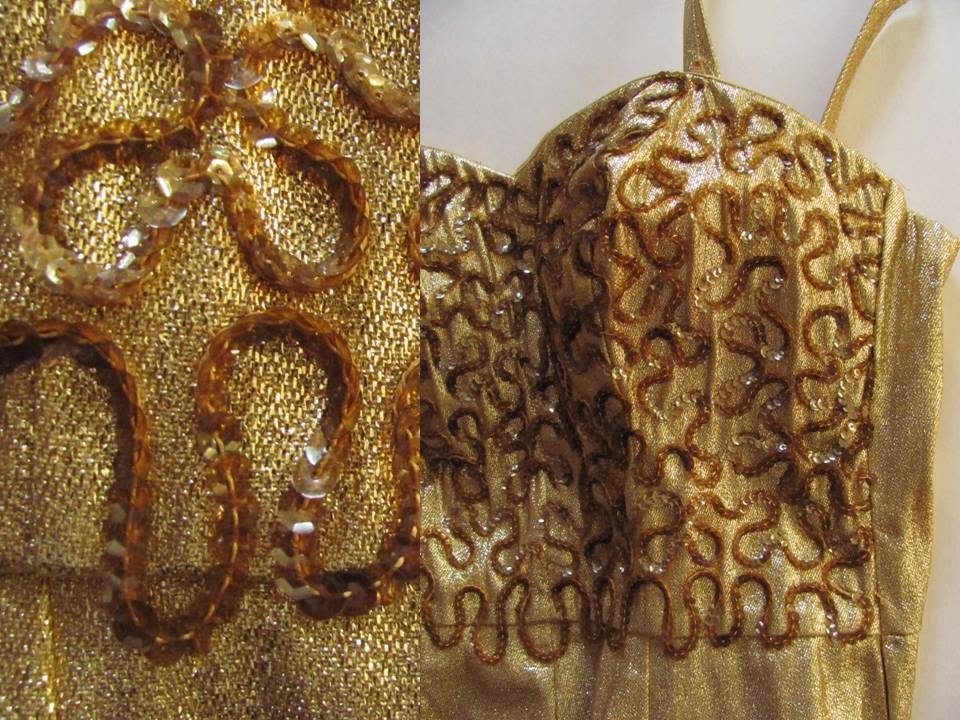
This super glam gold jumpsuit was made by "Ceeb of Miami", and probably dates from the late 1950's.
It was recently sold by my friend Holly at her "French Laundry Co." shop on Etsy. But before it left her shop, I was able to get to see it up close, and thought I would share what I found with you.
This bustier plus capri pant combo is made from a very stretch lame fabric. The lame fabric is stiff, yet flexible, with stretch in the cross-wise grain. The capri pants are simple, with traditional darting and slits at the ankles. It has a deep metal zipper with inside placket up the center back seamline.
The bustier is sewn with all-over sequin trim in a serpentine pattern. The bodice shaping is princess seamlines, with a back zipper.
The bustier is constructed with a full bra sewn into the top. There are small removeable stays at the sides of the built in bra to keep it 'up'.
There is a fold-over edge facing around the edges. This fold-over edge is backed with elastic to be sure it fits tightly. A wide nylon fabric fly backs the zipper opening to prevent any skin pinches. Buttons are sewn into the top edge of the bustier for removable straps.
The sequin design was applied after the bodice was sewn, using a chain stitch machine. It appears that the bodice front was sewn to the pant front across the waistline seam first. At this point the sequins were applied. After that the side seams were sewn.
The center back zipper is a strong metal type. This slide shows that zipper, both open to expose that fly fabric, and zipped up. A heavy snap secures the top edge.
Overall, this jumpsuit has a surprisingly simple pattern design and uses construction methods that are not difficult. The type of boning and lining that we often expect to see in a bustier is not present here. Perhaps this is because most women would be wearing their own strapless bra, often in a 'long line' design to the waist. This would then mean that the garment does not need to provide support or 'molded' bustline shaping.
The garment label lists this as a size 12 / 34.
Garment Measurements:
Bust: 34 inches
Waist 28 inches
Hips: 42 inches
Inseam crotch to hem: 25 inches
Underarm to waist: 8 inches
If you want to sew a glam jumpsuit like this for yourself, I think it would not be difficult. By working with a good pant pattern to start, a princess seamline bustier can be sewn to that around the waistline.
Pants: try Butterick B5895, a pant with 'high' waistline and back zipper (omit the pockets), or Vogue pant fitting pattern, V1003, a classic pant that has all the right darts.
Bustier: Butterick B5419, a long line bustier that can be altered to stop at the waistline. The bodice for McCalls M6646, is perfect.
On the Ceeb website they state that they have been in business since 1942 in southern Florida. Their main product is swimwear, I'm also interested in finding out more about jumpsuits of this type from the "Ceeb" label. Feel free to share what you know in the comment section.
Friday, January 10, 2014
Bonnie Cashin: Mohair Blanket Coat, Up Close
This 1960's Bonnie Cashin coat for Sills was found recently by Miss A who shared it with me in an excited text message. My respose: So when do I get to see it in person!. For me, coming across a Cashin coat in a vintage or thrift store is like finding a colorful sea shell on a wide sandy beach. Eureka!
This coat has that classic Cashin silhouette: kimono sleeves attached in one with the body. This allows that bold plaid check to continue out onto the sleeves without breaking up the graphic look.
But what stops the show here is a great, dramatic cape like collar. On closer study, it seems to have been inspired by a triangle shawl shape. Imagine folding a large square wool shawl into a triangle then draping it around your shoulders, over a coat. This has that same effect.
What pushes it over the top is that this shawl collar is cut from a wildly colored double cloth: fuzzy amber, orange and red colors on the outer mohair textured side with a blinding magenta pink and red on the other smooth surfaced side. That contrast is used to its advantage with this collar design since how its worn or draped can effect whether that contrast is seen or not.
Narrow suede trim binds off all edges. The coat is not lined, so that bright pink and red side is clearly seen when worn. Like so many Cashin wool coats, this one has roomy pockets in the side seams. It was designed with a very wide hook fastening at the neckline that at one time were covered in suede. The center front would hang loose and unfastened.
I will share the inner workings of this design and the technologies she used to create the look in my next post on this great coat.
If you are interested in seeing more designs from Bonnie Cashin, you will want to check out the links below:
Bonnie Cashin Online Resource, UCLA, Biography with Photo Archive
Bonnie Cashin, my Pinterest Board (a growing collection of images)
Subscribe to:
Posts (Atom)