Friday, August 26, 2011

Featuring a 1970's Dress, "Jerry Silverman" label


JERRY SILVERMAN by SAULINO

The designer label "Jerry Silverman" showcased wrap dresses during the 1970's that were trimmed with UltraSuede. This deep peacock blue matte jersey wrap dress has UltraSuede used in the yoke, at the hip, shoulders and collar. The drapey matte jersey is shown in a Halston-style bodice. This dress has a distinctive look that is higher in quality than most of the 1970 jerseys we see today.

Style details:
Ultra Suede
scluptured hip yoke with mock buckle
banded wrap front and collar
rounded shoulder yoke
rounded wrist cuffs with hook closure

matte jersey
gathers around the shoulder yoke
gathers around the hip yoke (skirt is nearly a half circle)
- dress is unlined, and is meant to have a draped bodice

About Jerry Silverman

It's interesting to note that Jerry Silverman began his career as a Harvard trained New York lawyer in 1933. He made a career switch to fashion in 1938, working for "Martini Designer" and becoming an owner before joining the military in WWII. After the war in 1946 he met his future business partner, Shannon Rodgers, a former Hollywood costume designer. Together they formed "Jerry Silverman" in 1959. Rodgers was the designer for this new venture of high end women's fashion. A dynamic team, they attended the couture shows in Paris to keep on up with current trends. Their dresses were popular with first ladies of the day, along with countless New York wives. The "Jerry Silverman" label was later bought by Warnaco, yet Silverman continued to be still involved. Silverman and Rodgers were active in promoting American design and supported fashion education, donating their huge historical fashion collection to Kent State.

Ultrasuede, early 1970’s

Probably the most important fashion textile development of the 1970’s was Ultrasuede, by Dr. Okamoto at Toray in 1970. This was the first mircrofiber, an ultra fine fiber that would continue in development as it produced softer fabrics. Ultrasuede was an expensive washable alternative to suede, and became popular in higher priced fashion during the decade of the 1970's. Designers such as Halston would make this a fashionable textile, using it in his shirt dresses and jackets.

Find more information on this designing duo HERE.

Find this lovely dress HERE.


Sunday, August 21, 2011

Asher Fabrics: Couture Fashion, 1958


Ascher, London has posted five couture fashion portfolios from 1958. These scrapbooks with photos showcase designs using the original textiles by Zika Ascher, including mohair fabrics that Ascher was developing. It is wonderful to look through each collection. They captures the couture look from that year so well.

Also on this site is a gorgeous gallery of Ascher Scarves from the mid-1940's that were designed by known artists of the day.

Ascher Fabric Couture Collections, 1958

Haute Couture, Paris: Spring and Winter
Cardin
Desses
Givenchy
Griffe
Heim
Lanvin-Castillo
Laroche
Matta
Riviere
Rouff

Haute Couture, London: Winter
Cavanagh
Cardin
Paterson
Riviere

Alta Moda, Florence: Spring and Winter
Antonelli
Baratta
Capucci
Carosa
De Luca
Fabiani
Simonetta

(a special thanks to BonBon Atelier for reminding me of this collection)

Friday, August 19, 2011

Vintage Simplicity Sewing Patterns: 1958

Vintage sewing patterns are a great resource to have. Whether I am trying to date a dress, or looking for new ideas, I just can get enough of them!

Mena Trott of Sew Weekly recently found a Simplicity 1958 pattern book. She has posted page after page on flickr for all of us to see. It's great fun to view these, and what's even better, the back views are there too. How often do we need to get those details and they aren't available? I think you'll enjoy this new resource, and if you're unfamiliar with Sew Weekly you may want to check that out too.

(the Simplicity pattern shown in this post is from my own collection)


Tuesday, August 16, 2011

Sewing Vintage Fashion: Vogue Patterns, April 1960


vintage vogue 9967
vintage vogue 9967
Vogue 9967. Blue eyelet, embroidered with dots, great full sleeves on fitted shirt waist dress

vintage vogue 9991
vintage vogue 9991
Vogue 9991. Floral border on cotton with matching stole wrap, sleeveless bodice with deep "V" back

vintage vogue 4104
vintage vogue 4104
Vogue 4101. Small kimono sleeve bodice with 3.5 yards wide gathered skirt in mauve ribbed cotton

These three vintage Vogue patterns are all sewn in cottons. They appear in "Ladies Home Journal", April 1960 (the Kim Novak cover is so sadly damaged I couldn't include a photo for you). It is interesting to note how easy the dresses would be to sew. The seam lines are classic, so that they might be duplicated today using patterns available.

The slides below show some current sewing patterns from Vogue, Butterick and McCall's that I found online. These could provide the basic garment to work from. Gathered skirts are not common in today's patterns, so that style would need to be improvised (easy stuff to do).


A kimono sleeve bodice is not common today, but there is one vintage styled pattern from Butterick that is similar. This pattern also has a "V" back (remove the bow). Small cap sleeves will also get the 'look'. When sewing a "V" back, that diagonal cut seam will need to be stabilized with twill tape, a strip of interfacing or elastic. That way it won't gap or fall off the shoulders.


The fitted top with deep "V" back on the blue floral dress is very simple. When cutting a "V" back neckline, be sure that the front neckline stays high enough to keep the shoulders in place. If the front is also low cut, the shoulders slip down easily. Dressmakers would add little snaps inside that neckline so the bra strap could be fastened to the shoulder, keeping it in place.

Basic fit patterns are great for classic bodices such as this one. For the vintage sewist, this type of pattern is essential to own. It can be used for many styles once a true fit has been made. All three pattern companies carry a version of this pattern.

An alternative to simple darts is the princess bodice. Those vertical seam lines make for a better fit on curvy bodices. I show a princess pattern for each style.


This full skirted shirt dress with puffed sleeves can be duplicated in two ways: as a dress or as a blouse with gathered skirt (an easier fit for most). Those great gathered sleeves are probably easier to locate in a 1980's pattern, since current sleeves have a slender upper arm. I found a few blouses that might make a fitted bodice, and two have fuller sleeves.


Wednesday, July 20, 2011

1930's: On the Beach

30s beach
On the beach in the early 1930's. Staying cool in style!

Wednesday, July 13, 2011

1950's Summer Pool and Play Set

1950s fashion

1950s play suit
When sewing vintage fashion styles, sometimes you have to copy an idea, rather than use a pattern. This Simplicity sewing pattern from the 1950's has a classic detachable skirt worn over a short playsuit. The wrapped bodice seems strongly influenced by Claire McCardell and other American designers who were creating styles with an Indian sari influence. The jumpsuit image shows how the edge of a sari could be used to create a dramatic diagonal on the one shoulder top.

For a sewing project, this outfit is worth taking a second look, especially for the wrapped neckline which can be made with or without the second shoulder panel. The easy to sew gathered skirt is accented by a detachable cummerbund. The skirt fastens in front and it acts as a cover-up for going indoors at the country club.


The back of the pattern shows how the pieces are cut. Even though this pattern is no longer available, it is possible to re-create the same look with a gathered skirt over a jumpsuit or shorts and halter top.


The original pattern seems to be Simplicity 7605, however with the torn edge I can't be sure. Currently Butterick 6582 has a similar wrapped bodice that could be used for the top and Vogue 1003 has a basic pant pattern that could be good place to start the shorts.

Tuesday, July 12, 2011

1930's Bridal Bias Cut Gowns

flapper bride

flapper weddingDuring the 1920's and 1930's, flapper brides had real style. Wedding looks broke away from the rigid silhouettes of the previous generation because these were modern girls with a new point of view. The first bride shown here dates from 1930 and wears a 'Juliet' inspired gown. It has an empire raised waistline with short puffed sleeves that have long fitted lace arms. This bias cut gown has a long fitted body with flared hemline in a silhouette will become very popular in the years that followed.

flapper brideVeils were a dominant look coming down the aisle. This bride is also from the early 1930's and shows that to be wrapped in a haze of netting can create an air of mystery we don't see often in current bridal looks today. Seen through the gauze, we can see her soft leg-o-mutton sleeves and draped cowl neckline. I bet there is a row of covered buttons down the back of this bodice. Her flared hemline is sewn to the fitted gown at about knee level, creating a long train behind her.

1930's bride The third bride dates from a bit later in the decade. Her dress is a classic bias cut, with a softly flowing wide flared hemline that the photographer will manipulate into a swirl of fabric at her feet. Again, the veil plays an important part in the overall silhouette of the bridal ensemble.

As you look at these, don't miss the men's attire. Wouldn't it be lovely if fathers, attendants and grooms once again wore morning coats to daytime weddings? The longer, tapered coat is so elegant, and it creates a wonderful look to the bridal party 'scene'.

Monday, June 27, 2011

1950's Dress by Anjac Fashions of California

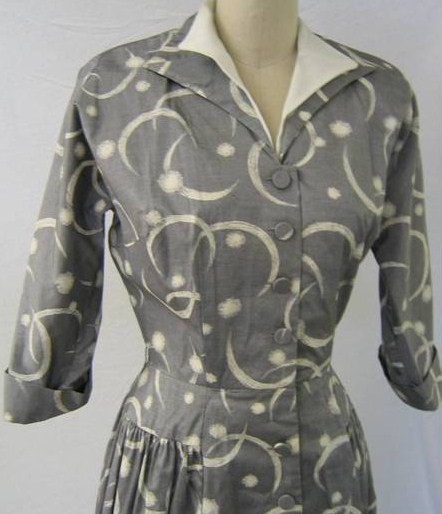
Anjac dressA 1950's day dress by Anjac of Los Angeles is a perfect example of a mid-decade look for adult women. The wing collar is doubled, with a white top collar to frame the face. Classic 3/4 length sleeves have turned back cuffs. The center front closure is dotted with self covered buttons from the "V" neckline to hem.

AQnjac DressA slender body silhouette is achieved by having the fitted torso with dropped waistline. This is a silhouette similar to what we see in Givenchy's designs for Audrey Hepburn ("Love in the Afternoon" and "Funny Face", 1957). By lowering a gathered skirt to the hip bone, the waistline doesn't look bulky and full.

The unique fabric pattern is screen printed in white on what seems to be an acetate textile with some shine in soft gray. The fabric texture enhances the dress design, creating emphasis for the skirt folds.

The dress's label is designed to promote California fashion. This marketing technique was popular among companies in the region who hoped to see their products displayed in "California boutiques" at department stores throughout the US.

Anjac labelThe dress label reads:
Anjac fashions
Made in California
Styled by Jack Needleman

ANJAC story

The Anjac label was designed in Los Angeles for over 30 years. The company was founded by Jack Needleman, who named his new apparel company by combining his name with his wife Annette’s. Needleman had moved to Los Angeles with his wife in 1943 from New York City. In New York he worked in the apparel industry as a jobber. Although Anjac was begun to produce dresses, his business focus would later center on more profitable real estate transactions in the Garment District. By the 1960’s this was to become the force of his business.

Anjac designer, Ilse Metchek, joined the company in 1967. She arrived from Catalina, having worked there designing sportswear. At Anjac her profitable styles financed Needleman’s property expansions in the garment district where he would build an empire that exists today and includes many important historical buildings in the area. He would pass away in 1999, the properties now managed by his family.

Needleman maintained the Anjac label until 1984, when he sold it to Metchek. Under her leadership the company was renamed “Ilse M. Inc”. Metchek designed for her label until 1990 when she gave it up to take a position as president at White Stag. Today Ilse Metchek is president of the California Fashion Association in Los Angeles, which she formed in 1994 to promote unity and compliance within the local apparel industry.

REFERENCES

Fit to a T: from modeling to management, Ilse Metchek taps into her decades in the apparel business to guide the California Fash, by Maya Meinert: Los Angeles Business Journal, March 23, 2009, http://www.entrepreneur.com/tradejournals/article/197105816_1.html

Jack Needleman, OBIT, by Myrna Oliver: Los Angeles Times: May 4, 1999, http://articles.latimes.com/1999/may/04/news/mn-33753

Orpheum Owner Steve Needleman Is Bringing Life Back to Broadway, by Jason Mandell: LA Downtown News: Sept. 24, 2004, http://www.ladowntownnews.com/articles/2004/09/27/news/news03.txt

Thursday, June 16, 2011

Book Review: Couture Sewing Techniques

Couture Sewing Techniques by Claire B. Shaeffer

How to sew with couture techniques is a hot topic right now, as is just about anything with a "Couture" label. But true couture, that specialized apparel design system that is the property of the French is a unique breed of fashion. Similar construction can be found in fashions from other locations, of course. But all must attain a level of excellence that is rarely found in apparel construction.

Claire B. Shaeffer is an historian of couture who lives and breathes this medium. She is a prime expert in the field, especially in the area of construction technologies. Her book in the subject "Couture Sewing Techniques" originally published in 1993, has been one of the top references for sewing couture fashions. This spring her edited version has become available.

This edition seems flawless in scope and detail so it's difficult to imagine what might have been 'left out' in content. Techniques are shown both in detailed lined drawings and with colored photos. The historical couture fashions are great to see, and bring a high level of authenticity to this work. The topic of couture sewing is covered so completely that the book should become a 'must have' reference for any fashion sewist.

Couture Sewing Techniques
by Claire B. Shaeffer


Pub. Date: May 2011
Publisher: Taunton Press, Incorporated
Format: Paperback , 240pp
List price: $24.95

ISBN-13: 9781600853357
ISBN: 1600853358


The Dressmaker's Handbook of Couture Sewing Techniques by Lynda Maynard

A second book with essentially the same title: "The Dressmaker's Handbook of Couture Sewing Techniques" falls short when compared with the Schaeffer edition. Perhaps the editor felt that putting "couture" in the title was necessary to sell books? Whatever the reason, the title is misleading.

The techniques in this book are shown in step-by-step format with full color photos, and there are runway photo accents. This is a very visual book that captures the excitement of couture fashion.

What this book contains is a variety of fashion sewing techniques. The flow and content order in this book seem out of alignment. It begins with methods for bindings and finishes (that include techniques for knits), it ends with "Essential couture techniques". "Making a muslin" is in the final two pages before the glossary begins.

How can we end a book on couture sewing with the most important part of any fashion sewing experience: the pattern and fit? And why are "essential couture techniques" the last chapter? I would also ask why a couture book includes knits. While knits are part of the current couture line-up, the techniques we are shown belong in a sportswear text, not this one.

Overall, this would be better if it had been marketed as a fashion sewing handbook, although even then it would need more instruction into the art of fitting and pattern selection. The author is known for her fitting techniques, so perhaps that is another book.

The Dressmaker's Handbook of Couture Sewing Techniques
by Lynda Maynard


Pub. Date: December 2010
Publisher: Interweave Press, LLC
Format: Paperback , 144pp
List price: $26.95

ISBN-13: 9781596682474
ISBN: 1596682477