

Showing posts with label California fashion history. Show all posts
Showing posts with label California fashion history. Show all posts
Friday, November 11, 2016
James Galanos: California Couture, Part I
James Galanos will be known, not only as a California designer for the stars and first lady, Nancy Reagan, but also as one of the few American couture designers. In light of Mr. Galanos recent passing, I am sharing this biography that was written as part of my graduate thesis. I have divided it into two parts, to make this post less lengthy.

Monday, May 18, 2015
Michael Novarese, 1970's Gown: New in the Shop

This gorgeous Michael Novarese gown from the 1970's has so many couture qualities that I thought I would share it here with you. On the hanger, it feels exquisite, so light weight yet built as only a high end gown can be.
Novarese started his design business in 1957, and by the mid-1960's he was showing his collections along with other California designers. Like this dress, his long "after five" gowns for special occasions as well as weddings were being designed in the early 1970s by him (Feb. 1972). He was also known for producing "bold dramatic prints" during that time (Spring 1976) in the same style as the textiles in this gown.
Michael Novarese was known in his day as a California couture designer, along with other California designers at that time: Helga, Charles Cooper, Georgia Bullock, Sebastian, Lucie Ann, Mr. Blackwell, Joanna Nelson, Lee Herman, Stanley Nelson and Helen Rose. He showed with the "California Fashion Creators" and participated in fashion shows on the east coast when few other California designers took the time to travel and present their collections.

This close up view shows the silk chiffon textile. It is a woven design of black chiffon with a gold lame plaid stripe. Over this the floral design has been printed, creating a fabric that is still soft, but glimmers when moving in the light.


I think that the low square neckline, bodice fit and sleeves of this dress are timeless in their simplicity and flattering silhouette. Novarese tended to design dresses for mature women, so he knew how to flatter their best assets.
The softly full skirt has an inverted box pleat at center front. While it lies flat when the wearer is standing, it allows for movement and sitting ease without adding visual or literal bulk around the hips.

The back view is clean, smooth and well fitted. There's nothing here to create a bad fit or unusual problem.

Of interest in the construction of this dress is the application of boning in the side seams. These would keep the bodice smooth and less likely to wrinkle. Bones also could help to keep the bodice in place and the sleeves from falling off of the shoulders.
The neckline is edged in a fine piping that visually give the gathered neckline a sharp edge. It's details like these that make this dress a wonderful example of California couture, designed for the Hollywood social scene or an evening wedding.
This gown has been listed for sale in my Pintuck Style shop. It comes from my long term teaching collection that has a focus on California designers. Because of this, I know it has been carefully stored and preserved, and is in 'like new' condition (as most high end gowns are).
I first found this dress because the high quality textile caught my attention. I can't remember how often it's the textile that makes me notice a dress first. The better the fabric, in general, the better the garment. In this case it was a dramatic find and a wonderful dress to study and document over the years.
More on Michael Novarese:
Obituary
Monday, October 6, 2014
Pat Premo: a California Fashion Desiger
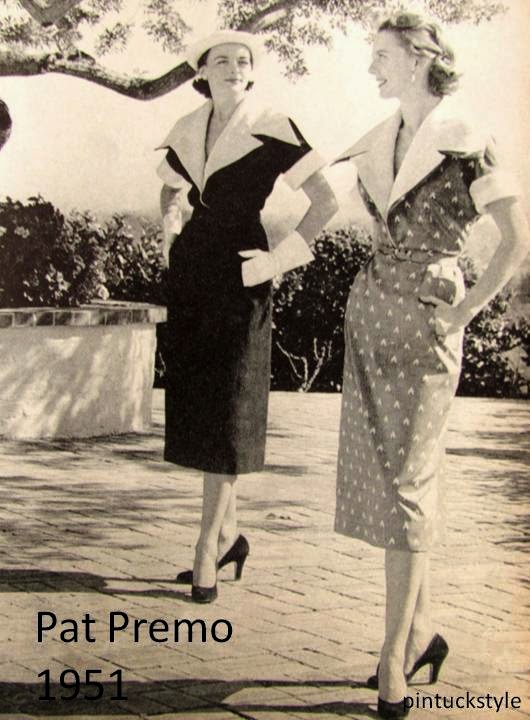
Pat Premo was a California designer who made her name during the 1940's and was strong through the 1960's, showing her unique style of using texture and pattern in her fashions, and looking for inspiration for her unique silhouettes in ethnic apparel
During the 1940's, California style was a direct selling point for fashions designed in Los Angeles, and sold nationally. These styles were distinct in the use of ethnic textiles, innovative textures and patterns in textiles, along with playful, easy to wear fashions for both indoor and outdoor living. Much of what the rest of the country saw were colorful fashions, perfect for resort and warm season wear, and Pat Premo was a successful designer of these styles.

Her playful short and skirt set is typical of the kind of styles that were being designed and manufactured in Los Angeles during the 1940's and 1950's.


.



In the 1960's, she continued to present unique styles made from distinctive textiles. Her fashions were sold in the best high end department styles and commanded top prices.

Today, finding a vintage Pat Premo label is a rare find to be treasured. This would be a fashion made from the best textiles available, and sewn to meet high quality standards.
Friday, September 21, 2012
Fern Violette: California Designer

This dress was designed by Fern Johnson Violette. She was born in 1920 in Montana, and grew up on a farm. At age 19, she married Ed Violette and had soon had a daughter. In her early 20’s they moved to Southern California to work in the aircraft factories during WWII.
After the war, Fern worked for a Los Angeles apparel manufacturer. While there she found that she was a natural for the fashion business. This inspired Fern to open her own company, under the “Fern Violette” label. She produced high-end women’s fashions from a location at 48 Market Street in Venice, California.

Later in her career, she hired Jay Morley, Jr. (1981 – 1997) to design for her. He is credited with his name on the label. Jay was the son of a well known actor from the early movie era and worked in the movie business as well. He had a prolific career from 1949 to 1957 as a low budget film costume designer, and is often given screen credit for his gowns. He was known to produce fashions that were more dramatic that Fern’s own earlier signature style.

Fern’s fashions are said to have been worn by Jackie Kennedy, among others. Her line was sold at Bloomingdale’s, Sak’s Fifth Ave, and the Los Angeles luxury store: Bullock’s Wilshire. She designed until the mid-1970’s when she retired with her husband and moved back to Montana where she lived until she passed away in 2010.

This "Fern Violette" design is a cotton two-piece dress, probably from the mid 1950's. It features a rolled collar with a "V" back.
Monday, July 20, 2009
Lilli Ann Suits from the 1940's: the early years
 The history of the Lilli Ann company is interesting to American fashion. It was important to the economic development of San Francisco, as well as a large producer of woman's suitings from the 1940's through the 1980's. The early years show design creativity and luxury in style. Knowing the general silhouette and costume type will help the vintage collector to identify age of their Lilli Ann. This post profiles the early years.
In 1934, an apparel company called "Lilli Ann" was originated by Adolph Schuman and named for his wife Lillian. Originally this apparel company was a typical sort of start-up operation, with two used sewing machines and two part-time employees working in a tiny studio in the Chinatown district of San Francisco. Throughout the life of the company, it would be identified with San Francisco, both in advertising and in its economic and political influence in that city.
These early ads from 1941 through 1944 show suits and coat outfits advertised as a "costume suit". Silver fox fur and other furs are often combined with wool fabric to create a sense of luxury.
The dark costume suit above from 1941 (pre-WWII) has wide sleeves with silver fox fur trim, and was priced at $55. The fit and flared princess silhouette was typical of Lilli Ann's very feminine look during that era. The second coat from 1943 has silver fox trim around the hemline. Paired with a fez style hat, this has a Russian influence to the overall ensemble. Again, the costume suit has a fit and flare 'A' silhouette made distinctive by a draped collar.
 In this second set of illustrations, coat and suit ensembles are shown. Both coats have a button pleated revere lapel (both are essentially the same coat), although the light coat is from March 1943, and the darker set is wool from Spring 1944.
The suits worn beneath the top coats are form fitting, with sculptural seam lines. The light suit has a classic princess pattern draft that "V" points into the waistline button for a very slender illusion. The second suit has "V" details on each side of the waistline. The front is closed with 3 buttons that match those on the coat. It is also fun to notice how the original suit was accessorized with hat and gloves.
At upper right corner is a view of the "Lilli Ann" garment label used during that time.

Both outfits shown above are from 1943. More fox is seen, this time as a large collar that is a style carry-over from the 1930's. On the other suit, leopard fur is used on lapels, buttons and toque hat. These details create visual interest in what are classic suit patterns. It is important to notice that a 6 gore straight skirt is shown with all suits during this era. The first skirt from 1941 was 'A' line in silhouette.
All through the war years, luxury was seen in Lilli Ann suits and coats. Excess use of textiles was controlled, as required, but luxury was available none the less. After WWII, Adolph Schuman would move to put his San Francisco suit company on the map with increased national advertising in "Vogue" magazine, along with some innovative political involvements. This began an important era for Lilli Ann company.

This advertisement shows the makers label used by Lilli Ann company through 1943 (important to notice that it does not list "Lilli Ann" name in that label). It does show "a California Costume" at a time when this from of regionalism was popular.
Subscribe to:
Posts (Atom)