Showing posts with label California fashion designer. Show all posts

Monday, May 22, 2017

Gilbert Adrian: 1950's Suits by California Designer


This 1950's newspaper advertisement for suits is a great showcase for fashion designer Gilbert Adrian.  This regional ad appeared in 1951 while he was at the very height of his career as a fashion designer with a salon that catered to Hollywood's young and fabulous. The fashion illustration is drawn to capture all of the style details that Adrian was famous for, in a layout that uses two suits in different scale, thus calling attention to the larger image. As was common at the time, the artist is not credited.

Friday, May 22, 2015

Michael Novarese: California Fashion Designer

Michael Novarese, California fashion designer biography


When I wrote a recent blog article about a Novarese dress from the 1970's I was discouraged by the lack of information on this talented fashion designer from California, so I dug deeper to find that he was well celebrated by the press during his time. What I write here is based on many regional and national newspaper articles on Michael Novarese made through out his career, and his obituary published online.

Michael Novarese stated that he always knew he would design women’s fashion. His love was for elegant, well designed fashion, and that is what he planned to create.

Of Italian descent, he was born in 1926, in Memphis, Tenn. At an early age his family would move back to Italy where he spent his early childhood, returning to Memphis as a youth and completing high school there. This was followed by serving in WWII and being stationed in Europe. After the war he returned to Memphis for a short time, but moved finally to Los Angeles where he studied fashion at Woodbury College. This was located in downtown Los Angeles at that time. It had a small but strong program in apparel design, graduating other fashion designers of note such as William Travilla.

In his early career, he worked as a blouse designer. This would evolve to designing evening cocktail dresses in a custom dress making business. By 1957 he was able to open his own label with eight dress designs. These were made from silk crepe, a classic textile with a matte finish and a slight stretch that he used often throughout his carer. He was able to sell these first designs to Saks Fifth Avenue.

Early on, Novarese had made the decision to create only high end fashion constructed with quality textiles and sewing techniques. He would focus on a customer who was often professional, working in high paid careers such as advertising and public relations. They wanted his quality designs as part of their stature both at work and at home. In 1981 he would estimate that 70% of his customers were professional women. “My clothes fit as investments because they have a very secure look about them” and could be worn for several seasons to validate that investment.

As a young designer in his thirties, he was seen as slim, small and brown eyed by one reviewer in 1962. His southern drawl was an asset, along with his vibrant and engaging personality. By this time he had been in business for only five years, yet he was being interviewed in New York by regional fashion journalists for local papers. That year he also presented his collection in his hometown of Memphis, which was an honor for him.

Novarese evening designs were known for being subtle, elegant and finely made. He was able to do this while still incorporating texture through beading, lace and fullness. Often this was emphasized in the sleeves, an area that he was well known for embellishing or making dramatic statements. When asked about this infusion of renaissance style he would reply “After all, I am of Italian extraction”. His early childhood in Italy played a part in creating his elegant signature styles.

He worked with professionals at the top of the field. His beading woman, Mae Murry in Los Angeles, was known for her work in movies as well. She created the wonderful textures his evening gowns were known for. “She’s the greatest in the business” was his comment about her. His work also emphasized pristine dress making. “I always believed that a customer is entitled to a complete product in that the inside should look as good as the outside.” To do this he “set a guideline in regard to the way clothes should be made”.

Because his designs required couture level sewing and expensive high quality textiles and trims, his fashions were known for being expensive. In the 1970s, his dresses were bringing in $1,000 each. He recounts a story of one new customer who loved his prints so much that she ordered the same dress in five prints, spending over $12,000 to do this. In the late 1980’s he would state the “competition in our price bracket is fierce, and we have to ensure every faculty we possess to maintain a position in the marketplace”

In 1974, his customers would spend between $400 to $2,500 on a dress. Early on, established actresses such as Bette Davis and Ann Baxter were clients. Other actress customers during his career included Jane Russell, Liza Minelli, Judy Garland, and Dinah Shore. His gowns were also worn in the 80’s by the Reagan era wives in Washington D.C. He describes his client as “a lady who understands quality fabrics, quality workmanship and designs that are not limited to that particular period”.

This made for a conservative sense of style. During an economic down-swing, he would comment that “you don’t play around with design when the economic situation is not secure. You deviate when a lot of money is around. Customers want clothes that won’t go out of style and they’ll wear what they buy from two to five seasons.” The point of view was that his fashion should be classic, (my) “clothes are not fad-oriented, gimmicky or eye-distracting. They are clothes that will take you from year to year and still look correct”.

He maintained that to stay in business he had to emphasize his unique style, the quality of the garment, and the fine dressmaking skills that created it. He would be most popular in Los Angeles, Chicago and Houston, while also traveling to present his collections in trunk show throughout the US and in New York City.

When asked why he didn’t create another line at more affordable prices he responded that “I had no intention of dressing mass America. I left that to someone else”. And “I do not design sport clothes or swimsuits. My clothes are day-through-afternoon dresses and cocktail, evening, debutante and wedding dresses”. Part of this was due to his dress making standards where he wound never “vacillate from a set method in regard to making clothes. It’s just as easy to make it correctly and well”. These designs would be worn by the customer “who understands quality fabrics, quality workmanship and designs that are not limited to that particular period” in time.

In Los Angeles, Novarese was part of a well known group of designers called the “California Fashion Creators”. They promoted their own regional apparel at a national level. He was also one of a select few California designers whose collections were considered couture along with Charles Cooper, Lee Herman, Stanley Nelson, and Wiliam Travilla. They often presented their collections together in New York during fashion week. In 1965 they produced a fashion show at the Plaza Hotel, hoping to snag buyers and the press on Sunday with their unusual concept of fashion and buffet.

Novarese retired from his business in 1992 at about 66 years old. His final business location was in West Hollywood on Holloway Drive, a convenient location to both Hollywood and Los Angeles. His retirement was honored and celebrated by his clients who staged a special invitation dinner with a gallery display at a local design college, each invitee was encouraged to wear her best Novarese to this event. That final year he had worked about 35 years under his own label. In retirement he lived in both Palm Desert and Los Angeles. Novarese was well known for his volunteer work in the community and his philanthropic works through the Catholic church. His partner of 36 years, Robert Nelson is still living in southern California.

In one of the last statements Novarese made about his designs, he said “Strangely enough, my clothes are not, and never have been designed with California in mind. They have an international flavor that can be worn in any spot in the country, as well as in Europe.” Having lived his life both in the US and Europe he would know best about that.


Resources:
While there isn’t a book or chapter written on Novarese, his life and designs were documented by the many female fashion journalists who worked for the syndicated national press and smaller local newspapers during his career:

Barbara Cloud, 1965, 1966, 1981: Pittsburgh Press, Pittsburgh Post-Gazette
Peggy Gandy, 1987: the Oklahoman
Doris Klein, 1964: syndicated
Mary Lou Loper, 1992: syndicated
Jean Miller, 1974: St. Petersburg Times
Aileen Ryan, 1962: Milwaukee Journal
Mary Jan Spencer, 1965: Blade News
Joan Sweeney, 1968: syndicated
Violet Webber, 1970: Toronto Blade

Monday, November 3, 2014

Georgia Bullock: a California Fashion Designer


Georgia Bullock was a California fashion designer. She was born in the small town of Whittier, Ca. in 1918 and raised in southern California. In the mid-1930’s, while in college at USC, she worked as a floor model and sales associate at a major department store in Los Angeles. After graduating, she was hired by Bullock’s Wilshire, followed by a milliner and later an established fashion designer. Knowing that she wanted to pursue fashion design, she studied at Frank Wiggins Trade School in Los Angeles. During this time both her work experience with customers along with her technical training prepared her for a career in fashion.


About 1941, with an idea for a basic black dress and $50 in cash, she and her partner Dorothy Phillips started a dress company with this one design. This new company would give her additional experience with buying trips to New York and selling wholesale. This small business lasted two years, so that by 1943, at 25 years old, she was in business for herself. She did most of the work herself in her little factory to start, but by 1945 she was quoted in national newspapers as a California fashion designer and selling her designs nationally. Her business would grow, moving to several factory locations in Los Angeles as her needs progressed. This suit was advertised in the mid-1940's.

“In my own designing, I try constantly to stress fit and flattering lines, rather than the specious and merely startling. I want to give the ready-to-wear customer the opportunity to buy good lines in the same sort of basic costumes (as custom made fashions).

“Now that the designers, newly freed of wartime stringencies, can create radically different styles in great variety, women have an ideal opportunity to choose the unhackeyed, to insist upon buying, not what is the rage but what is exactly right for them.

“California has a background and atmosphere which promotes a new, fresh feeling in our styles” she says. “American women are so different from European women, in shape and posture, and way of life. We, in California, are, I think, particularly well equipped to interpret much that is typically American”. Her philosophy would shape the kind of fashions she designed, always keeping in mind her customer’s figure and lifestyle, working to create designs that would flatter them.

She was married with a baby by 1948, but continued to design. In the early 1950’s she had her own manufacturing plant in Hollywood. In addition, Georgia took a design position with the well known label “Nellie Don” in 1953, located in Kansas City, the largest manufacturer of women’s clothing. It appears that she was able to work from Los Angeles for this venture while still working on her own line.


The “Georgia Bullock” label would symbolize the effortless style of the well-to-do woman who could afford the best in design, fabrics and fit. During this time her style tended toward suave and sophisticated. During the early 1950’s she widened her line to include sportswear with a elegant sense of style. Catering to the country club crowd, she presented her fashion shows on her own tennis courts at her home in Holmby Estates. These fashions were carried by the high end department stores, such as Saks, I. Magnin’s, and Bullock’s Wilshire.


In 1958 her fashions were worn on the Danny Thomas television show “Make Room for Daddy”. This symbolized her connection to the entertainment industry and to her ability to self promote as well.

Her career continued to grow, with clients nationally. By the early 1960’s, she was living in Malibu, creating fashions for the California beach, country club and resort lifestyle.

In an important move, in 1963 she launched her “Miss Georgia” line. These designs were less expensive with price points around $50 (her “Georgia Bullock” label sold for twice that). They were more fitted, showing clean lines, long sleeves or capped sleeves, while her own label was more complex and fashion forward.

Career Highlights:

1961: Bright cotton prints were shown for patio, poolside and at home dresses were seen to knee or ankle length with hem flounce. Georgia kept artist smocks in her lines for at-home wear, often in gay prints. Wraparound dresses, jackets in printed cottons, pants and long slim dresses with adjustable belts were also popular.

Mid-1960’s “Barefoot styles”: she described her at-home fashions as something that should be worn barefoot, much like her own beach lifestyle. It included artist smocks, eyelet pants, and hostess dresses for the bare foot.

1964: Her high end line showed the“costume look” with a jacket or coat and dress in slim sheaths, princess lines, pleated styles, lowered waistlines. Overblouse silhouettes and longer jackets to hide hips were part of her figure flattering strategy.

In 1966 she would receive the Designer of the Year award for her work. Georgia’s final years as a designer were in the 1970’s. At that time she continued to show her lines at her home, then in Palm Springs or at the beach town of Carlsbad.

Georgia Bullock was considered a couture designer for the designs under her own label, never sacrificing quality fabrics and styling or catering to fads. She continued to live in southern California until her passing in 1991. During her career, her name was well known nationally and she had full page magazine advertisements. Overall, she will be known for her classics: designed with a good fit and in fine fabrics. Georgia’s designs were was popular for her blazers and jackets, sheath dresses and ensembles, but also the colorful casual lines, designed for her own California lifestyle.


Monday, October 6, 2014

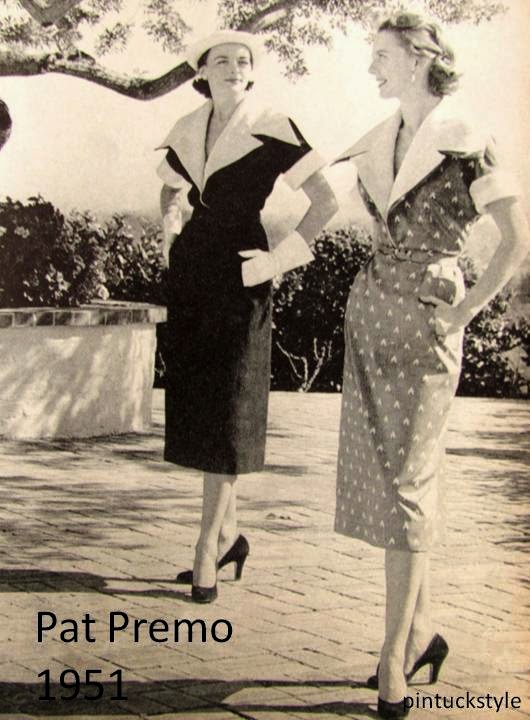
Pat Premo: a California Fashion Desiger


Pat Premo was a California designer who made her name during the 1940's and was strong through the 1960's, showing her unique style of using texture and pattern in her fashions, and looking for inspiration for her unique silhouettes in ethnic apparel

During the 1940's, California style was a direct selling point for fashions designed in Los Angeles, and sold nationally. These styles were distinct in the use of ethnic textiles, innovative textures and patterns in textiles, along with playful, easy to wear fashions for both indoor and outdoor living. Much of what the rest of the country saw were colorful fashions, perfect for resort and warm season wear, and Pat Premo was a successful designer of these styles.


Her playful short and skirt set is typical of the kind of styles that were being designed and manufactured in Los Angeles during the 1940's and 1950's.


These sundresses were called "sun back" dresses for their open back, usually sold with a bolero coverup.

.

She included day wear as well, styles suitable for lunch, work or daytime activities by an active woman.


In the 1960's, she continued to present unique styles made from distinctive textiles. Her fashions were sold in the best high end department styles and commanded top prices.


Today, finding a vintage Pat Premo label is a rare find to be treasured. This would be a fashion made from the best textiles available, and sewn to meet high quality standards.

Wednesday, February 8, 2012

Rudi Gernreich California Fashion Designer: early 1960s fashion designs

Rudi Gernreich sportswear, early 1960s


early 1960s dress, Rudi
Early on, California fashion designer Rudi Gernreich was associated with the young fashion innovators. In these early 1960's designs, his look was clean cut, easy to wear and popped with bright contrast or graphics. The silhouettes forecast the shirt or "A" line shapes that would be widely worn later in the 1960s

These styles show that even common fabrics such as table cloth checks found new fashion meaning under his genius. Although he was working with wovens, during this time many of his designs were wool double knits for Harmon Knitwear.

Prices were above average, with the little striped Harmon Knitwear sailor dress and jacket selling for $65.