Thursday, October 31, 2013
Vintage Halloween: Pumpkin Circle Skirt
Have a great Halloween! Hope your holiday circle skirt collection has something as fun as this for you to wear today.
Wednesday, October 30, 2013
Vintage Dress: 1960s Mod Party Outfit
This is a fun vintage fashion look from the 1960's. A Mod silk dress in autumn colors is perfect for parties. Right about now most of us have quite a few events in our schedule, and maybe one or two should include some sort of great outfit like this.
This mid-1960s (based on the longer length) dress is couture quality. With an "I. Magnin" label to validate this quality, it is of the lightest silk chiffon, edged in hand beaded collar and cuffs. This longer length can easily be taken up to a shorter hem, but I am listing it in that original length. It could also be belted, since it is a classic 'shift' silhouette.
Here is a close-up detail of this wonderful fabric and delicate beading around the neckline. You can see more of this MOD DRESS HERE
Tuesday, October 29, 2013
Edith Head: "Sabrina" & "Penelope" gowns
The Google banner for Edith Head has inspired me to repost this article from a few years back on her design for "Sabrina" in 1954. I am adding a great illustration for Natalie Wood's role in "Penelope" from 1966 as well.
Edith Head illustration for Audrey Hepburn as "Sabrina"

This look is so classic and as perfect for this New Year's as it was in the 1950's. You can whip up your own version with a 1950's vintage sewing pattern such as Simplicity 3002. Current retro style patterns Vogue #8874 or #8789 when sewn up in black also have this vintage look with its horizontal neckline. Wouldn't that be fun!
For the Natalie Wood film "Penelope", in 1966 Edith designed a dramatic wedding gown with a "hi-lo" hemline that is alot like what we are seeing so much of in gowns right now. This was to have had a very Mod look to it, with an "A" line open lattice cage shape over a little shift dress.
Friday, October 25, 2013
Vintage Dress: 1950s Outfit for Fall
This vintage dress in fall colors is a perfect transition outfit into cooler weather. Add a toasty cardi to it when things grow colder. From the 1950s or very early 60s (based on the longer skirt length), this classic 'Mad Men' era sheath dress seems to be custom made, complete with fine piping around the neckline, waistline and sleeves.
I also wanted to share how great the fabric design from this dress is. It has a neat mid-century modern air to it, with the geometric color patches and cross-hatch overlay.
1950s DRESS can be found HERE.
Thursday, October 24, 2013
Rene Bouche: Fashion Illustration from 1956
It's time to be thinking ahead about the holidays, so I am posting this fashion illustration as a reminder to all of us: plan ahead!
This terrific 50s fashion illustration is by Rene(RR) Bouche and it certainly gets one in the mood for holiday elegance and sophistication. For me, while I personally won't try to re-capture this look, a rich red pashmina might be just the thing to add to my wardrobe this year.
Here's the full 1956 illustration, so you can see the rest of this page:
Tuesday, October 8, 2013
Coco - Inside CHANEL Video
Quite busy of late, but here's something wonderful to catch your eye until I can get back to my blog!
Saturday, September 14, 2013
McCalls 7126: 1961 Sewing Pattern for Research & Inspiration
Dated 1961, this home sewing pattern by McCalls 7126 is a great example of sportswear in the early 1960s. This look was a bridge between 1950's silhouettes where an hourglass figure was important, to the loose "A" line and 'hip hugger' silhouette of the later 1960's.
There was a strong Asian design influence through out the 50's. Starting during the WWII era, this trend was influenced in part by American fashion designers Claire McCardell, Rudi Gernreich, Bonnie Cashin and others. Their work often shows very simple tunic styles over a slender trouser, as this sport set from 1961 shows. The feature here is a very flat tunic top design with classic front slit down to a 'yoke' seam line across the upper bust line. Hinting of a smock or peasant top, this was a popular look for both resort and sports wear.
Of additional interest are the fabric colors: blue and green. This combination was growing in popularity during this time influenced by bright tropical and Asian color schemes. Often these were seen in strong graphic and abstract floral patterns such as those from the popular Scandinavian design house Marimekko. A flat tunic top was the perfect shape to showcase these colorful and graphic textiles.
The schematic drafts of this ensemble show clearly how the back views appeared and how the patterns were designed. It is interesting to see that what appears to be a casual dress made by belting a longer version of the tunic, is actually a fitted skirt with the bulky tunic tucked into the waistline.
The bodice of the tunic is artfully fitted with a dart shaping that has been integrated into the horizontal mock yoke seam line. This would reduce extra underarm bulk and help the side seam to hang neatly.
This pattern design has potential today made up in solid linens, larger scale prints and graphics. The clean lines and simple shaping are perfect for our current silhouette trends, worn with slender pants or leggings.
Wednesday, September 11, 2013
Vintage Bridal Gowns: on view at the Pasadena Historical Museum
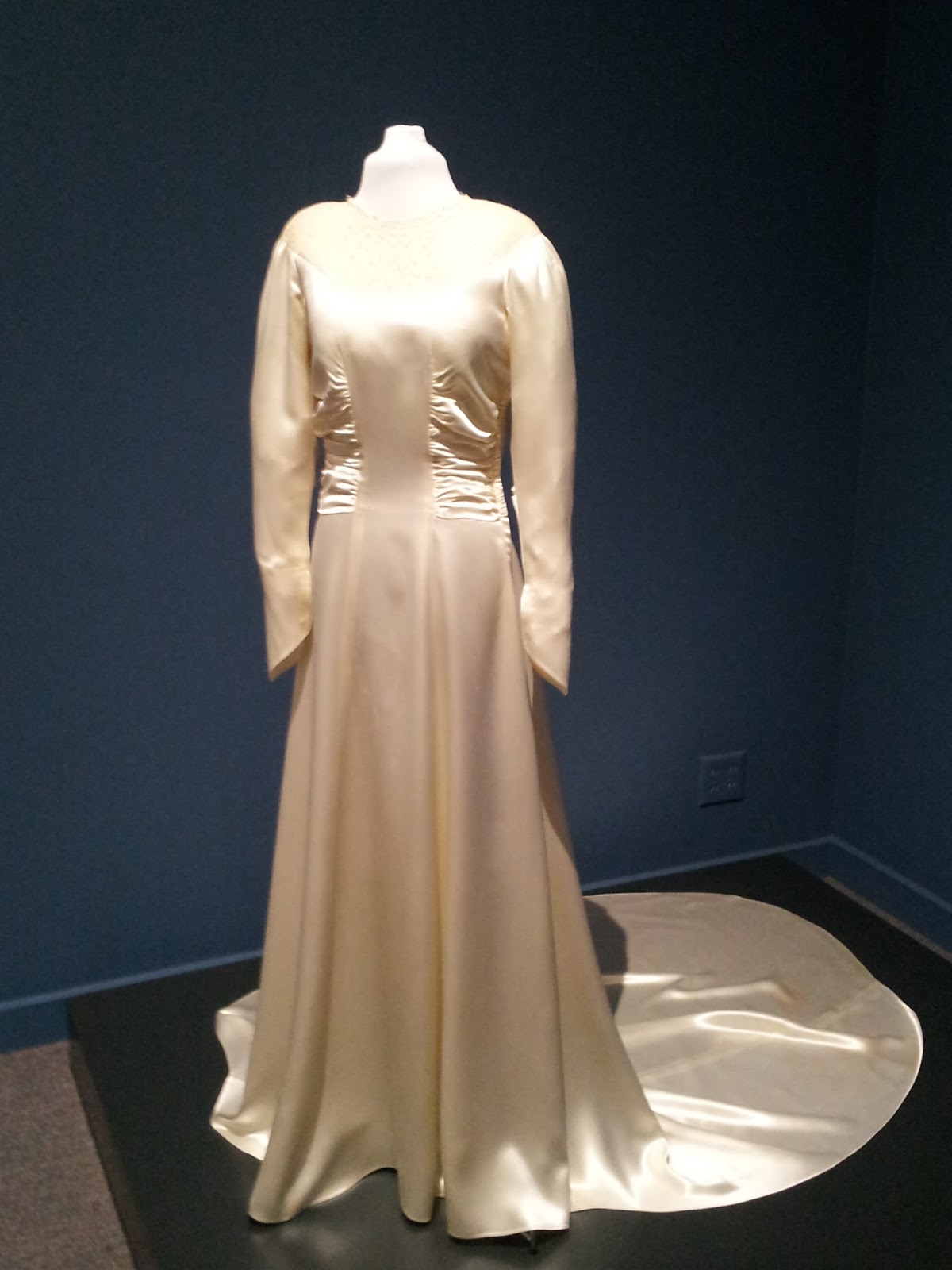
This lovely satin bridal gown opens an exhibition of wedding dresses currently on display at the Pasadena Historical Museum. Carefully edited, this collection of gowns shows bridal designs from the WWII era through current styles as worn by brides from Pasadena.
This first gown shown was designed and sewn in 1944 by Seamstress Auntie Nui of slipper satin. It was worn by Chiyoi Marumoto Ogawa, one of the young women who were married in the WWII Japanese concentration camps here in California. This dressmaker went on to provide many more gowns for the brides in this camp, as well as in Pasadena after the war. Typical of all gowns during the war tie, it is a simple dress with long sleeves and flattering shirred bodice that was typical of the draping worn during that era.
The post war years saw an explosion in marriages as the GIs returned home again. While the expense of a wedding gown was often beyond the budget of many young couples, wedding gowns grew in importance. Often one gown would be shared by many brides. From 1948, this gown by bridal designer William Cahill of Beverly Hills shows what the best in wedding gowns looked like. Of shiny slipper satin, the neckline is framed in a lace bertha collar. Like most gowns of this time, it has modest long sleeves suitable for wearing in church. This dress was worn by bride Jane Campbell Wells of Pasadena.
Of special local interest, this gown was the first bridal ensemble sold at Bullock's, Pasadena when it opened in 1948. Later this high end chain of department stores would be sold. Now the original building is owned by Macy's, who recently rehabilitated the architecturally significant building.
This curvy 1952 Cahill gown of nylon lace and tulle was paired with a small, fitted lace skull cap that had a veil attached. It has many features similar to crinoline gowns of the mid-1800's. The silhouette has a dramatic shirred "V" neckline and the classic "New Look" hourglass full skirt. The ensemble was worn by bride Marilyn Hubbard Roberts.
In 1955, the Governor of California's daughter Carolyn Knight Weedman wore this William Cahill gown for her wedding in the governor's mansion, Sacramento. It shows alencon lace, satin, and silk chiffon. The lace bodice with Elizabethan collar is fitted, with long sleeves and an hourglass silhouette that has a dropped waistline with a slight curve in front. To create the ballerina length skirt (which Cahill was famous for designing), there were four layers of fabric: silk chiffon with decorative stitching (top layer), nylon netting nylon bobbin net, and ribbed acetate (slip layer).
From 1958, this dramatic debutant dress with draped skirt and textured bodice by Cahill shows how far formal gowns evolved in just a few years. The gown of silk taffeta has a draped bubble skirt with train in back. The bodice is textured with layers of fabric flower petals and dips low in the back. It was worn by Janet Curci who wore a silk and tulle, beaded gown for her wedding later in 1962.
This exhibition of wedding gowns is displayed in the galleries of the Pasadena Historical Museum. The show also includes gowns from the 1960s to present day. The museum itself is worth a visit, as it is on the grounds of a large mansion located on the famous Orange Grove section of old Pasadena. This exhibit is on view through November 3, 2013.
Monday, September 9, 2013
Fall Fashion, 1949: Claire McCardell does Tartan Plaids
Taking a look back to the fall of 1949, fashion of the late 1940s was showing dramatic and inventive silhouettes that followed Dior's New Look. American designers such as Claire McCardell would see a huge rise in their fashion star as the post war economies allowed for greater experimentation and design creativity than had been possible during the war years.
Back to school fall fashions have always included plaids in the mix. Warm wool plaids would appear in the fall magazine issues that hit newstands during the hottest weeks of late summer, providing the reader with an exciting change from hot weather wear.
While the classic, preppy kilt and other plaid skirts seemed to dominate, there have always been those who explore plaids just a bit further. Case in point: Claire McCardell's knife pleated plaid dress on the left with push up sleeves and a dramatic shawl collar (Miron worsted wool, $59.95 at Lord & Taylor). On the right is a dress designed by Dorothy Cox. Her design shows a traditional plaid made up as a wonderful cape collar over a circular skirt ($55 at Henri Bendel). Both are from the fall of 1949, when skirts were wide, hems longer, and gorgeous textiles were becoming more plentiful. These would be the seed of style for the next decade to come, the 1950s fashion silhouette.
Subscribe to:
Posts (Atom)


.2.jpg)

.5.jpg)
.jpg)