Saturday, May 28, 2011

Vintage Dress: late 1930's to early 1940's


Dating vintage dresses can be fun, with so many clues to find hidden in the dress. The vintage dress shown here dates from the late 1930's through early 1940's. It is of black crepe, cut with a skirt that has 10 gores sewn to the hip yoke. This fanciful design was lost when WWII rations controlled skirt yardage. In addition, it has 2 metal zippers by Talon: one at the back neckline, and the other in the left side seam. These are typical locations for zippers during that era. The metal zippers would become unavailable during the war years, so we can assume this dress was made prior to 1942.

The photos below give some close-up views showing the details of both bodice and skirt. These details can help when trying to create reproductions. They also provide inspiration when designing modern fashions with a hint of vintage.


The bodice bows are set on very small pockets where the yoke meets the crepe bodice. The striped yoke and sleeves are made from 1/4" wide strips of the crepe fabric, sewn to a sheer black backing.


The skirt has 3 gores in back and 7 in front. The hip yoke is cut in one with the center gore, creating a "T" shaped panel. The length is original to the dress, with an inch deep hem. There are signs of belt loops at each side seam.

Bodice shirring in 5 rows creates gathers at the waistline. These provide the fit without darts because the entire bodice is cut on the bias.


Measurements:
bustline = 42" around
waistline = 33" around
hipline = 40" around
bodice length = 17" from shoulder, over bust to waistline
skirt length = 27" from waistline to hem at side seam
sleeve length = 5" at side seam
sleeve width = 12" around at cuff
hem line circumference = 84" around

Available at PintuckStyle on Etsy

Sewing Retro Sun Dresses: 1930s and 1940s Vintage Styles

retro sewing

It is easy to sew a retro style sun dress. Vintage styles are sometimes hidden in modern patterns. Using contemporary commercial patterns has a few advantages: availability, fit, cost. For anyone who loves the 1930's and 1940's look, true vintage from that era can be fragile, valuable and difficult to fit. With some cute reproduction cotton prints, it's now possible to re-create similar styles to those sewn up and worn during the 30's and 40's.

These sundress patterns have a 40's vibe, with the simple cut and soft skirt. At first glance, these may seem to be alot like dresses from the 1950's. Probably the biggest difference between 1940's and 1950's sundress patterns are the softer skirts and shorter lengths in the 40's. The knee length skirts look better with the wedgie sandals worn then.

In revising these current patterns it's possible to get a cute retro look. The first style is ready to go, just shorten it to knee length. The center view could be made more retro looking with a simple white collar or adding bow where the little 'V' notch is in front. The third view has a 1930's vibe, with the higher waistline and flared skirt. By choosing a hem length appropriate to the time, you will have a sweet sun dress so like the ones you see in vintage movies.

Fabric selection is a breeze with the great reproduction cotton prints for sale. Although produced for quilts, these fabrics are very similar to the affordable cottons women used in that earlier era. Quilting cottons are also a great fabric for new sewists because they don't slip, stretch or act funny. Pre-wash any cotton fabric a few times to be sure it has shrunk before you cut out your pattern.

Trims such as contrast bias tape, bigger sized buttons and patch pockets are design features that can be added to really make these simple dresses unique and very retro. Try these trims and you will notice how vintage your dress can look.


RETRO STYLE SEWING PATTERNS
Sun Dresses:
Simplicity 2174 - Princess seamline dress with pockets
Simplicity 3827 - Raised waistline with 'V' neckline
Vogue 8725 - Sweetheart neckline with halter neck tie

NAUVOO QUILT COMPANY
Nearly all of these vintage style cotton prints are from WINDHAM FABRICS 1930's and 1940's collection of cottons.

Tuesday, May 24, 2011

1930's Vintage Fashion: Turn Around to See the Back View

1930 dress
1930's dress
1930's fashion
1930 vintage fashion

Fashion during the 1930's was cut with diagonal bias seams to be smooth and slinky. The back view of a dress was often its best feature. These illustrations are from an old scrap book of mine, so I can't give you the exact dates, however most are from the early half of this decade. These fashion illustrations are just a peek into the wide range of back views seen during that time.

If you are dating a vintage dress that seems to be from this era, check out the back, that may help determine what decade it is from even more than the front view. And if you are going to sew for summer, why not consider adding some back interest to your project, that could make it something special.

Sunday, May 15, 2011

Helen Rose

Helen Rose
Helen Rose has been in the news lately, with her stunning wedding gown for Princess Grace being so influential. Helen Rose was known for her softly feminine designs, and this is one that captivates her style. It is a weightless silk chiffon made with impeccable workmanship. The very modest bodice and sleeves are given drama with a swirling, soft pleated skirt. The design accent is a wrapped chiffon sash in scarlet, brown, and the self beige color. It's genius for the subtle red 'pop' toned down with the chocolate. Who would think of that color combination today? Yet it works perfectly.

Label:"Robinson's, California", a Southern California department store.

Saturday, May 14, 2011

Sewing Retro: Vintage Shirt and Blouses

sewing retro
Wearing true vintage fashion can be difficult. Sometimes they just seem too costumey, and not casual enough for real life. Fit and availability are other issues. These problems can be solved nicely by sewing your own vintage looks. But this project can present another problem: where to find vintage styled patterns and fabric?
A good place to start are casual shirts with a 1950's or early 60's design style sewn up in fabrics that seem very vintage in look. Shirts and blouses fit easily into our modern lives, while capturing the essence of vintage fashion. They are also some of the easiest fashion sewing projects, and can be a great way to start sewing for yourself.

retro fabric
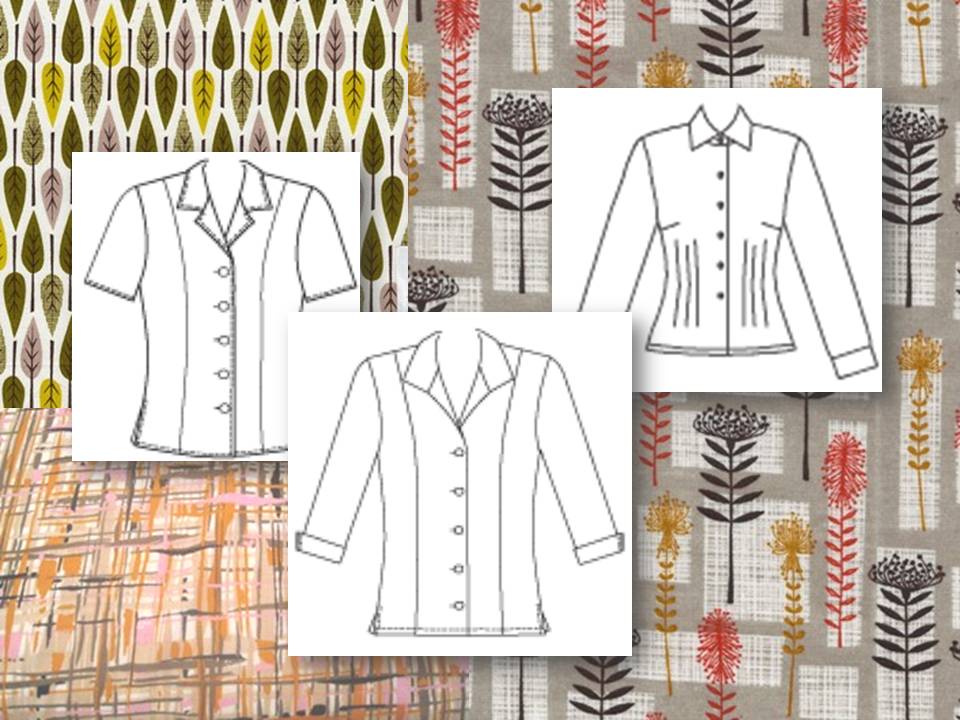
Button front blouses with a fitted silhouette are available from several of the big pattern companies. Keeping the fit close to the body provides the retro silhouette you want. Slim sleeves, worn short or long are classic. Note the details: collar shape and button fronts.
The best fit for a curvey body shape are the long princess seam lines that will make up a slender style. These are also easier to alter.
For more design details, the Vogue7003 blouse has several front darts, with is such a vintage look. This style also comes with French cuffs.

retro fabric
Selecting the right printed fabric comes next. Three of the most popular themes are nature (top), pictorial (middle) and graphic (bottom). The 'all over' prints are easiest to lay out, since you won't need to match anything. These prints are a good choice when sewing a princess seam line style. The horizontal motifs in the bottom set are best in patterns that have simple bodice darts and only the center front needs to be aligned.

So, consider making a blouse for summer (no sleeves, now that's easy!).

All of the retro style fabrics shown here are from BonBonAtelier on Etsy.
Fabrics:
CLOUD 9: POTS AND JUGS, PROTEAS, AVENUE, SHARDS
KOKKA: HOT AIR PARIS, RUSSIAN FAIR
LIZZIE HOUSE: PEEPS
ALEXANDER HENRY: DAGMAR PLAID


Blouse Patterns:
MCCALLS6285, MCCALLS6076, MCCALLS5138, MCCALLS2094,
UTTERICK5538, BUTTERICK5538, BUTTERICK5300
VOGUE 7903

Monday, May 2, 2011

Royal Wedding Gown: Vintage Inspirations

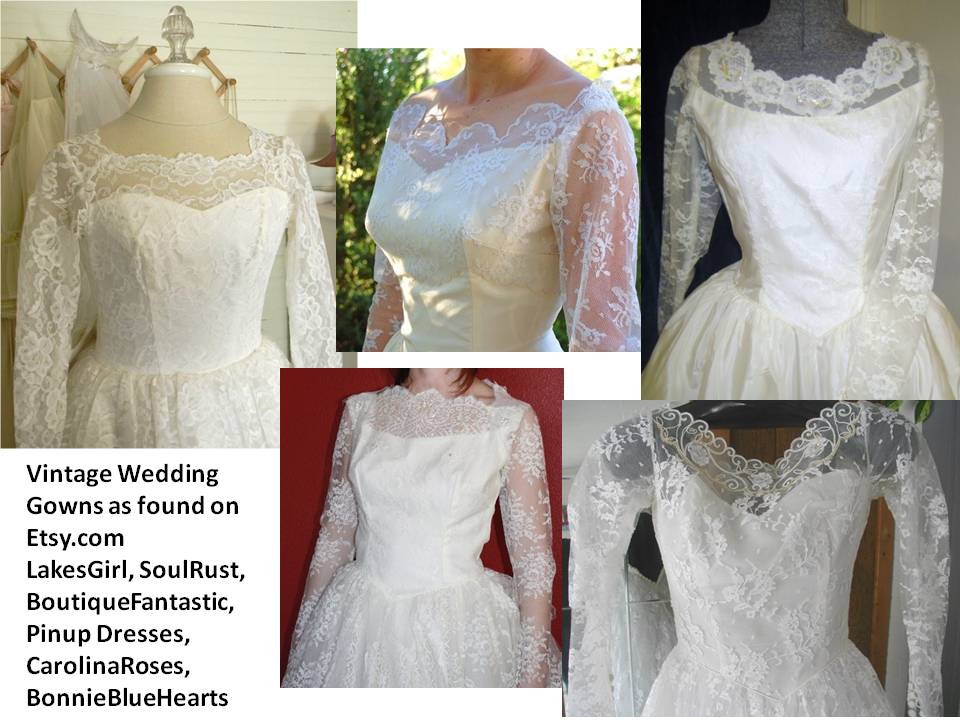
1950's wedding gowns1950's Wedding Gowns are a source of inspiration for current trends in wedding styles. The royal wedding gown showed this with its lovely lace jacket worn over a classic sweet heart neckline, strapless gown. Most reviews point out the connection between the Grace Kelly gown with its own lace bodice, but a review of current vintage gowns for sale on Etsy.com shows many versions of this style.

Sewing patterns are perfect if you want to create your own version of a lace bodice. You'll notice that many have higher necklines, prim and proper for the bride in 1950! The handmade gown could use a modern sewing pattern for the strapless dress, but a vintage pattern for the lace over-bodice. By using both, a well fit style is possible for a modern figure who may not fit the tiny 1950 waistline.

1950's wedding gowns, lace bodiceIf the bride wants to re-capture a true vintage look, there's nothing like a gown from that era. Shown here are some of the many lace bodice gowns available on Etsy. Necklines can vary from high to a wide cut with lace edging, as most have here. These are so flattering because they widen the shoulder line, making the waistline appear more narrow. This creates the perfect hour glass silhouette.

Not getting married this summer? Well, wouldn't it be fun to use this inspiration to sew up a summer cocktail dress with matching lace jacket? Another more easy option would be to make a black lace jacket to wear over an existing little black dress that you already own. Those long black lace sleeves would be gorgeous!

(See better details: Click on slides to see them in full size)

Sunday, April 3, 2011

Under Tuscan Sun: Sewing Retro Style Dresses


"Under Tuscan Sun" from 2003 remains a popular chick flick, in part due to the vintage styles worn by the lead characters, designed by veteran costume designer Nicoletta Ercole. The 'white dress' that the lead character Frances (Diane Lane) wears created quite a scene when the movie was shown. It was a mini trend at the time. Women everywhere wanted to find that white dress.

Dresses featured in this film seem timeless: fitted bodice with longer tea length hemlines. This look couldn't be more current, as tea length styles are once again in fashion. I thought it might be fun to take a second glance at these costumes.

Eight years have passed since I wrote this blog post. At the time, little did I know that it would become one of the most popular posts ever for this blog. Out of respect for those of you that come here looking for these wonderful dresses, I thought it would be a good time to update the sewing patterns that I listed here. I'll share some new patterns with you at the end of the original post.


The white dress seen in a back view shows clearly the silhouette of this outfit. Below the neatly fitting surplice wrapped bodice, a semi-circle skirt is cut to a vintage 1950's 'ballet' or 'tea length' hem line.

The bodice fit is accented by a black belt which is the perfect way to note a slim waistline. I show a close-up view of the wrapped bodice, which crosses over to the front darts. The facing is wide, completely covering the bodice center front. It's my guess that the inside fastens on the front left at the dart to keep this from draping open, as surplice tops often do.

The sleeve is cut in a short kimono style to make this crepe dress look like it has short sleeves, but without a shoulder seam line. This gives it that late 1940's style.

It is important to notice that this is a mock wrapped dress because the skirt is not wrapped, having a half circle skirt instead. To get that look this dress should have a side zipper.

What makes this dress such a success is the fabric selection. I believe this is a quality crepe. During the late 1940's we see many similar dresses in this textile. At that time rayon, silk and wool were used to drape soft fold and body contoured silhouettes. Crepe would provide the necessary weight and hand to drape the front wrap, soft shoulder and graceful circle skirt. The bodice appears unlined, except for the facing.


A wedding scene has Frances appearing in yet another captivating dress. This one is probably Thai silk in luminescent peach. It has a great circle skirt, looking similar to that on the white dress.

The bodice of this dress is a classic cut: front and side darts create a smooth fit. This crisp fabric requires a set in sleeve, seen here with small cuffs. A narrow shawl collar and covered buttons on the front add soft, but not contrasting details. The one color accent is her wide belt. The skirt on this dress does not continue the center front buttons of the bodice. This would require a side zipper.


Katherine, played by Lindsay Duncan is an fanciful character whose references to Fellini are underscored by her wardrobe. Some of these gowns appear to be true vintage, others are close copies. This red dress coat dress and hat serve to give this character the eccentric drama she requires. Wide lapel details enhance the monochromatic theme of her red on red outfit.


In a Fellini moment, we see Katherine in the village fountain, wearing a dress very similar to Fellini's famous fountain scene. It is a slender strapless black sheath with a sheer overskirt lined in gray chiffon. Another black dinner dress with a lace overlay or yoke may be vintage, its delicate details certainly are classic for that era.

Now, where to find or re-create these styles? I have found a few sewing patterns that could be altered to reproduce the same look. Actually, the dress styles here are not difficult to sew. The challenge is in the fit instead, so find a willing assistant to pin your fit may be required.


What both of Frances's dresses have in common is a circle or semi-circle skirt sewn at the waistline to a fitted bodice. In both cases that makes the front closures decorative, because the real dress opening will be a side zipper.

These two wrap front sewing patterns have the essential bodice details of the white dress. The green style by Butterick 5030 is closest in cut (minus the collar and ruffled sleeves). The Butterick pattern has front bust darts and will fit a curvy body shape while the Vogue 6846 style is without darts, for a more slender figure. With both bodices, altering the pattern by drafting a wider shoulder cut from the bodice will create the type of sleeve seen on the white dress.

Because this should be a mock wrap dress, a circle skirt should be sewn to the bodice instead of wrapping the front skirt. This skirt was probably cut in a 1/2 circle.

When adding a circle skirt, completely fit the bodice first to get the waist measurement and skirt length. The skirt will be drafted from those measurements.

The real style challenge is to capture the skirt silhouette. In the movie versions, both were full or semi-circle skirts that were sewn to the fitted bodices, requiring a side seam zipper. While a circle skirt pattern can be found for sale, it is not impossible to cut an original version to fit the bodice.

When preparing to draft a circle skirt, the directions ask for a waist measurement. Use the bodice waistline measurement from a fitted garment. Be sure to draft a skirt with side seams. When doing this, I use an open floor space, chalk, yardsticks and even string to create the true arc.

Hemming circle skirts is most easily done with a very narrow double fold that is hand sewn or machine stitched. When using softer fabrics like crepe, before hemming the finished dress will need to hang for a week or so to let the hem 'hang out'. After that, have the length measured while wearing the dress. This will even out what is probably an uneven skirt length.

If you want more information on drafting circle skirts, the images I show here for the skirt draft are explained in full on the Sew News website for Drafting a Circle Skirt.


This concludes the original post. The sewing patterns shown above, Butterick 5030 and Vogue 8646 are still being sold, as of this posting.

To add to the wrap dress collection above, I found several more patterns from Vogue 8896, 8784 and 8379. When looking to match a pattern with your fabric, take care to see if the pattern is designed for a woven or stretch textile, as both are available.


The slender shirtwaist dress by McCalls 6891 has classic bodice darts to create a fitted torso, as well as set in sleeves. The collar is the traditional notch style, making this look close to the original seen in the film.  McCall's 6696 is another option.  For a pattern with bustline adjustments, try using McCalls 7185, but add the circle skirt instead.  Probably the closest silhouette to the film's original is McCalls 7081, with the wrap front and wide hemline.


Katherine's outfits are much more vintage inspired.  Her black strapless sheath with lace cover up can be seen in McCalls 7321, a dress that can be made with fitted bustier bodice, straight skirt and lace sleeves and neckline.  There is a bustier dress with straight skirt that has a chiffon overskirt, which would give the same effect as the glamour seen in the original dress, by McCalls 6838.  Butterick 6353 by Gertie also has a fitted bodice and skirt with floating chiffon train.

To create Katherine's red dress, the selection narrows down.  Butterick 5747 has a wonderful portrait collar that would do the trick if you are willing to have short sleeves. Or you could use Vogue 8346, a coat pattern with wide lapels and a fitted princess seamline to create the dress (try a fitting muslin first to be sure it's not loose loose, as coat patterns tend to be that way).

I want to thank everyone who has contacted me or left comments over the past few years. It has been alot of fun seeing how this post really fills a need that women who sew have. Beautiful dresses that fit well. That isn't too much to ask, is it?

Like what you see here?  Keep up with my blog posts on Bloglovin, and I am also on:

Facebook - Pintucks
Instagram - Pintuckstyle
Pinterest - Pintuckstyle
Twitter - Pintucks

Saturday, March 12, 2011

1930's Women's Pants: Polka Dots and Sailor Styles

1930's <br />Deco Beach Pants
1930's Nautical Jumpsuit
1930's Sailor style pants
1930's Woman's suit
1930's Sailor styleWide leg pants are showing up in fashion again, affected by the 1970's influences currently affecting trends. The sailor styles we saw during the 1970's had their origins in the 1930's when women began to wear 'beach pajamas' and men's tailored trousers.

The women's beach pajamas illustrated here date from the early 1930's (some are dated 1931), and show how women were able to choose from a wide variety of style details and looks. Most interesting to me is the white double breasted suit. Who says YSL was the first to put women in pant suits? Here's a great example from nearly 40 years earlier!

So be inspired, this silhouette has alot to offer and is a great change of pace from the skinny jeans we have seen for the past few years.

Tuesday, March 1, 2011

1950's Vintage Fashion: Little Cover Ups

bolero jacket, Butterick 7243
Simplicity 2501
McCall's 9330
Little cover ups for spring and summer dresses during the 1950's came in many styles that included bolero and small capelets. The looks shown here are from sewing patterns that give both the dress and cover up views. There is an amazing variety of styles that were worn over dresses during this decade. From simple shapes to trims with buttons, collars and turned back cuffs. Today we tend to wear cardigans over dresses, but why not plan to sew a cover up when you make your next vintage styled dress? It's such a cute look!

Top view: Butterick 7243
Middle view: Simplicity 2501
Lower view: McCall's 9330


The little bolero shown here features turned back cuffs on the short sleeves and a winged collar. Mock buttons on the front are a cute accent. For most outfits, this shape really is figure flattering, creating a nice hour glass silhouette.

Black bolero with matching skirt