Showing posts with label 1950's fashion. Show all posts

Monday, November 17, 2014

Lilli Ann: Mauve Jacket with Fur Trim, 1958


This Lilli Ann suit jacket dates from 1958. It's signature fur trimmed bodice drape can be found on several jackets from that era. This one is a soft wool crepe in a pastel mauve color. Dyed to match silver fox fur trims a diagonal drape that crossed the jacket hem with a pearl button detail.

I have a few detail photos to share that fill in any gaps that the general full view misses. What is always interesting about a good Lilli Ann suit jacket are the signature details, going beyond what most jackets of the era show. These jackets tend to appeal to a flamboyant, dramatic and self confidant customer who loves feminine and sexy details to her outfits.


Rather than a simple strip of fabric, the wool has been pleated from a wider shoulder down to a narrow hanging "scarf" with a "pom pom" of fur at the end. A narrow band, like a belted edge, encircles the jacket hem. Where the scarf crosses that band it has an overlapping piece that is fastened with a pearl button in a bound buttonhole.


The swag is accented by the diagonal hemline at high hip level. This diagonal hem continues around the back, creating a well integrated design from all angles that is flattering to many body types.  This diagonal is seen in several other Lilli Ann jackets, so it must have been a popular silhouette for that label.


How this jacket was accessorized can be seen in the original magazine advertisement from 1958.


The 3/4 sleeves are designed to be worn with a longer glove proportion. The original skirt was narrow and below knee length, and worn with simple heels. Small pearl earings complete the ensemble, a scale that enhances but does not overpower the pearl button accent at the left hip.

In the early 1960's we can find advertisements for for similar styles from Lilli Ann. Like those shown here, this jacket was probably designed as a cocktail suit, to be worn to formal luncheons or semi-formal evening events where pearls and fur were appropriate. The soft pastel color would be a spring look. The label photo shows the texture of the wool crepe and the type of lining typical for a Lilli Ann jacket.


PS, I have more on this Lilli Ann style in the following other blog posts:

Lilli Ann: Vintage Suits from the 1950's and early 1960's: more advertisements showing suit jackets

Lilli Ann: 1950's Jackets that Inspire: more information on this jacket

Pinterest: Follow my board "Lilli Ann of San Francisco" --an ongoing collection of dated advertisements and other Lilli Ann designs for collectors and anyone who loves this label.

Monday, November 3, 2014

Georgia Bullock: a California Fashion Designer


Georgia Bullock was a California fashion designer. She was born in the small town of Whittier, Ca. in 1918 and raised in southern California. In the mid-1930’s, while in college at USC, she worked as a floor model and sales associate at a major department store in Los Angeles. After graduating, she was hired by Bullock’s Wilshire, followed by a milliner and later an established fashion designer. Knowing that she wanted to pursue fashion design, she studied at Frank Wiggins Trade School in Los Angeles. During this time both her work experience with customers along with her technical training prepared her for a career in fashion.


About 1941, with an idea for a basic black dress and $50 in cash, she and her partner Dorothy Phillips started a dress company with this one design. This new company would give her additional experience with buying trips to New York and selling wholesale. This small business lasted two years, so that by 1943, at 25 years old, she was in business for herself. She did most of the work herself in her little factory to start, but by 1945 she was quoted in national newspapers as a California fashion designer and selling her designs nationally. Her business would grow, moving to several factory locations in Los Angeles as her needs progressed. This suit was advertised in the mid-1940's.

“In my own designing, I try constantly to stress fit and flattering lines, rather than the specious and merely startling. I want to give the ready-to-wear customer the opportunity to buy good lines in the same sort of basic costumes (as custom made fashions).

“Now that the designers, newly freed of wartime stringencies, can create radically different styles in great variety, women have an ideal opportunity to choose the unhackeyed, to insist upon buying, not what is the rage but what is exactly right for them.

“California has a background and atmosphere which promotes a new, fresh feeling in our styles” she says. “American women are so different from European women, in shape and posture, and way of life. We, in California, are, I think, particularly well equipped to interpret much that is typically American”. Her philosophy would shape the kind of fashions she designed, always keeping in mind her customer’s figure and lifestyle, working to create designs that would flatter them.

She was married with a baby by 1948, but continued to design. In the early 1950’s she had her own manufacturing plant in Hollywood. In addition, Georgia took a design position with the well known label “Nellie Don” in 1953, located in Kansas City, the largest manufacturer of women’s clothing. It appears that she was able to work from Los Angeles for this venture while still working on her own line.


The “Georgia Bullock” label would symbolize the effortless style of the well-to-do woman who could afford the best in design, fabrics and fit. During this time her style tended toward suave and sophisticated. During the early 1950’s she widened her line to include sportswear with a elegant sense of style. Catering to the country club crowd, she presented her fashion shows on her own tennis courts at her home in Holmby Estates. These fashions were carried by the high end department stores, such as Saks, I. Magnin’s, and Bullock’s Wilshire.


In 1958 her fashions were worn on the Danny Thomas television show “Make Room for Daddy”. This symbolized her connection to the entertainment industry and to her ability to self promote as well.

Her career continued to grow, with clients nationally. By the early 1960’s, she was living in Malibu, creating fashions for the California beach, country club and resort lifestyle.

In an important move, in 1963 she launched her “Miss Georgia” line. These designs were less expensive with price points around $50 (her “Georgia Bullock” label sold for twice that). They were more fitted, showing clean lines, long sleeves or capped sleeves, while her own label was more complex and fashion forward.

Career Highlights:

1961: Bright cotton prints were shown for patio, poolside and at home dresses were seen to knee or ankle length with hem flounce. Georgia kept artist smocks in her lines for at-home wear, often in gay prints. Wraparound dresses, jackets in printed cottons, pants and long slim dresses with adjustable belts were also popular.

Mid-1960’s “Barefoot styles”: she described her at-home fashions as something that should be worn barefoot, much like her own beach lifestyle. It included artist smocks, eyelet pants, and hostess dresses for the bare foot.

1964: Her high end line showed the“costume look” with a jacket or coat and dress in slim sheaths, princess lines, pleated styles, lowered waistlines. Overblouse silhouettes and longer jackets to hide hips were part of her figure flattering strategy.

In 1966 she would receive the Designer of the Year award for her work. Georgia’s final years as a designer were in the 1970’s. At that time she continued to show her lines at her home, then in Palm Springs or at the beach town of Carlsbad.

Georgia Bullock was considered a couture designer for the designs under her own label, never sacrificing quality fabrics and styling or catering to fads. She continued to live in southern California until her passing in 1991. During her career, her name was well known nationally and she had full page magazine advertisements. Overall, she will be known for her classics: designed with a good fit and in fine fabrics. Georgia’s designs were was popular for her blazers and jackets, sheath dresses and ensembles, but also the colorful casual lines, designed for her own California lifestyle.


Wednesday, October 8, 2014

Bonnie Cashin: 1949 Coat Patent with Design Details


The well known mid-century American fashion designer, Bonnie Cashin, began to find her signature style in the late 1940's, and this design patent from 1949 shows two of her popular design elements together in one garment.

The Noh coat, an Asian inspired garment would be part of her 'look' for decades. In this design we find it in its early stages of development. The silhouette is consistent with her later designs. As this look developed, she would venture further into a timeless cut by excluding the bust dart that starts on the the shoulder seam. That would create a flat pattern, without shaping.


This is a draft taken from a later Noh coat, dated from the early 1970's. Here her classic lines are seen: a flat coat that is cut with the sleeves in one with the body.  Like the coat from 1949, it includes a small mandarin collar and large, roomy pockets.

This helps us to see how Bonnie Cashin refined her early designs to reach a style that she felt was classic and suitable to her range of textiles, colors and layering concepts.


The other design element in the 1949 patent that became part of the Cashin design vocabulary is the concept of using a clasp purse as a pocket. This diagram shows the clasp coin purse open, the full coat draft shows that same purse folded forward. This delightful and quirky detail continued to appear in designs through out her career, including the leather handbags she would design for Coach. An example from 1954 showing a plaid skirt with purse pocket is on the MET website HERE.

So, this coat patent may be of a style that might seem fairly typical for the late 1940's or 1950's, but upon closer inspection it is a key starting point in the signature style of a major American fashion designer, Bonnie Cashin.

Monday, October 8, 2012

Australian Home Journal: Online Resource


Aren't these fashions from the 1940's and 50's delightful? They come from the terrific online source for "Australian Home Journal", 1949 - 1952.

In the "read online" format it can be viewed like a book with turning pages, or tiled. Personally I like the tiles best, since it's easy to scan the issue and enlarge only the pages you want to see.

Each issue has a few dress patterns. They are drawn in small scale, but are helpful if you want to copy a look from the magazine. Have fun with this site, you'll find it a great source for fashion for the average girl, guy and child during this era.

I want to thank Caitlin at "3:50 From Central" for pointing out this great fashion resource to me on her blog.

Tuesday, September 18, 2012

Back to School Fashions, 1959


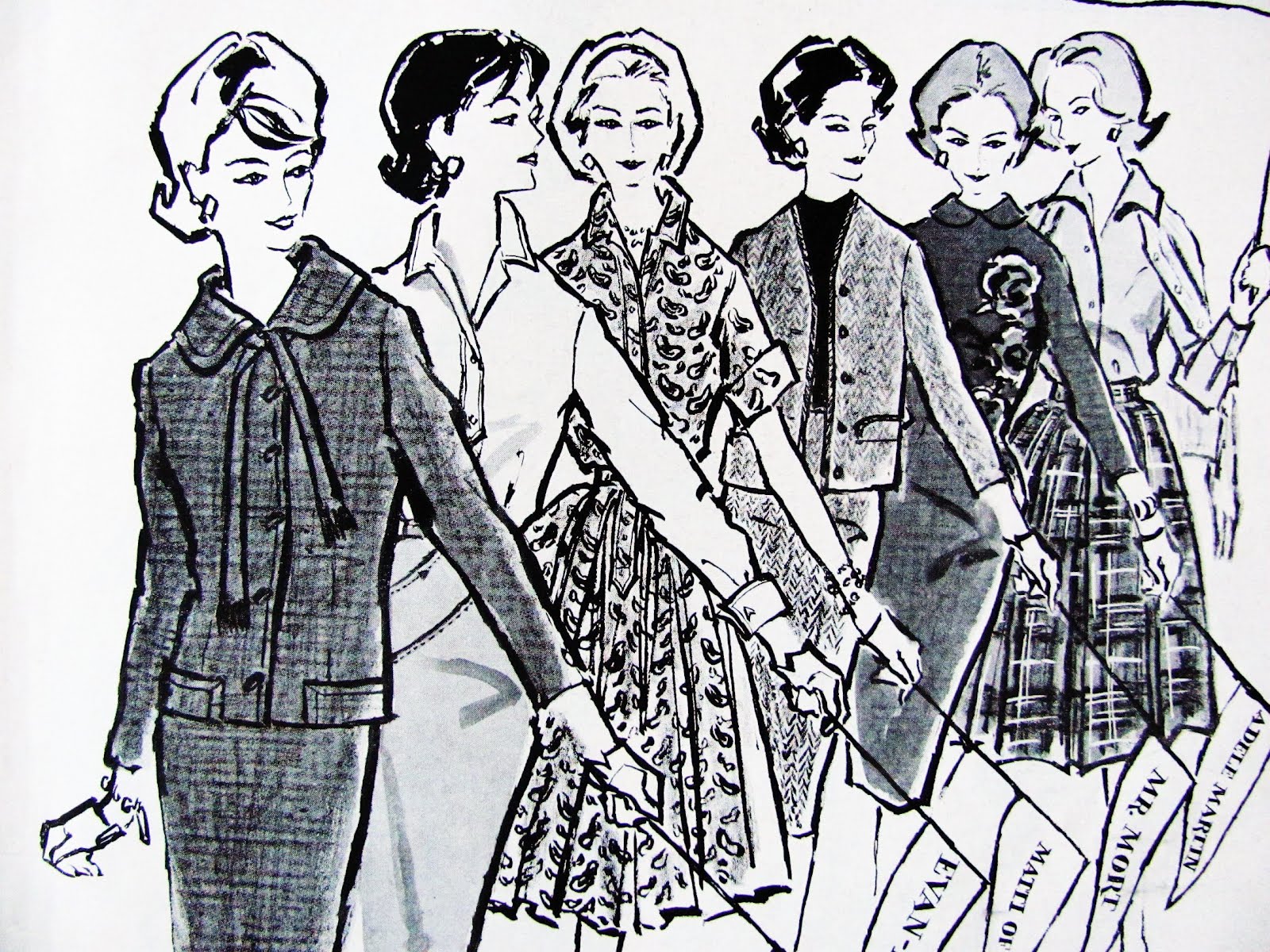
Gotta love how the 1950's and 60's were so excited about 'back to school' and fall fashions in general. That was always the thickest magazine issue of the year. I guess after a summer of old cotton dresses, new wool Chanel-style suits, crisp paisleys and plaids were a sight for sore eyes.

Thursday, July 19, 2012

1949 - 1980 Fashion Video


Women's Fashions, Year by Year: 1949 - 1980 by Wallygreeninker

When I was a kid, old fashioned movies were shown at school on rainy days and for special events, here's a fun 'movie' that's perfect for a hot afternoon. (enjoy!)

This video is a great overview of fashion history from 1949 to 1980, slowly progressing from one strong look to the next as the years roll by. Lasting more than 6 minutes, it shows 4 frames or slides for each year during this 30 year period. The images are of popular styles and give a good overview of the 1950's, 60's and 70's.

Saturday, February 4, 2012

California Design: An exhibit worth seeing

"California Design: 1930 - 1965: Living in a Modern Way" showcases a wide variety of furnishings, graphic arts and life-style accessories. We were happy to see more than a few great iconic fashion pieces such as this Lobster duo designed by Mary Ann De Weese for Catalina Sportswear in 1949.

If you thought this exhibition at the Los Angeles County Museum of Art was only about the Eames', you will find that to be only the tip of the design ice berg!

Lobster fashions from the collection of Esther Ginsberg, Golyester Antiques

LACMA Museum exhibition continues through June 3, 2012

Friday, January 6, 2012

RBW: Count Rene Bouet-Willaumez, Fashion Illustrations: June 1950

RBW
1950s illustrations
50s fashion illustrations
The three fashion illustrations here are editorial drawings from the June 1950 issue of "Vogue" magazine painted by Count Rene Bouet-Willaumez (RBW). He was a top fashion illustrator from the pre-WWII era, along with Carl Erickson, better known as "Eric", Christian Berard and Rene Bouche. Having built a strong reputation during the 1930's, RBW would continue to provide drawings for Vogue and Bazaar into the early 1950's.

His loose, Asian inspired brush work illustation style was part of the "Expressionist" movement. He was proficient in creating a dynamic illustration using black india ink on rough cotton paper. The 1950's would mark the end of fashion illustration editorials in glossy fashion magazines. Photography moved quickly into the dominant editorial position.

Drawing from a live model wearing the dress, his technique can be seen in the use of a wet paper to flow on the gray shaded areas. When that had dried, he painted the illustration, probably using a tapered asian paint brush or similar shaped water color brush dipped in deep black india ink. The textured areas are 'dry brush' painted with a brush that has had the ink pressed out, so the brush is damp. This style had a sensitive line that was popular through out the magazine and newspaper industry during this era.

Monday, June 27, 2011

1950's Dress by Anjac Fashions of California

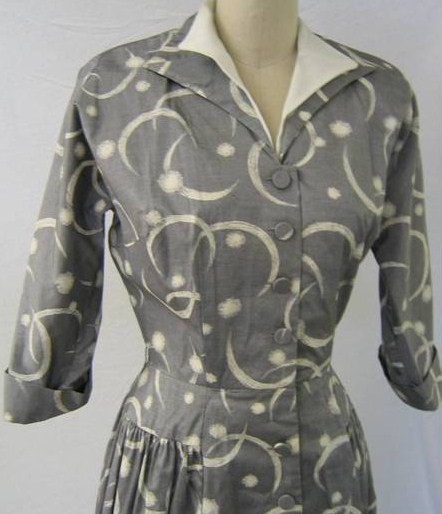
Anjac dressA 1950's day dress by Anjac of Los Angeles is a perfect example of a mid-decade look for adult women. The wing collar is doubled, with a white top collar to frame the face. Classic 3/4 length sleeves have turned back cuffs. The center front closure is dotted with self covered buttons from the "V" neckline to hem.

AQnjac DressA slender body silhouette is achieved by having the fitted torso with dropped waistline. This is a silhouette similar to what we see in Givenchy's designs for Audrey Hepburn ("Love in the Afternoon" and "Funny Face", 1957). By lowering a gathered skirt to the hip bone, the waistline doesn't look bulky and full.

The unique fabric pattern is screen printed in white on what seems to be an acetate textile with some shine in soft gray. The fabric texture enhances the dress design, creating emphasis for the skirt folds.

The dress's label is designed to promote California fashion. This marketing technique was popular among companies in the region who hoped to see their products displayed in "California boutiques" at department stores throughout the US.

Anjac labelThe dress label reads:
Anjac fashions
Made in California
Styled by Jack Needleman

ANJAC story

The Anjac label was designed in Los Angeles for over 30 years. The company was founded by Jack Needleman, who named his new apparel company by combining his name with his wife Annette’s. Needleman had moved to Los Angeles with his wife in 1943 from New York City. In New York he worked in the apparel industry as a jobber. Although Anjac was begun to produce dresses, his business focus would later center on more profitable real estate transactions in the Garment District. By the 1960’s this was to become the force of his business.

Anjac designer, Ilse Metchek, joined the company in 1967. She arrived from Catalina, having worked there designing sportswear. At Anjac her profitable styles financed Needleman’s property expansions in the garment district where he would build an empire that exists today and includes many important historical buildings in the area. He would pass away in 1999, the properties now managed by his family.

Needleman maintained the Anjac label until 1984, when he sold it to Metchek. Under her leadership the company was renamed “Ilse M. Inc”. Metchek designed for her label until 1990 when she gave it up to take a position as president at White Stag. Today Ilse Metchek is president of the California Fashion Association in Los Angeles, which she formed in 1994 to promote unity and compliance within the local apparel industry.

REFERENCES

Fit to a T: from modeling to management, Ilse Metchek taps into her decades in the apparel business to guide the California Fash, by Maya Meinert: Los Angeles Business Journal, March 23, 2009, http://www.entrepreneur.com/tradejournals/article/197105816_1.html

Jack Needleman, OBIT, by Myrna Oliver: Los Angeles Times: May 4, 1999, http://articles.latimes.com/1999/may/04/news/mn-33753

Orpheum Owner Steve Needleman Is Bringing Life Back to Broadway, by Jason Mandell: LA Downtown News: Sept. 24, 2004, http://www.ladowntownnews.com/articles/2004/09/27/news/news03.txt

Tuesday, March 1, 2011

1950's Vintage Fashion: Little Cover Ups

bolero jacket, Butterick 7243
Simplicity 2501
McCall's 9330
Little cover ups for spring and summer dresses during the 1950's came in many styles that included bolero and small capelets. The looks shown here are from sewing patterns that give both the dress and cover up views. There is an amazing variety of styles that were worn over dresses during this decade. From simple shapes to trims with buttons, collars and turned back cuffs. Today we tend to wear cardigans over dresses, but why not plan to sew a cover up when you make your next vintage styled dress? It's such a cute look!

Top view: Butterick 7243
Middle view: Simplicity 2501
Lower view: McCall's 9330


The little bolero shown here features turned back cuffs on the short sleeves and a winged collar. Mock buttons on the front are a cute accent. For most outfits, this shape really is figure flattering, creating a nice hour glass silhouette.

Black bolero with matching skirt

Saturday, November 13, 2010

Mad Men Era: Green Silk Cocktail Coat


Vintage fashion from the late 1950's or early 1960's can be created in silhouettes that stop traffic. Mad Men style, it's something to wear this winter.

Sometimes something perfect comes along, and this emerald green cocktail coat from Sak's Fifth Avenue is one of those moments in fashion history. Sculptural and refined, it's waiting for an evening on the town or keeping off the sea breeze when you admire the view of Hollywood from a hillside terrace.

Green Silk Satin Cocktail Coat: Sak's Fifth Avenue

Monday, August 2, 2010

Vintage Fashion: 1950's Shelf Bust


The shelf bust in vintage fashion is always a fun style to see. It is nearly daring, a bit outrageous, and always eye-catching. A recent blog post by Gertie on shelf bustlines presented a great gallery of styles that show a variety of versions. Many are draped, a few are pleated.

I remembered this dress from my California collection, and decided to share it with you. Maybe you will get some inspiration from seeing it up close and personal.

The dress itself is a heavy, crisp black faille, with the same fabric used for the bustline. Its late 1940's or early 1950's flange hip pockets help to balance out this imposing shelf bust and collar in white.

The label says it is "A Filmland Creation" by "Miss Hollywood". I"m guessing if you wear it, you will get discovered, or in the very least mistaken for Jane Russell or Marilyn's cousin, new in town and ready to be cast in a leading roll.

Thursday, March 4, 2010

Lilli Ann: 1950's Jackets that Inspire


If the Lilli Ann company during the 1940's and 1950's is known for anything, it is their fearless use of eye popping details and dramatic flare for contrasting trims. These two lovely wool jackets from the 1950's are examples of how far jacket design can go.

The lavander wool crepe jacket has a swag of drapery that falls to a pom-pom of fur at the end! This is accentuated by a diagonal hemline around the jacket. It appears to move on it's own with the swing and swirl of this design. The drape with fur trim seems to be a popular Lilli Ann trim, and it can be found in other jackets as well.

The second slide shows an early tailored silhouette that is spiked with diamond shaped appliques of the same wool in various shades. These are zig-zagged onto the jacket, around the hips and at the collar points. In fact, the collar diamonds overlap into 'space' and aren't entirely bonded to the jacket structure. This style is part of a line, having seen one go up on Ebay recently, I know that the diamond appliques were used in more than one style.

Plain tailored jackets from today might take note of these two looks. Wouldn't it be fun to re-style a jacket with diamond appliques? Or a swag? Don't let plain jackets fool you, there is a wealth of possibilities, if only someone would try!

(To get a closer look, click on the image)

NOTE:
Both garments were found at Etsy in forward thinking shops who recongnized the glory of a Lilli Ann jacket, even though it might be spiked with moth holes to the point that it can't be worn. Keeping them for study and inspiration is a perfect way to use such unwearables.

top photo: lavander wool crepe with fur trim and rhinestone button, c. 1955, from Fabgabs on Etsy.com
second photo: tan wool with diamond applique trim, c. 1950, from Vintagekttn on Etsy.com

Saturday, September 26, 2009

Lilli Ann: Vintage Suits from the 1950's & early 1960's


Two examples of Lilli Ann suits, showing the span of a decade: 1950 to 1960.


The well tailored suit jacket became an important element for Lilli Ann designs between the late 1940's and early 1960's. During this decade, the overall silhouette was not be altered significantly, but details were many and varied considerably. Jackets showed a smooth fit in the torso, with long narrow or 3/4 length sleeves. The hip was fitted and hems were short or long. In general, the suit skirt remained narrow and unadorned.


The brown wool suit pictured above from the early 1950's has a mock bolero with self bow tie. The face is framed by a wing collar. Bolero shaping sets off the small hourglass waistline which is emphasized even more by a single button.


In this creamy aqua crepe suit from about 1960, a variation in small pleating is used to frame the face with drama. The use of an asymmetrical front is seen. Lilli Ann would use this popular design devise often during this era.


A Lilli Ann advertisement from early 1960 shows several versions of suits from the collection of that year. Continuing the trend that Dior began over a decade earlier, jackets appear to be derived from a basic fitted New Look silhouette. The body is then altered with many styles of collar and neckline drapery. Overall, the look is very feminine and dignified, spiced with details in texture and trim.


Following this collection in 1960, the design of Lilli Ann makes a notable swing towards more current fashion trends of the day. This was a move to showcase a younger, exciting and innovative look to the Lilli Ann customer. An updated silhouette left behind the New Look styles that Lilli Ann had promoted for more than a decade.


This article is third in a series on Lilli Ann fashions.
Earlier articles may be found in the links to the right.


Do not copy text or images from this article without permission.
You may contact us at the email address posted on this site,
thank you

Saturday, August 1, 2009

House Dresses: Fashion at home, cottony and cute

A stepchild of fashion, the humble house dress has been worn in one form or another for centuries. When women's fashionable gowns were silk, this was even more so. Wearing 'wash dresses' of cotton calico allowed mothers and maids to get their chores done, while wearing something cool, comfortable, and easy to launder. The sketch here is from 1928 and shows a simple to sew house dress pattern at a time when home sewing was on the upswing in a growing suburban culture.


Following World War II, a flood of changes affected fashion. The availability of fabrics, both natural and synthetic soared. Add to this the availability of the zipper. This innovation had become popular in apparel during the 1930's, but the war years put a stop to that. After the war, the zipper became a 'must have' element in all apparel. During the late 1940's and through the 1950's, zipper use was at an all time high, as women happily abandoned their buttons for the convenience of a zipper. This house dress pictured above of cotton calico sports a sweetheart neckline and pockets edged in looped trim. A long center front zipper is set between full length rows of tiny pintucks (label: Nip'N'Tuck).

House dresses changed from being softly fit to becoming more fashion aware during the 1950's and 60's. The sporty rust red version shown here is by "Swirl". This wrapped house dress has huge patch pockets embellished with large appliques of fruit, veggies and kitchen kitch. The back wraps around and snaps at the waistband for a great flexible fit.


This cute polka dot dress is by another popular label "Models Coat". Originally a cover up for fit and runway models, it has similar 'easy to wear' features as other house dresses.

As young women moved from dresses into pants for day wear during the late 1960's and 1970's, the house dress lost its position in the housewive's wardrobe. Jeans, blouses and 'T' shirts took its place to become the prefered apparel for chores and leisure activities at home.

More on House Dresses:
Fuzzy Lizzie Vintage Clothing: overview of 'Swirl' house dresses
Eda Danese: The House Dress

Wednesday, February 4, 2009

Bustle Dresses in the 1950s


Bustle-style dresses in the 1950's are easy to spot. Dresses with the most Victorian influences had a ruffle, drape or bow detail at the back. The wide crinoline styles of Christian Dior are well known, but what is fun to spot are the slender bustle influences that also show up during this decade.

Twentieth century fashion saw a revival of Victorian fashion by the 1930's, with little back drapes topping crepe skirts in 1937 (see "The Women" by Adrian for examples). After WWII, Dior's "New Look" brought in a re-discovery of the hourglass figure, and a deep influence from 1850's and 1860's fashion.
The bustle styles from 1870 and 1880 decades were a natural development during the 1950's as fashion explored the slender silhouette. Often these dresses are nearly plain in the front view, saving the fuss for the back.

We were excited to find these two examples from the 1950's with charming back details. The blue lace dress is an amazing example of pattern design, and it is collectable for that alone. We love the floating back panel that is set at a flattering hip level in back, with layers of cascade ruffles from hip to hem.
Our plaid example has that school girl charm so familiar from movies such as "Meet Me in St. Louis" (1944) and "Gigi" (1958). The dropped waistline in 1958 may have been the influence here.

Both dresses are available at our Etsy shop online:
pintuckstyle.etsy.com (or click on our photo display at the right),
or drop by the shop to try one one (we are also happy to have you just look at them and take in their gorgeous details).