Monday, October 13, 2014

The Corsets of Gaultier


If you love corsets, lingerie, and vintage, you probably have more than a passing fancy for Jean Paul Gaultier, whose corset styles have influenced fashion trends and costumes with their couture details and punky concepts.

This year, the Barbican in London showcased one of the largest fashion exhibitions I have seen, the designer featured was Gaultier. His designs were showcased more by topic and type than era, so it was a great way to see his star designs and get a better understanding of his signature styles.

Probably the most well known of his work centers on lingerie specific to corsets. I thought that I would share some of the corsets that were shown throughout the exhibition halls. They range from traditional, satin and pink to outrageous and straw.


He uses metal or corset strips often to create a sense of shape and form, like corset bones without the fabric creating shape.


Satin too makes an appearance using more traditional lingerie techniques.


And to wrap this corset festival up, here's a version in straw.


The Barbican, London: The Fashion World of Jean Paul Gaultier: from the Sidewalk to the Catwalk: April 9 to August 25, 2014"

Wednesday, October 8, 2014

Bonnie Cashin: 1949 Coat Patent with Design Details


The well known mid-century American fashion designer, Bonnie Cashin, began to find her signature style in the late 1940's, and this design patent from 1949 shows two of her popular design elements together in one garment.

The Noh coat, an Asian inspired garment would be part of her 'look' for decades. In this design we find it in its early stages of development. The silhouette is consistent with her later designs. As this look developed, she would venture further into a timeless cut by excluding the bust dart that starts on the the shoulder seam. That would create a flat pattern, without shaping.


This is a draft taken from a later Noh coat, dated from the early 1970's. Here her classic lines are seen: a flat coat that is cut with the sleeves in one with the body.  Like the coat from 1949, it includes a small mandarin collar and large, roomy pockets.

This helps us to see how Bonnie Cashin refined her early designs to reach a style that she felt was classic and suitable to her range of textiles, colors and layering concepts.


The other design element in the 1949 patent that became part of the Cashin design vocabulary is the concept of using a clasp purse as a pocket. This diagram shows the clasp coin purse open, the full coat draft shows that same purse folded forward. This delightful and quirky detail continued to appear in designs through out her career, including the leather handbags she would design for Coach. An example from 1954 showing a plaid skirt with purse pocket is on the MET website HERE.

So, this coat patent may be of a style that might seem fairly typical for the late 1940's or 1950's, but upon closer inspection it is a key starting point in the signature style of a major American fashion designer, Bonnie Cashin.

Monday, October 6, 2014

Pat Premo: a California Fashion Desiger


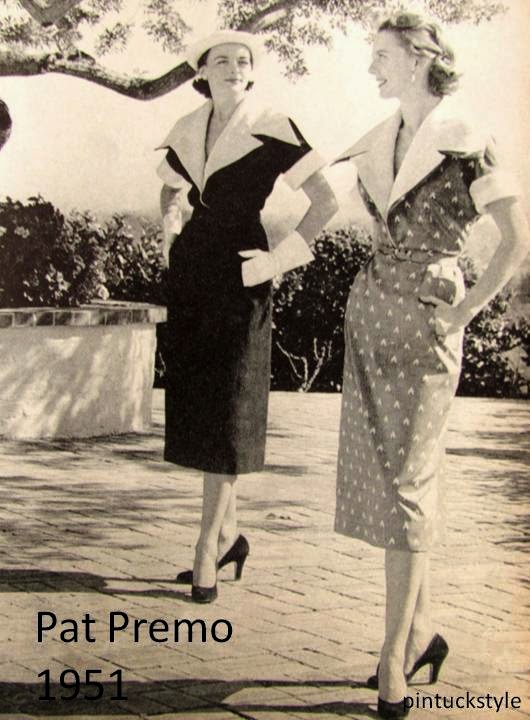
Pat Premo was a California designer who made her name during the 1940's and was strong through the 1960's, showing her unique style of using texture and pattern in her fashions, and looking for inspiration for her unique silhouettes in ethnic apparel

During the 1940's, California style was a direct selling point for fashions designed in Los Angeles, and sold nationally. These styles were distinct in the use of ethnic textiles, innovative textures and patterns in textiles, along with playful, easy to wear fashions for both indoor and outdoor living. Much of what the rest of the country saw were colorful fashions, perfect for resort and warm season wear, and Pat Premo was a successful designer of these styles.


Her playful short and skirt set is typical of the kind of styles that were being designed and manufactured in Los Angeles during the 1940's and 1950's.


These sundresses were called "sun back" dresses for their open back, usually sold with a bolero coverup.

.

She included day wear as well, styles suitable for lunch, work or daytime activities by an active woman.


In the 1960's, she continued to present unique styles made from distinctive textiles. Her fashions were sold in the best high end department styles and commanded top prices.


Today, finding a vintage Pat Premo label is a rare find to be treasured. This would be a fashion made from the best textiles available, and sewn to meet high quality standards.

Wednesday, October 1, 2014

Nelly Don: a short film clip

The "Nelly Don" label represented the largest women's dress manufacturer in the mid-20th century. This Kansas City business was started in 1916 by a fascinating women named Nell Donnelly Reed who created innovations in manufacturing, design and employee benefits. Here is a short clip is from a larger film titled "Nelly Don: A Stitch in Time"(2006).


Monday, September 22, 2014

Sewing a Vintage Style Wardrobe: 1952 Dress


When I saw this Lobell's advertisement in "Charm" magazine, spring 1952, I thought those amazing pockets seemed very familiar. It only took a quick look through the Butterick pattern's set of retro styles to find this exact dress! How often does that happen? So in the interest of fun sewing and vintage styles, here is a great project that is easy to sew as well.


This is the original 1952 ad, and in it you can see all of the fun details that make this dress unique. The only departure from this original design in the sewing pattern is the lack of buttons down the front, but those are easy to add.


Here is Butterick 6055, the pattern that captures this vintage look perfectly. The bodice has an easy fitting kimono shoulder and sleeve, which makes any alterations easier too.


This close up of the pocket details shows how similar the dresses are, and it also gives a better idea of how the pockets are sewn. These could have contrasting ties, or even be a contrast color as well.

When sewing a dress with this type of kimono sleeve bodice, I recommend fabrics that aren't too stiff, thick or crisp, since this will make the sleeve look and feel like wings. Any moderate woven will do, even sheers like organdy or organza sew up well in this style (plan on a co-ordinated color full length slip instead of lining). For fall or winter, a dark plaid cotton with white collar is a classic look, both in the 50's and now as well.

Advertisement copy:
Pocketeer, in flower fresh zephyr cotton…Just $8.95
So smart…this combed zephyr cotton step-in that takes a day’s labors in its stride…goes blithely on to an evening’s date!
Pockets on the grand scale…a skirt that billows free and full! Sanforized to launder perfectly!
Raspberry, green, navy, aqua, charcoal grey, maise, lilac
Sizes 10 – 18, 9 – 17, $8.95.
Lobells, Inc., Hanover, Penn.


Friday, September 19, 2014

Claire McCardell: 1942 Popover dress, the design diagram


When it comes to an American classic, this popover dress by Claire McCardell is one of the most popular. McCardell was able to capture a moment in the social scene where utility and fashion intersected, creating this original garment design that was patented October 31, 1942 at a time when yardage and trims were in short supply.

This dress wraps across the front and buttons down the left side. It pre-dates the later back wrapped house dresses made popular by such labels as Swirl. Sewn up in sturdy fabrics like cotton denim, it provided a women with a serviceable garment that had a bit of style as well.

A photo of the original appears in the MetMuseum web site HERE. With a closer look at the actual garment, it appears that the sleeves were probably cut very 'flat' in a kimono shape, rather than set to hang down at a angle from the shoulder line, as the draft suggests.

If you are wondering about patenting apparel, it is interesting to note that at one time the apparel industry tried this method to reduce copies from being made of original garments.  Class D2 patents (apparel) during the 1940's was about 16.6% of all patents (compare this with 3.6% today).  That was for 45,277 patents made during the 40's.

source: US Patents

Wednesday, September 17, 2014

Artcraft, Stockings of Elegance: Fashion Illustration, mid-1940s


This fashion illustration from the mid-1940's is a show stopping layout designed to showcase stockings. It makes a statement through the use of attitude, style and elegance, which is probably the most any stocking brand can hope for in a magazine advertisement.

Artist: not credited
"Artcraft, Stockings of Elegance"
technique: India ink wash for cast shadow, India ink and quill pen for sketch, highlighted by white crayon (conte crayon or oil pastel), on a gray paper stock. Lettering graphics were written in purple ink.

Monday, September 15, 2014

Sewing a Vintage Style Wardrobe: the 49er Plaid Jacket from Vintage Pendleton


I love those vintage 49er wool plaid jackets from the 1950's Pendleton ads. When summer winds down, a vintage style wardrobe can be inspired by the ads and articles in fashion magazines from past decades. Pendleton's 49er jacket were widely popular during the middle of the century, but its classic lines, color and fit are terrific as a new vintage inspired wardrobe addition.


This advertisement from the autumn of 1956 would be perfect to sew for this year's vintage inspired look. It is a very simple shirt jacket, with easy to sew details: four black shell buttons up the front with a convertible collar, long sleeves with cuffs, and a back yoke with small gathers. All of this can be topstitched to keep its shape.


Most of these jackets were shown belted. This ad from the winter of 1953 featured low set patch pockets cut on the bias, that sit below that belt. The convertible collar has longer points, and easily creates an open neckline above the larger scale four button front. The roomy sleeves have buttoned cuffs. From the back view, there is a back yoke with modestly gathered shirt body sewn to that.

Finding a current pattern with this style in women's patterns is not easy. While a convertible collared blouse has been considered a classic, right now the larger pattern companies are not featuring this style. Working from a Palmer/Pletsch sewing pattern may be the best option. Where I may have to alter that pattern is to create a higher sleeve cap, because I want the classic 49er shoulder. The sleeve should be shaped with a higher shoulder so that it hangs straight from the shoulder. Another feature in the original 49er is a front tuck in the jacket armhole that releases bustline fullness at about mid-armhole in front. A more modern fit solution is a side dart.


McCall's 6942 is the nearest in style to the 49er. It has the same convertible collar, back shoulder yoke, cuffed sleeves, and center front buttons without a placket. This means that the bias cut patch pockets will need to be drafted, and the back pleat at the yoke will need to be converted to gathers across that seamline.

This pattern may be too large in scale for smaller women's sizes. It also should be checked for the sleeve shape. I might alter the armhole and insert a more fitted sleeve with cuff from another sewing pattern (I must have a few patterns around with that sleeve). If the sleeve pattern is used, I would tape together the extra sleeve seam that creates that cuff placket and sew a more traditional cuff placket.

Two other patterns caught my eye: McCall's 5992, a PJ top with the right shape, and NewLook 6963, a shirt pattern with a more fitted body, high sleeve cap and back yoke. This pattern would need the sleeve lengthened and a cuff added (or substitute in a similar sleeve with those details). The back yoke probably rolls around towards the front more than the original does, but that might not be a problem.

With several different plaid variations, it's possible to sew up several to wear this fall. I also think this easy to sew shirt jacket would be a good pattern to use for making up holiday gifts that any vintage lover would want to own.

Read more about this famous shirt jacket by Pendleton, HERE.

Wednesday, September 10, 2014

Milena Pavlovic Barilli: Hanes Hosiery, Fashion Illustration of the 1940's


Fashion illustrations are part of what makes women's fashion magazines of the mid-century era wonderful. Tucked into those issues are advertising illustrations that surpass most of what we see today in the media and advertising. This artwork, influenced by Surrealism, was painted for Hanes hosiery by Milena Pavlovic Barilli (a talented artist who has gained more presence in recent years on the internet).

"Hanes no-seam stockings, sheer beauty from every angle", Milena Pavlovic Barilli, 1944: Hanes