Friday, February 21, 2014

Made in the USA: California Contractor, Ball of Cotton


In less than a month, it seems like the Olympic sweaters from Ralph Lauren's collection have come and gone, yet the story behind those cotton knits is worth a closer look. From a knitting business in southern California that produces high quality knits, the Olympic sweaters were hand assembled by the "Ball of Cotton" company. A local company for more than 20 years, the owners Eddy and Elizabeth Park produce their own brand, along with private label jobs such as the Lauren label for the Olympics.

Eddy Park has developed a manufacturing process that keeps all of his production state side but still maintains a high capacity of 6,000 sweaters per month, so it's not a little mom and pop outfit, but rather an option for designers who want high quality knits made under local supervision and production. An interview with the couple can be seen HERE

While New York city would like the public to believe that the city is the center for US apparel, in fact it is southern California that leads the US in employing the most apparel manufacturing workers (43,000) in the nation.

What make the LA/Orange county region successful is that nearly 7,900 apparel contractors are in business (2011). Additional 'boutique' contractors are often so small as to not be counted along with the large businesses, yet they contribute towards regional success. The businesses In southern California are often geared towards higher production values, turnover and methods. This is something the less expensive off-shore manufacturing process often does not do successfully.

As more contractors build up manufacturing that is independent from offshore production, such as Eddy and Elizabeth Park have done, we will be able to find more apparel available to us that is made in the USA from concept through production.

Ball of Cotton Website

Additional information on the southern California industry: California Economy Predicted to Improve Next Year and Grow Modestly, By Deborah Belgum | Thursday, February 20, 2014 a recent economic forecast released by the Los Angeles County Economic Development Corp.

Wednesday, February 12, 2014

Lillian Montaldo: Early Fashion Entrepreneur


The "Montaldo" label originates from a fabulous chain of high fashion stores that were owned and managed by an early pioneer in fashion retail, Lillian Montaldo. In 1918 she opened her first fashion store in Kansas. Lillian would continue to open more shops in cities through out the south, mid-west and even in Colorado during her long career in retail. Her stores were popular for high end designer fashions that came from New York and were also sold in stores along 5th Avenue.


Known for their luxury, Montaldo's attracted women who wanted to wear the best. Even the interior design of the shops was styled with luxury and presented a French allure.

During her career, Lillian worked from New York to procure the latest fashions for her shops. Her concept of a high fashion chain of retail stores was an early venture into ready to wear fashion in the U.S. She is also unique in that the fashion business was still a 'man's world' at the time she began her career.

Lillian was honored for her achievements in fashion in the late 1960's. Her 'empire' would last until the 1990's, more than 70 years of success.

The "Montaldos" label satin dress shown here was probably sold in the very late 1940's or early 1950's during the "New Look" trend. The gown has heavy embellishment of sequins and chenille on the bodice and a long flared box pleated skirt that falls to below knee level. It has a traditional side zipper of metal. The house label is sewn into the bodice lining.

More photos of this gown are shown at Pintuck Style, my shop on Etsy.

Other resources on Montaldo's: Lillian Montaldo is profiled by Betsy L. Hendrix

Advertisement from 1923: HERE

Saturday, January 25, 2014

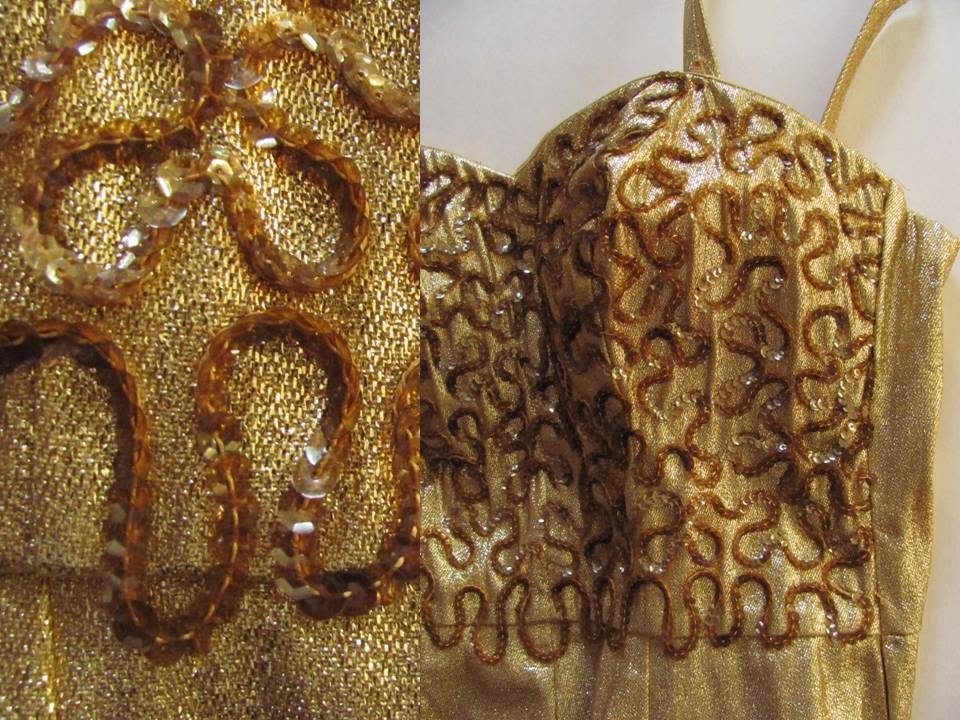
Ceeb of Miami: Gold Lame Jumpsuit


This super glam gold jumpsuit was made by "Ceeb of Miami", and probably dates from the late 1950's.


It was recently sold by my friend Holly at her "French Laundry Co." shop on Etsy. But before it left her shop, I was able to get to see it up close, and thought I would share what I found with you.


This bustier plus capri pant combo is made from a very stretch lame fabric. The lame fabric is stiff, yet flexible, with stretch in the cross-wise grain. The capri pants are simple, with traditional darting and slits at the ankles. It has a deep metal zipper with inside placket up the center back seamline.


The bustier is sewn with all-over sequin trim in a serpentine pattern. The bodice shaping is princess seamlines, with a back zipper.


The bustier is constructed with a full bra sewn into the top. There are small removeable stays at the sides of the built in bra to keep it 'up'.

There is a fold-over edge facing around the edges. This fold-over edge is backed with elastic to be sure it fits tightly. A wide nylon fabric fly backs the zipper opening to prevent any skin pinches. Buttons are sewn into the top edge of the bustier for removable straps.


The sequin design was applied after the bodice was sewn, using a chain stitch machine. It appears that the bodice front was sewn to the pant front across the waistline seam first. At this point the sequins were applied. After that the side seams were sewn.


The center back zipper is a strong metal type. This slide shows that zipper, both open to expose that fly fabric, and zipped up. A heavy snap secures the top edge.

Overall, this jumpsuit has a surprisingly simple pattern design and uses construction methods that are not difficult. The type of boning and lining that we often expect to see in a bustier is not present here. Perhaps this is because most women would be wearing their own strapless bra, often in a 'long line' design to the waist. This would then mean that the garment does not need to provide support or 'molded' bustline shaping.

The garment label lists this as a size 12 / 34.

Garment Measurements:

Bust: 34 inches
Waist 28 inches
Hips: 42 inches
Inseam crotch to hem: 25 inches
Underarm to waist: 8 inches


If you want to sew a glam jumpsuit like this for yourself, I think it would not be difficult. By working with a good pant pattern to start, a princess seamline bustier can be sewn to that around the waistline.

Pants: try Butterick B5895, a pant with 'high' waistline and back zipper (omit the pockets), or Vogue pant fitting pattern, V1003, a classic pant that has all the right darts.

Bustier: Butterick B5419, a long line bustier that can be altered to stop at the waistline. The bodice for McCalls M6646, is perfect.


On the Ceeb website they state that they have been in business since 1942 in southern Florida.  Their main product is swimwear, I'm also interested in finding out more about jumpsuits of this type from the "Ceeb" label.  Feel free to share what you know in the comment section.

Friday, January 10, 2014

Bonnie Cashin: Mohair Blanket Coat, Up Close


This 1960's Bonnie Cashin coat for Sills was found recently by Miss A who shared it with me in an excited text message. My respose: So when do I get to see it in person!. For me, coming across a Cashin coat in a vintage or thrift store is like finding a colorful sea shell on a wide sandy beach. Eureka!

This coat has that classic Cashin silhouette: kimono sleeves attached in one with the body. This allows that bold plaid check to continue out onto the sleeves without breaking up the graphic look.


But what stops the show here is a great, dramatic cape like collar. On closer study, it seems to have been inspired by a triangle shawl shape. Imagine folding a large square wool shawl into a triangle then draping it around your shoulders, over a coat. This has that same effect.


What pushes it over the top is that this shawl collar is cut from a wildly colored double cloth: fuzzy amber, orange and red colors on the outer mohair textured side with a blinding magenta pink and red on the other smooth surfaced side. That contrast is used to its advantage with this collar design since how its worn or draped can effect whether that contrast is seen or not.

Narrow suede trim binds off all edges. The coat is not lined, so that bright pink and red side is clearly seen when worn. Like so many Cashin wool coats, this one has roomy pockets in the side seams. It was designed with a very wide hook fastening at the neckline that at one time were covered in suede. The center front would hang loose and unfastened.

I will share the inner workings of this design and the technologies she used to create the look in my next post on this great coat.

If you are interested in seeing more designs from Bonnie Cashin, you will want to check out the links below:
Bonnie Cashin Online Resource, UCLA, Biography with Photo Archive
Bonnie Cashin, my Pinterest Board (a growing collection of images)

Friday, December 6, 2013

1938 High School Year Book: the Senior's Story

1938 School Yearbook for Long Beach, CA
Poly High Schhol's new campus built following the great Long Beach earthquake a few years earlier

This summer I came across an old yearbook in the stacks at a thrift store. Yearbooks have value for dating apparel, hairstyles and noting trends for a certain time. In this case, I was more than interested because it was from the Long Beach, CA school district, published for the Class of 1938, a time when the entire city published one annual for all schools, including junior high with high school. I am guessing this was an economic measure, in part because 1938 was still the "Great Depression" and this book needed to be affordable to all.


In 1938, seniors were probably born about 1920, a few years following the First World War. They would have been the fore-runners of the big baby boom that surged the US population during the 1920's, following the return of soldiers from the war. Unfortunately for this group, life wouldn't be easy for them. When they were nine, the economy crashed, leaving many homeless and often without money for food, let alone clothing.

This annual dates from nine years into that era of hard living. These kids knew nothing else. Long Beach had been a mecca for hope during the 1920's, when during the mid-decade new house starts were historically high, as palm lined avenues were paved and the sunny beach city grew out into the fields behind the bay with Mediterranean style bungalows and apartment buildings.


Only a few years after the big crash, something worse happened: the largest earthquake since San Francisco fell at the turn of the century rocked this seaport city, tumbling homes, businesses and setting the surrounding hillside oil derricks aflame. The population fled inland and up into Los Angeles for safety. Many left town while others stayed to rebuild it.


The high schoolers we see here probably owned only the shoes that you see them wearing. Many of the girls wear dark skirts, which may have been hand-me-downs from a sister or cousin. These basics could be worn with several blouses to make up their school wardrobe. Yet there is a diversity in style and personality that shows how creative they could be on a very limited budget.


Sports programs for young women were in full swing, with modern uniforms often 'checked out' to each girls by the PE department. It's also easy to see that these students are enjoying themselves, and seem to be happy. In our own time, when shopping is recreational and having more than we can use is so common, it's a reminder how unimportant owning things can be.


In looking at this yearbook, I also had another treasure to dig for within its pages. I knew someone who would have been there, and I was hoping to find her. In the roster of senior photos, there she was, known as "Midge", Mary Ellen Hill lived a block from the great new high school, leaving for UCLA after graduation. There she enjoyed a degree in music and the company of her sorority sisters before joining the military and serving on the east coast.

Like everyone else in these photos, within a few years the second great war would encompass their lives, changing their directions and re-orienting their viewpoints from the secure world of high school as we see it depicted here. (Doing a bit of quick math, these students are about 93 years old now, and it's amazing how many are still here to tell us their stories, if we want to hear them.)

Wednesday, December 4, 2013

1944 RBW Fashion Illustration: Davidow Suits


This ink wash fashion illustration is by RBW and shows Davidow suits for winter, 1944. The signature Davidow soft tailoring is already in evidence by the soft belting and shirt-style jackets pictured here.

I include this Davidow set to reference earlier designs from this label (see previous Davidow post HERE). I also have an earlier post on RBW, the sign-off for Count Rene Bouet-Wilaumez, whose illustrations during the 1930's through 1950's were a signature look for "Vogue" magazine, HERE. On Pinterest I am building a Davidow board with both advertisements and garment photos.

Elsewhere online you can find Davidow posts at "The Vintage Traveler" HERE and at "Past Perfect Vintage" HERE.

Monday, December 2, 2013

18th Century Hair Fashion & A Story of Changing Portraits


The Huntington Library in San Marino, CA, has a wealth of artwork dating from the 1700's. From this collection, a recent article discussed how these paintings depict women's hairstyles from the 1700's, and that these silhouettes are known for becoming more fanciful and extreme as the years progressed. Starting with a close fitting hair silhouette at mid-century, hairstyles gained height over the years, becoming the topic of conversation, jokes and public outrage. Feathers, ornaments and hats topped these towering structures.

A unique viewpoint on this topic is brought up in the recent article "Hair Today, Gone Tomorrow" by Kimberly Chrisman-Campbell, "Huntington Frontiers", Fall/Winter 2013. In this study, the author shows how hairstyles changed during this time, mentioning the influences of both British and French trendsetters of that era. She notes how hair fashion was transforming more quickly than apparel fashion. Of most importance was that the trending hair silhouettes became a problem when it came to portraits. While the artist may have painted the subject in the height of fashion, these portraits were usually out-dated only a few years later by the inclusion of an extreme hair style.

The out-dated paintings were brought up to date with more current hairstyles when possible. Ideally, the original artist painted over the earlier hairstyle, transforming it into a more acceptable silhouette. The range of success in this technique varied. Today these alterations can be seen using modern technology that allows us to rediscover the original layers.

"Hair Today, Gone Tomorrow" is fascinating reading for both the costumer as well as the general fashion buff. It sheds light on past styles and how fashion trends moved quickly, even in the late 1700's.

Tuesday, November 26, 2013

Davidow: early 1960's Couture Suits


Davidow suits from the early 1960s are vintage gems. While they have great diversity in cut and style, the quality of textile makes them standout among other suits from this era.

I wanted to share a copy of the Davidow brochure for Spring 1960. This issue shows what we might consider to be very conservative styling: simple jacket silhouettes and narrow skirts that hide the knees are the norm here. I have included the decriptions too as they contribute more detailed information.


These brochure pages show the Chanel style suits that Davidow was famous for producing. Made from imported wools, Davidow uses the "Chanel" name in many references and advertisements when describing their brand of suiting. A press review from a 1971 New York Couture press fashion show stated that "Davidow has been a leading practitioner of the "Art of Chanel", among them the famous Chanel sweater suits... Davidow is apt to set a new wave of Chanel. Those who loved her clothes should consider a Davidow for fall and winter. They were highly acclaimed by all of the fashion press."


My old scrap books from the first half of the 1960's include Davidow advertisements. Most are from I. Magnin's or Bullock's Wilshire promotions. When available, I have included the descriptions that give details for the fabric, size range and prices.


The caption for the set of suits on the left above states that they are "destined to be your through-summer delights...rounded collar suits in red, yellow, blue, toast and turquoise...convertible collar style in red, yellow, blue...sizes 10 to 20...$129.. from a collection of new Davidows".


In the first half of the 1960's, with prices that ranged from $129 up to $198, it's easy to see why these suits were considered 'couture'. Southern California stores that sold the Davidow label were leading department stores such as Bullock's Wilshire, I.Magnin, and others. The collections were offered each season at 'trunk shows' where a rack of sample suits were made available at a showing supervised by a company sales representative. Clients were able to see the samples, try them on, and then order a suit that would be made to measure for them.

Don't miss my follow-up post on Davidow HERE.


Tuesday, November 19, 2013

Scrapbooking 1960 style: Clippings of Fashions & Advertisements


The Ceil Chapman dress advertisement I posted yesterday came from a fashion scrapbook that was probably assembled in the early 1960's.

Sometimes a great source for research and design shows up in unexpected places. What looked to me like a child's paper scrapbook collection turned out to be newspaper clippings from fashion advertisements during the early 1960's. While few dates appear, and few brands, designers, or store names are included, sometimes the scrapbooker would cut out that information with the fashion illustration. I.Magnins, the Broadway, Bullock's Wilshire, Bullock's, and other southern California department stores are represented.

The image above is not edited, and shows how dark and faded the paper pages and illustrations have become. Below are those individual pages shown in the scrapbook above.  They are darkly yellowed and fume faded, sometimes having glue spots.  However, the illustrations are a gold mine of fashion illustration styles, dress and suit silhouettes and pattern design from this era.


I plan to share more of these fun scrapbook clippings in future posts as I research this historical resource further.