Monday, April 20, 2015
Digital Fashion and Costume Libraries: The Casey Fashion Plates, Los Angeles Public Library
Researching the history of fashion and costume online has taken grand leaps recently. In part to sort out the best from the rest, I have a short series of posts here on digital costume and fashion image collections now available to the public online. I thought I'd start with the Los Angeles public library, because a girl has to have some loyalty to her home base.
The Casey Collection of Fashion Plates consists of original fashion plates, spanning the years from 1780 to 1880. This huge collection has over 6,200 images, and that's alot to sort through, but the search engine is easy to use when looking for a specific year's costume plates. The images come from both American and British publications.
Overall review: I found this huge site to be well organized and easy to search. The images are easy to enlarge using a touch screen and the quality of those enlargements is excellent. I would recommend this to anyone needing a large body of images for research on a specific year or era between 1780 and 1880.
Improvements: I would have liked each image to be dated in the general search pages, as they are not in chronological order. The search is by year only, terms and other details cannot be searched. I would like to be able to search by decade, rather than having to enter 10 searches in order to see a decade of plates.
How it works:
Images per page: setting from 10 to 50 are available
Text per image on the search page: none
Text per image on the detail page: date, title, collection and item I.D. This does not include notes on apparel or other details in the image
Enlargement: (+) icon on upper right of page brings up the image in large scale on page. This can be further enlarged by using a touch screen, or the ctrl/+ keyboard
Search: "search collection for" box will bring up images by YEAR only. Does not search by decade or garment type.
Return: "return to search browser" brings user back to first page to start a new search
Speed: I found this to search and load quickly.
Copy: no, images cannot be reproduced
Tuesday, March 17, 2015
7 Best Sheath Dress Patterns with Vintage Style: Easy to Sew
Ever wanted to make your own Little Black Dress? This article will review fitted sheath dress patterns that are easy to sew. This is a second post on easy to sew dress patterns with vintage style, following "9 Best Dress Patterns for Beginners: Easy to Sew". After mastering the super easy shift style dress, it's time to sew a classic sheath dress. This article is edited from a very popular article from three years ago, so the patterns shown are current and available
What makes the sheath dresses shown here easy to sew?
1) no waistline seam, and they look great if belted
2) dress skims the body, but isn't super tight or super loose (like a shift dress)
3) no set in sleeve (but this pattern does have sleeves if you want them)
4) most are still 2 main pattern pieces: front and back
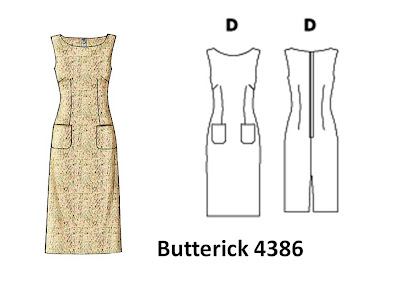
This is Butterick 4386, a dress with a classic darted torso. It can be sewn into so many great styles, from a "little black dress" to a tropical summer dress, the fit will be slender. There is a back zip and hem vent.
Now that you know what pattern style to look for when you want a smooth fit, here are more sheath style patterns that will create that silhouette. The patterns include New Look: 6261, Butterick, See and Sew: 5235, and two from McCalls: 2401, 7085. All of these patterns have vertical darts to shape the waistline and back views, and most have sleeves as well.
.
Curvey fit? A princess seam line pattern is the best for creating a good fit. Those long seam lines provide an opportunity to fit the bust line, torso and hips more carefully. There are six seam lines to work with, and each one can be let in or out only a little bit to affect the fit. Butterick "Fast and Easy" 5554 and Simplicity "Amazing Fit" 1586 both have armhole princess seams, so a good fit can be achieved with fuller bustlines. Both include sleeves, if that is something you want to include in your dress.
This style of shaping is a vintage feature, having both the angular French dart and the side bust dart. This will create a smooth 'fit and flare' silhouette. A French dart is sewn at an angle, and trims away the waistline without having the usual vertical dart showing in front. This is a good choice for bold patterns that shouldn't be cut up with vertical arts.
Once a good sheath pattern is selected, there will be a few things to consider.
Question: What fabrics are best for sheath dresses?
Answer: In addition to the simple cottons mentioned in the previous dress article for shift dresses (quilting cottons, cotton gingham, woven cotton plaids and stripes), we can add stretch wovens to our list. Keep your stretch manageable, don't select anything too 'wiggley' and out of control. When using a stretch, lay out the fabric so the stretch goes around the body (not 'up and down' or it will bag at the rear!).
If the fabric is soft or thin (like a brocade, lace or satin) I would suggest using a cotton or taffeta to 'back' that fashion fabric using a 'flat lining' or 'interlining' method shown in an earlier blog post HERE.
Obviously, the classic sheath dress is a vintage look that an experienced sewist can whip up in almost any fabric, from wool flannel to brocade.
Question: How can I make the sheath pattern fit me?
Answer: Make a fitting sample before cutting out the fashion fabric. This process is more essential with the semi-fitted sheath style. Plan to do a trial fit sample dress in a 'muslin' or similar cotton test fabric before cutting out your dress pattern.
If you feel you are an easy fit and don't need a fitting muslin, then when you cut your fashion fabric, I suggest using 1" wide seam allowances down the side and back seams lines. This will give room to alter for fit in case you need 'more room'. Math: get a 1" wide seam allowance by adding 3/8" to your cutting line if you are using standard US pattern's 5/8" wide seam allowances. Yes, you will have to draft that line onto your pattern tissue first, before you cut.
Slender fit: For a figure with small curves, look for slender darts. Don't take up extra width in the darts. Do your fitting from the side seams.
Curvey fit: For a figure with larger curves, the darts will be wider and may be shaped towards the dart point. This fit may also need side and back seam line adjustments. Traditionally, the back seam was cut 'on grain' or very straight, but now it is common to use that seam line to fit the back view more closely.
Princess seam lines make curvey fittings easier. Just distribute any alterations through the several seams, and you will notice that the fitting process is actually easy to achieve.
Question: How can I make the zipper easier to sew?
Answer: Add 1" wide seam allowances down the seamline where your zipper will be sewn. You will be soooo happy you have the extra fabric when you put in the zipper. It helps to have the extra width when trying to fold the fabric under. Before your start, be sure to clean finish the fabric edges. Doing that will make sure that the edge won't unravel and snag into the zipper. I use an overlock seam or I zig-zag over the fabric edge to bind that over and prevent it from unraveling.
Once you perfect sewing a sheath to fit, it could become your favorite: fast, great fit, and easy to sew.
Thank you for dropping by. If you liked this post, don't miss my articles on sewing and vintage fashion by subscribing to Pintuck Style blog on "Bloglovin", HERE . I'd love to hear from you too if you have any questions or want to see a blog post on a specific topic.
(This article was first published Feb. 21, 2012)
Monday, March 9, 2015
Fashion Bookshelf: Therese de Deillmont and the Encyclopedia of Needlework
Therese de Dillmont is the mother of all needlework crafts, having begun her instructional book during the 1880's: The Encyclopedia of Needlework. This book is still available, a tiny volume crammed with illustrations and 'how to' on many techniques that seem lost and forgotten today. My own volume shown here dates back at least a century, a gift that was found in Europe.
Alabama Channin has profiled Mme. De Dillmont in an article with just enough information to get you started on a search for your own copy. For me, this was one of the first books on my sewing self, and it is still a stand out today, black and while illustrations included.
Thursday, February 26, 2015
9 Best Dress Patterns for Beginners: Easy to Sew
This is the first is a short series on sewing patterns that are EASY to sew or EASY for new sewists (beginners). Because these styles tend to be shift dresses (loose with bust darts) or "A" line in shape, they are perfect for summer. This is the season to best sew for warm weather, the timing is right to make one of these styles.
This post is the first of a series on easy to sew dresses that I first published three years ago. As one of my most popular series, it has always generated alot of interest. Many of those patterns are no longer available, so I thought it was a good time to re-post the original article with new and current patterns from the 'big 4' companies. If you have a good pattern to recommend, just leave your comment below.
The shift dresses pictured above have an "A" line or loose fit, while the sheath dresses pictured below tend to fit the waistline more closely, and can be smooth over the hips. The sheath dresses all show back darts to trim out excess fabric in the back waistline area. Often this style has a back zipper, but the looser "A" line shifts can usually be sewn without a zipper for a 'pull over' style.
Both types of dresses shown here have bust darts in the side seam lines. This dart creates a smooth fit in the underarm and reduces bulk in the side seam area.
What I look for when choosing an easy pattern are several elements that need to come together:
1) seam lines: few seam lines to sew - just the side seams please!
2) pattern pieces: two main pattern pieces - front and back
3) darts: few darts - bust darts are fine
4) zipper: nope!
5) sleeves: nada!
6) neckline: simple and round, I think facing is easier than bias edge, but that's me
7) hemline: machine sewn? yes please
8) fabric: smooth, medium weight cottons: these are easiest to sew - quilter's cottons, cotton gingham checks, cotton shirting plaids and stripes.
Here's a few patterns that would be EASY for a newbie, or FAST for those with experience.
McCall's 6355: basic shift pattern by Palmer/Pletch, neck binding, optional fitting darts. This pattern has options for creating a good fit.
McCalls 6102: View D, shift style, 2 bust darts, pull over, large size range, neckline facing
McCall's 6465: view E, slip over, sleeveless bias tape arm holes, loose A line shape
FINDING YOUR SIZE:
READ the measurement section for the company that you are buying the pattern from. Each one will require the following: Bust, Waist, Hip. Be sure to measure without clothing for accuracy. If you are not the same size as the patterns listed, for this style of dress, choose your bustline to find the best size. You can add to the hip area if you need more room there, and the waistline measurement should have little effect on the pattern.
HOW WILL THE DRESS FIT? If you scroll down or click the tab on most pattern websites, you will find the GARMENT MEASUREMENTS. This information lists what a dress will measure after it has been sewn. These measurements can be compared with a similar dress or top you own, so that way you'll know what the results will be. Use this to select hem width, hip and bustline ease (the term 'ease' means looseness). It is a great way to find your pattern size for that specific dress, if you feel the size measurements may not be exactly your fit.
(the original version of this article was published February 17, 2015)
Thursday, February 12, 2015
Make Your Own Vintage Gloves: Free Pattern
Make your own gloves from a 1950's free vintage pattern in pdf file format. This file has patterns to enlarge and tutorials to get you through the sewing process. I can see this used for awesome glove and costume projects, so save yourself a copy now because you never know when you'll want to use it! You'll find that free pdf file HERE on PatternPatter.blogspot.com. The pdf file alone is HERE.
While I'm at it, I want to credit the original designer of these gloves, Edith M. Hummel, who wrote about making gloves in her book: "You can make your own gloves", 1946 and about accessories in: "You can make your own bags and accessories", 1952 and 1957. This pattern appeared in the January 1956 issue of Workbasket Magazine. Her books may still be available in long established libraries.
Friday, February 6, 2015
The Pendleton Mystery Shirt: Guide Shirt or Buckaroo Style?
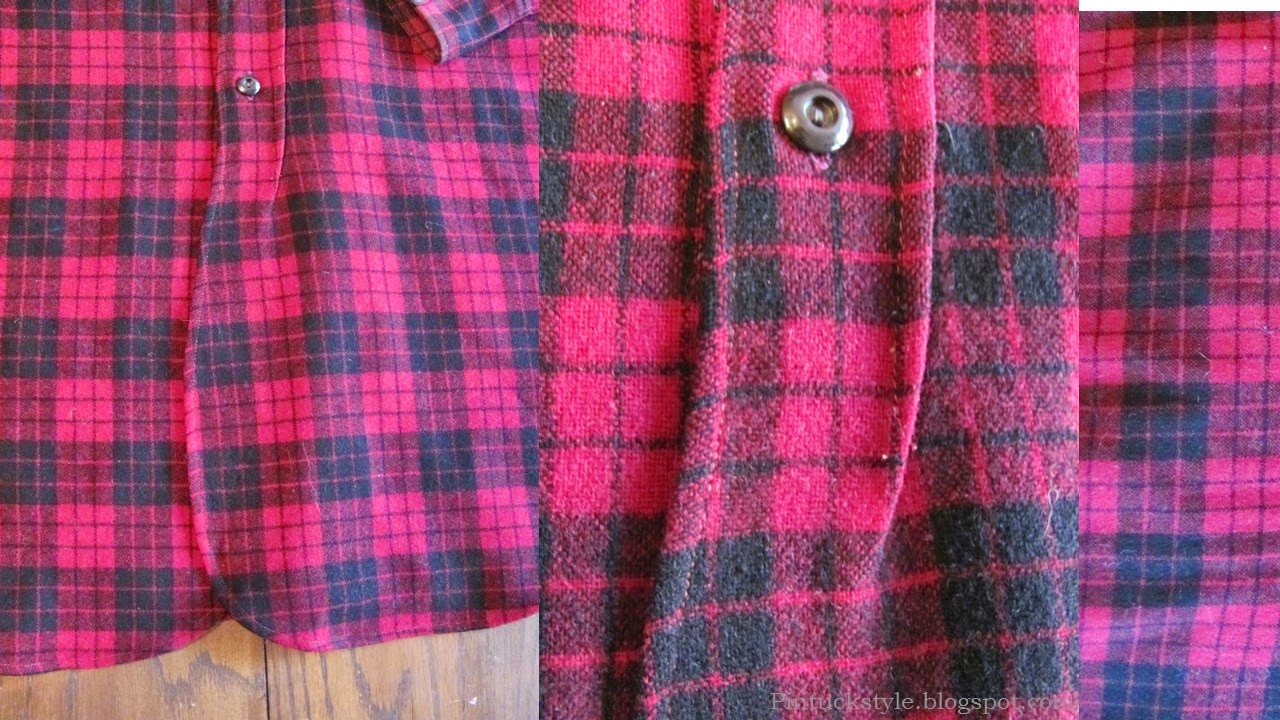
Pendleton wool plaid shirts are an American classic, and as such it can be difficult to determine the age of one, when it seems like all the others. This older Pendleton shirt, while sporting a well known black and red wool plaid check, has an unusual feature that is a design style new to me. When I first saw this shirt, my well-trained daughter (by me) had found it at the Goodwill, among all of the other wool shirts on the rack. She recognized the plaid, but what caught my eye when she waved it aloft ("Eureka!") was the uniquely curved center front and hemline.
Hemlines in men's shirts are funny because they have remained mostly hidden over time, carefully tucked into pants. Pendleton shirts worn outside the pants is a style preference that came into fashion after they had earlier been designed as a tuck-in sporting shirt. So when was this shirt made? The wool has a hard finish, without loft, spongey depth or fuzziness of some wools. It has the old label style and it is well worn.
After searching online, and not finding any mention of this hemline, I found a 1927 catalog page on the Pendleton site that shows the debut this same shirt. On the left side of the page, #572, appears worn by a man with a gun, but his version "Guide" has a 2-button cuff. This shirt has the same small breast pockets and clean fit of this shirt. In a color view of three folded shirts, the same plaid is shown for # 533 styles, and a one-button cuff as described. This is very similar to the "Buckeroo" featured on the opposite page, but in a different plaid (the Buckeroo is listed has being available in a 'tan plaid'). And finally, the garment label appears in the upper right corner of the right page, and this is the same graphic design. Here is a larger scale version of the catalog page.
So the question remains, do shirts from 1927 have this same hemline shape? When did this curved front phase out?
Below are more views of this shirt, showing how the front placket is shaped and lined. These clearly show a rather innovative method of pinching a tuck to created the front placket (rather than sewing on a separate long piece of fabric to create the button placket). These button plackets are lined, rather than faced with wool.
If you have suggestions or answers, let us know here so we can solve the mystery of when this shirt was made!
This close-up view shows how the center front lines swings wide to create a curved front overlapped edge.
The reverse side of the button plackets are lined and show the 'tucking' technique that created the placket, and also a small tuck release.
While the wool is still strong, the lined collar and label show signs of deep wear, and are becoming thread bare. This close up view also shows a twill lining that seems to show up on the very old shirts, and probably earlier than the usual 'satin' or twill versions in beige or other colors shown. I have also noticed on later shirts that chain stitching can be found on the back side of top stitching, which may be a later use than single needle top stitching.
HERE is a Buckaroo recently featured in the Pendleton Facebook page.
HERE is a catalog page featuring the Buckaroo shirt advertised as by "Levi" of Pendleton wool in 1938: Saddle and Western Gear, page 121
HERE is my Pendleton Pinterest file, I'll keep adding 'em as I find 'em!
HERE: a taxonomy poster showing the main styles in Pendleton shirts
Monday, January 12, 2015
Davidow Suit from the mid-1960's: A Closer Look
This Davidow suit I has been in my collection for awhile. The classic silhouette and rich texture make it as wearable today as it was when it was sold, probably in the mid-1960's when the longer jacket was popular. I thought it might be good to take a closer look, in part to show details used in this type of tailoring, and also to help identify a similiar suit if the label is missing.
When looking at a Davidow suit, one of the first aspects of the design is it's similar silhouette and texture to a Chanel. Davidow advertising and brochures mention this as well because they purchased those toile designs to use in their own company. For many women, while the Davidow label was expensive, it was much more affordable than the Chanel label.
Pockets, another Chanel inspired feature, are also influenced by military or safari styles in this jacket. The lower pocket with flap is actually a patch pocket with the flap attached, creating a more flattering look that is easier to use. The breast pockets are actually mock flaps and lay flat without a pocket under that flap.
The signature single layer collar Davidow had patented is not seen here, so the collar is conventional, having a facing to back the collar and lapels. These are soft and not tailored with heavy canvas, being more like a blouse in fit and weight. The front shows five textured gold metal buttons which is a departure from the covered buttons found on earlier jackets. Very narrow bound buttonholes are used.
The back view is smooth, with shoulder darts for fit across the back. The body is tapered at the waistline by the side panels that are set at the side body, under the arms. The collar fits flat and low around the center back, being cut on a curve to fit around the neckline.
Two piece sleeves have mock vents, secured with a single button. The shoulders are only lightly padded to retain a soft and natural silhouette. This jacket features the use of textured wool, much like Chanel during that time. This textile has aqua, turquoise, bronze and white yarns which appear to be heavy, but are actually very light weight. Both jacket and skirt are lined in aqua crepe.
This view shows the skirt waistband, with lining, hooks and eyes. There is a narrow waistband that is not crisp or heavily interfaced. The waistband fastens on the left side with a nylon zipper. Two hanging loops with the Davidow logo shown here, are sewn into the waistband at each side. The hem has been released, so it is hanging un-hemmed in these photos. The skirt lining is much shorter, perhaps taken up when hemlines grew shorter as the decade moved on into the 1970's.
This suit was sold by Bullock's Pasadena, probably at a trunk show where a model would have shown the suit to a customer, or the customer might have tried that one sample on. She would have waited for this custom made order to arrive back at the store. This location served clients not only in Pasadena, but also San Marino and all points east of there, since no department stores of this quality were located further east of Los Angeles. Customers from 40 and 50 miles away would have traveled to this store when there was a trunk show with new suits each season.
I have another article on Davidow, with examples of suits from the early 1960's HERE. I also posted an example of suits from 1944, HERE. In the 1944 suit illustration is is easy to see the signature looks that Davidow suits would be known for. It is also interesting to consider that Chanel did not start producing her suits until 1954, at a time when Davidow suits were already well known.
Friday, December 26, 2014
Peterson's Magazine: Victorian Fashion Resource, 1850 - 1888
Peterson's ladies magazines were an American staple during the last half of the 19th century when so many women lived in rural or isolated communities. These magazines brought serial stories, crafts, home tips and just about everything else you would expect from a home and life-style blog today. Even fashion illustrations were included, so that women could keep up their appearances, even on the prairie or at a small town wedding.
The magazine issues also recall the romantic Victorian past. These illustrations from the winter of 1888 seem perfect for a dreamy Victorian romance film with a few Christmas holiday scenes where our leading lady is seen wrapped in rich red velvet and fur.
Owning or finding copies of these wonderful magazines is difficult, but having them available online opens up another world. Bound issues from 1850 through 1888 are there for the looking. While the magazines contain mostly fiction and written essays, each monthly magazine had an illustrated center section (the first staple center fold!). As time went by, there were more illustrations in each issue, showing colored fashion plates, accessories and home crafts popular at the time.
Today this information can be inspiring, offering new viewpoints, ideas, and concepts that can be translated into modern life, or at least adapted into Steam Punk costumes or copied for more accurate period apparel.
These illustrations are from the first six month volume from 1888. A full list of links to the 1850 through 1888 volumes are available HERE. This goes perfectly with hot chocolate on a rainy winter afternoon.
Tuesday, December 23, 2014
Tom Tierney: Fashion & Costume Illustrator
Merry Christmas! This illustration is by Tom Tierney, the card he emailed out in 2012 for the holidays.
Tom Tierney virtually changed how people saw historical costume and fashion. Through his wonderful fashion illustrations that he introduced in the 1970's, the general public found a new way to see historical costume. His were colorful illustrations that everyone could identify with and enjoy. It's from these small beginnings that many costume and fashion students got their first glimpse of the world of fashion. Tom passed away this year, and I know we will miss seeing new examples of his work in the future. Thanks Tom for sharing your gift of illustration and your love of fashion with us!
John "Tom" Thomas Tierney
(October 8, 1928 - July 12, 2014)
Read more about Tom Tierney:
INTERVIEW: New York Times
INTERVIEW with Dover Publications, his publisher
INTERVIEW with NPR radio
INTERVIEW: newspaper/online, "My San Antonio"
Subscribe to:
Posts (Atom)