California fashion industry was well under way by the 1920's. Los Angeles had found its niche in two important local businesses: Hollywood and Tourism. This meant that by creating a strong brand identification with both the luxury of resort and sun sports, along with Hollywood and the glamour associated with it, a new identification was found for a growing apparel industry in the region.
During the 1920’s, the fashion industry saw several new trade and marketing organizations develop. The Associated Apparel Manufacturers of Los Angeles and the California Fashion Creators were important firsts during this decade of growth. The Fashion Creators would stage fashion shows at movie star homes to market new designs to the public.
By 1921 the Associated Apparel Manufactures of Los Angeles established a bureau of information, employment office, and a buyers office for out of town buyers. This meant that the fashion industry now had a core or 'go to' for information and marketing events.
In 1926, a group of 6 female designers, who owned their own businesses, formed the Affiliated Fashionist group. Its purpose was to promote their companies with many social events and fashion shows, often staged in the designer's homes, around a pool or outdoor Los Angeles theme. The first members were: Irene Bury, Viola Dimmitt, Peggy Hunt, Violet Tatum, Pat Perkins, Marjorie Montgomery, Addie Masters, Louella Ballernio, Agnes Barrett, and Mabs Barnes. Nearly 40 years later (in 1962) Peggy Hunt, Marjorie Montgomery, and Addie Masters were still in business. Violet Tatum and Pat Perkins had retired from the group early.
Several members, such as Mabs Barnes, who in 1933 would create the Satin lastex swimsuit with a one-piece skirt panel in front and bustline fit, went on to design important innovations and trends. Addie Masters specialized in glamorous, yet casual at home fashions with a “wrap-rascal” dress and hostess trousers in 1939.
In September of 1946, the group staged a fashion show at Peggy Hunt’s estate that was attended by 400 guests and showcased 72 styles. Resort and cruise wear fashions predominated. Ethel Joutras was the co-ordinating director of the event where the following fashions were featured:
Addie Masters: cover-up group in black and white, exercise suit that was a one-piece play suit with shorts and blouse
Marjorie Montgomery: play suit in turquoise
Viola Dimmitt: raincoat-dress, a coat that could be worn as a dress, made from black nylon
Agness Barrett: slacks and fashions with a Mexican color theme
Mabs Barnes: lingerie
Peggy Hunt: black crepe with nude sheers, and a junior line with Children and Teen styles, and another group called "Jean Carol" that featured women’s dresses. During WWII, actress Deanna Durbin was costumed in a ‘Jean Carol’ label for a movie. Peggy was the first to show sheer-yoke cocktail dresses.
Jeannette Alexander: dresses with a focus on the young sophisticate (Jeannette Alexander was Peggy Hunt’s daughter)
A press release in 1948, showed that at that time there were 8 designer members in the group. They were following Paris trends with 12” hems for day, and 9,10,11” for night. At this event, Peggy Hunt showed lace and marquisette accents and floor length gowns.
Louella Ballerino presented “American Gothic” dresses with subdued coloring. In 1950 she would show drapery prints in her dresses. Her styles were part of an "Americana" trend that may have spun off of the success of the musical "Oklahoma" in 1943. Agnes Barrett, like Louella presented nostalgic styles with a Victorian look that included braid trims, tucks, and skirts that flared in back.
Marjorie Montgomery designed for college girls with new looks in dolman sleeves, petal collars and cuffs, and easy skirts. Irene Bury kept to her classics and showed an afternoon dress in a green and white stripe.
Louella Ballerino also showed resort sportswear featuring a strapless bra in a black and white print, white shorts, with wrap skirt. Addie Masters continued her casual resort wear with at-home fashions in crepe of tangerines and pinks.
Mabs Barnes had little change in her now popular swimwear styles, but she did feature new colors and fabrics, with control panties, and girdles.
Viola Dimmett's coats were water repellent with full backs and some hoods, worn belted or loose, styles that made her label a big seller.
From the early years of the 20th century through to the 1960's, growth for a new apparel industry in southern California was enhanced by these innovative fashion pioneers. They are partly responsible for the strong brand identification that California fashion has in the world. They promoted their designs with marketing innovations that proved successful, creating a California "style" that local designers today still rely on.
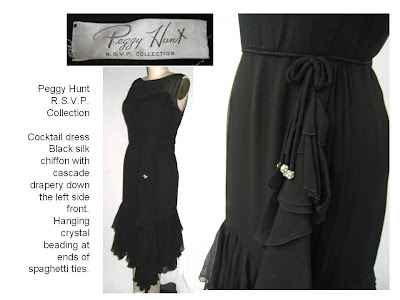
The cocktail dress shown here by Peggy Hunt features her well known nude sheer yoke and black silk chiffon with bias cascade. It probably dates from the late 1950's or early 1960's.


