Showing posts with label California fashion. Show all posts

Sunday, November 20, 2016

James Galanos: Documentary Video "Galanos by Galanos"


In 1996, a retrospective exhibition "Galanos" of the life works of James Galanos was shown by the Western Reserve Historical Society in Cleveland, Ohio, and the Los Angeles County Museum of Art. It featured a wide range of his fashions, from his early career through the later pieces.

Wednesday, August 19, 2015

Vintage Summer Fashions from Esprit: 1980's Sportswear from California


In the summer of 1980, Esprit (of San Francisco) designed by Susie Tompkins, launched a summer collection that embodied both American chic and sportwear. Using traditional Levi styling (a nod to the original San Francisco apparel company) this fashion group showcased bright primary colors, sexy 'short shorts', tube tops and skinny belts. A bit of a 1950's influenced design, these outfits captured the leading edge for wearable, young sportswear fashions.

Monday, December 8, 2014

Irene Lentz: Jacket c. 1949


This suit jacket by the MGM costumer and fashion designer Irene Lentz was probably sold in 1949. The label lists Bullock's Wilshire, located in Los Angeles, as the high end department store where it was shown. In July 1947, before her career at MGM terminated, Irene began a fashion business designing for a group of 25 department stores who helped to finance her business. With exclusive rights to Irene, Inc. for their stores, located across the country, they would make her fashion designs available to affluent women who patronized them.

She tried for two additional years to work for both MGM and establish her own “Irene, Inc.” business at the same time. After that she left the film industry to devote her creative energy to Irene, Inc, starting her wholesale business with 20 department stores showing her line. By 1951 she would have 37 stores that carried the Irene label.


This close up view of the jacket shows the layered crescent shaped collars that she designed which were accented by buttons. She used nine covered buttons in this design.


Crescent shapes disguised conventional darts and princess seam lines.

The business took off quickly, no doubt boosted by her reputation and well honed design and tailoring skills practiced during the years at MGM. She won the Neiman-Marcus fashion award in 1947 for her excellent work, the other recipient that year was Christian Dior.

A suit advertised for spring of 1949 shows slightly broad, but rounded shoulders on a tightly fitted jacket with long peplum skirt to cover the hips. This silhouette was typical for suits from that era.

By 1951 her business, design and showroom, had moved to a modern design and production facility at 3550 Hayden in Culver City. It had a fabric vault to store her valuable textiles, imported from the best European collections. Her fine suits used English wools and domestic textiles by such notables as Pola Stout (who also produced the graphic wools used by Adrian). She worked with a design staff that had been with her for many years. Her first pattern maker was Nancy Baker, a long time employee. Tailoring was done by John Deverling who had started with her during the Bullock’s Wilshire years.


This line drawing clearly shows the working details of the design with its dramatic crescents and over-lapping collars.

During this era, her light weight worsted wool suits had a slim, molded appearance, fitting close to the body. The shoulder line was softly tailored, not sharp, and the waistline was fitted. Early 1950’s showed face framing collars and turned back cuffs. The suiting textile she often used was all season light weight worsted wool, making it wearable year round.

It was the many couture level details, fine imported textiles, and feminine silhouette that made Irene's designs stand out from others during her era. This post WWII suit is especially dramatic and an excellent example of her fine workmanship.

Irene Lentz: Pinterest collection of images

Monday, November 3, 2014

Georgia Bullock: a California Fashion Designer


Georgia Bullock was a California fashion designer. She was born in the small town of Whittier, Ca. in 1918 and raised in southern California. In the mid-1930’s, while in college at USC, she worked as a floor model and sales associate at a major department store in Los Angeles. After graduating, she was hired by Bullock’s Wilshire, followed by a milliner and later an established fashion designer. Knowing that she wanted to pursue fashion design, she studied at Frank Wiggins Trade School in Los Angeles. During this time both her work experience with customers along with her technical training prepared her for a career in fashion.


About 1941, with an idea for a basic black dress and $50 in cash, she and her partner Dorothy Phillips started a dress company with this one design. This new company would give her additional experience with buying trips to New York and selling wholesale. This small business lasted two years, so that by 1943, at 25 years old, she was in business for herself. She did most of the work herself in her little factory to start, but by 1945 she was quoted in national newspapers as a California fashion designer and selling her designs nationally. Her business would grow, moving to several factory locations in Los Angeles as her needs progressed. This suit was advertised in the mid-1940's.

“In my own designing, I try constantly to stress fit and flattering lines, rather than the specious and merely startling. I want to give the ready-to-wear customer the opportunity to buy good lines in the same sort of basic costumes (as custom made fashions).

“Now that the designers, newly freed of wartime stringencies, can create radically different styles in great variety, women have an ideal opportunity to choose the unhackeyed, to insist upon buying, not what is the rage but what is exactly right for them.

“California has a background and atmosphere which promotes a new, fresh feeling in our styles” she says. “American women are so different from European women, in shape and posture, and way of life. We, in California, are, I think, particularly well equipped to interpret much that is typically American”. Her philosophy would shape the kind of fashions she designed, always keeping in mind her customer’s figure and lifestyle, working to create designs that would flatter them.

She was married with a baby by 1948, but continued to design. In the early 1950’s she had her own manufacturing plant in Hollywood. In addition, Georgia took a design position with the well known label “Nellie Don” in 1953, located in Kansas City, the largest manufacturer of women’s clothing. It appears that she was able to work from Los Angeles for this venture while still working on her own line.


The “Georgia Bullock” label would symbolize the effortless style of the well-to-do woman who could afford the best in design, fabrics and fit. During this time her style tended toward suave and sophisticated. During the early 1950’s she widened her line to include sportswear with a elegant sense of style. Catering to the country club crowd, she presented her fashion shows on her own tennis courts at her home in Holmby Estates. These fashions were carried by the high end department stores, such as Saks, I. Magnin’s, and Bullock’s Wilshire.


In 1958 her fashions were worn on the Danny Thomas television show “Make Room for Daddy”. This symbolized her connection to the entertainment industry and to her ability to self promote as well.

Her career continued to grow, with clients nationally. By the early 1960’s, she was living in Malibu, creating fashions for the California beach, country club and resort lifestyle.

In an important move, in 1963 she launched her “Miss Georgia” line. These designs were less expensive with price points around $50 (her “Georgia Bullock” label sold for twice that). They were more fitted, showing clean lines, long sleeves or capped sleeves, while her own label was more complex and fashion forward.

Career Highlights:

1961: Bright cotton prints were shown for patio, poolside and at home dresses were seen to knee or ankle length with hem flounce. Georgia kept artist smocks in her lines for at-home wear, often in gay prints. Wraparound dresses, jackets in printed cottons, pants and long slim dresses with adjustable belts were also popular.

Mid-1960’s “Barefoot styles”: she described her at-home fashions as something that should be worn barefoot, much like her own beach lifestyle. It included artist smocks, eyelet pants, and hostess dresses for the bare foot.

1964: Her high end line showed the“costume look” with a jacket or coat and dress in slim sheaths, princess lines, pleated styles, lowered waistlines. Overblouse silhouettes and longer jackets to hide hips were part of her figure flattering strategy.

In 1966 she would receive the Designer of the Year award for her work. Georgia’s final years as a designer were in the 1970’s. At that time she continued to show her lines at her home, then in Palm Springs or at the beach town of Carlsbad.

Georgia Bullock was considered a couture designer for the designs under her own label, never sacrificing quality fabrics and styling or catering to fads. She continued to live in southern California until her passing in 1991. During her career, her name was well known nationally and she had full page magazine advertisements. Overall, she will be known for her classics: designed with a good fit and in fine fabrics. Georgia’s designs were was popular for her blazers and jackets, sheath dresses and ensembles, but also the colorful casual lines, designed for her own California lifestyle.


Monday, October 6, 2014

Pat Premo: a California Fashion Desiger


Pat Premo was a California designer who made her name during the 1940's and was strong through the 1960's, showing her unique style of using texture and pattern in her fashions, and looking for inspiration for her unique silhouettes in ethnic apparel

During the 1940's, California style was a direct selling point for fashions designed in Los Angeles, and sold nationally. These styles were distinct in the use of ethnic textiles, innovative textures and patterns in textiles, along with playful, easy to wear fashions for both indoor and outdoor living. Much of what the rest of the country saw were colorful fashions, perfect for resort and warm season wear, and Pat Premo was a successful designer of these styles.


Her playful short and skirt set is typical of the kind of styles that were being designed and manufactured in Los Angeles during the 1940's and 1950's.


These sundresses were called "sun back" dresses for their open back, usually sold with a bolero coverup.

.

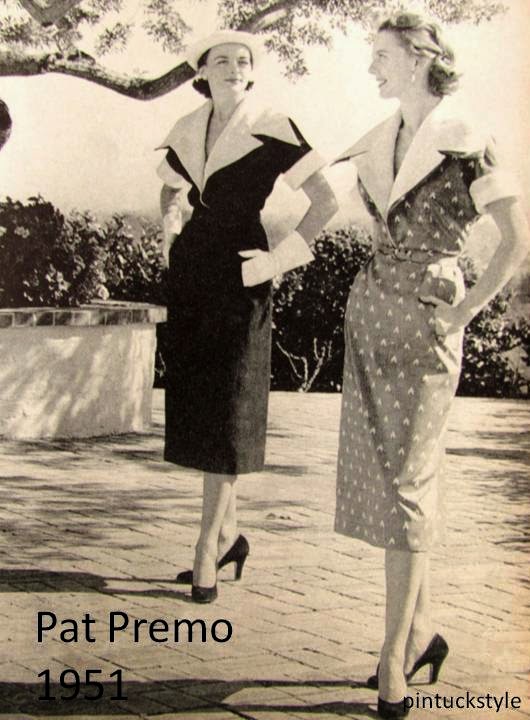
She included day wear as well, styles suitable for lunch, work or daytime activities by an active woman.


In the 1960's, she continued to present unique styles made from distinctive textiles. Her fashions were sold in the best high end department styles and commanded top prices.


Today, finding a vintage Pat Premo label is a rare find to be treasured. This would be a fashion made from the best textiles available, and sewn to meet high quality standards.